Thursday Oct 15, 2026
Thursday Oct 15, 2026
Thursday, 26 March 2026 00:30 - - {{hitsCtrl.values.hits}}
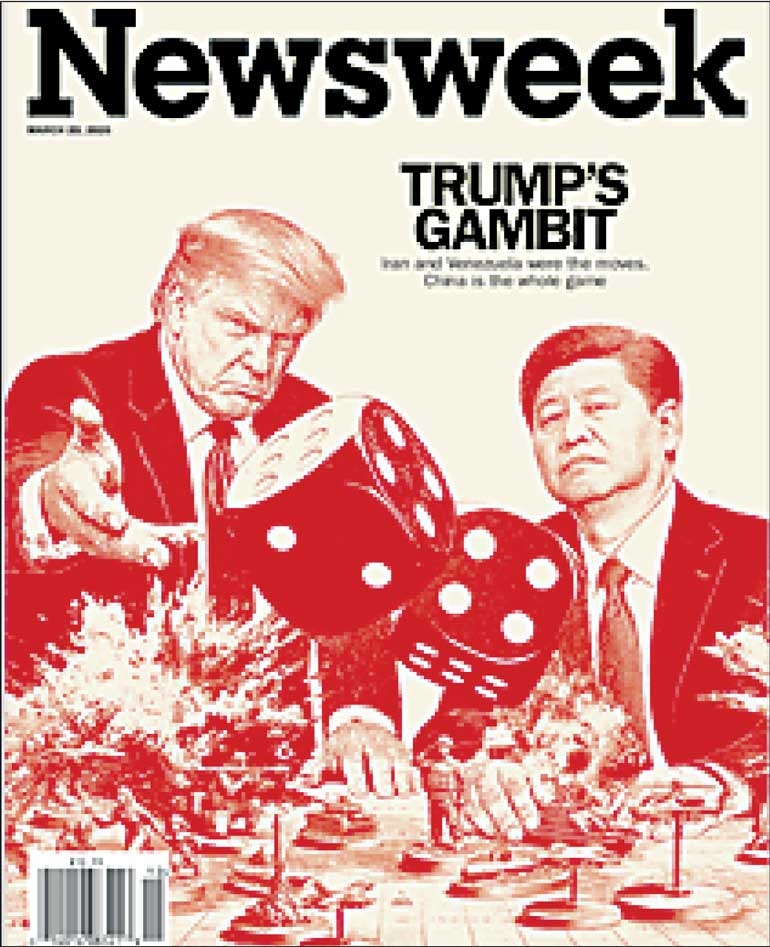
‘China is the Whole Game’ reveals Newsweek
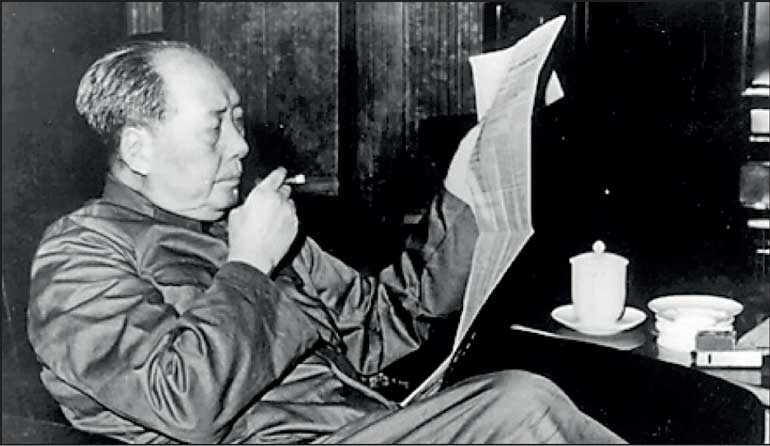
Mao Zedong’s current relevance
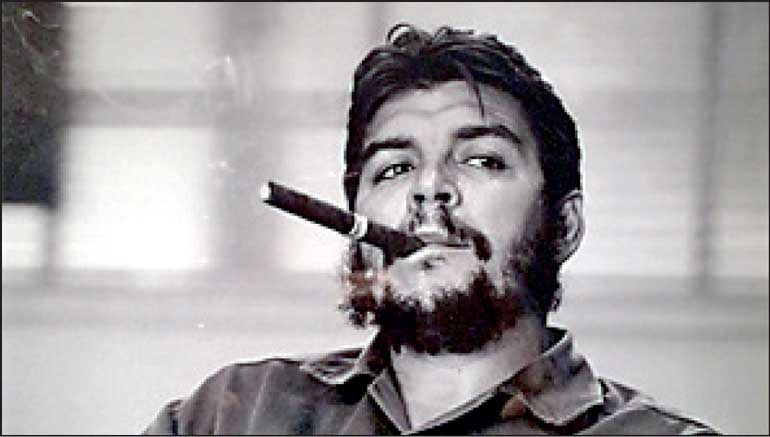
Che Guevara, Martyr and Prophet: predicted current conflicts
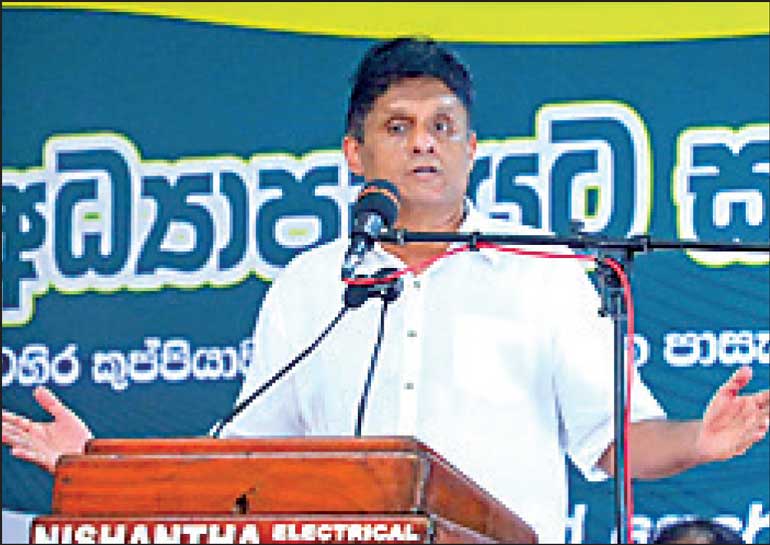
Sajith Premadasa studied International Relations at the LSE

Namal Rajapaksa’s WION lecture called for ‘strategic balance’
 Whichever way the five-day pause in President Trump’s threatened attack on Iran’s energy infrastructure goes, the big picture dealt with in this column stands.
The closest historical precedent and parallel of the US-partnered, patronised, assisted and enabled Israeli rampage throughout the Middle-East (Gaza-West Bank-Lebanon-Iran-Syria sporadically) is Nazi Germany’s Blitzkrieg through Europe.
With aggression comes obfuscation.
Hezbollah is said to have provoked the IDF, but the former fired rockets at the Israelis only because the Spiritual Leader of the world’s Shiite Muslims, Ayatollah Ali Khameini had been assassinated by US-Israel.
US Director of Counterterrorism Joe Kent, a Green Beret with 11 tours of duty, resigned because the US intelligence consensus was that “Iran posed no imminent threat to the USA”, but is vilified because his wife, a US navy officer, was killed by ISIS in Syria. However, every informed person knows that ISIS was not Iran-backed, and Iran and the Hezbollah fought against the ISIS with air support from Russia.
The US attack on Iran is sought to be justified by referring to Iranian-designed cone-shaped IEDs exploding on roadsides in Iraq and killing US soldiers. There is no mention that the US had invaded Iraq on the basis of the colossal WMD lie.
Netanyahu’s war
Netanyahu’s Likud originates in the Zionist terrorist tradition as distinct from the Israeli Labour party tradition which was the stronger at Independence. The Irgun Zvei Leumi and the Stern gang were practitioners of assassination. In 1946 the Irgun blew up a wing of the King David’s Hotel killing 96 people. Little wonder then that Netanyahu believes he can win the war by assassinating Iranian leaders and high-ranking personalities.
Sri Lankans know that’s simply untrue. So should most students of modern history.
The separatist Tiger terrorists killed a former Prime Minister of India (Rajiv Gandhi), a sitting Sri Lankan President (Premadasa), blinded another in one eye in an assassination attempt (CBK), blasted ruling party secretary and State Minister of Defence (Ranjan Wijeratne), blew up the most brilliant military officers (Generals Kobbekaduwa and Wimalaratne), bombed the ruling party Presidential candidate (Gamini Dissanayake), shot an iconic Foreign Minister (Kadirgamar), executed leading military officers in Colombo (e.g., Maj Gen Parami Kulatunga), nearly killed the serving Army chief during the final war (Sarath Fonseka). That kill list is partial. Hitler-fan and Israel-fan Prabhakaran used his Black Tiger suicide bombers the way Netanyahu uses Mossad and the Air Force. But who won, who lost? The Sri Lankan State won, the Tigers lost.
 The US-Israel decapitation strategy will not win the war or destroy the Iranian state. Lenin’s rejection of ‘individual terrorism’ was correct: the assassination of leading personalities, even the Tsar, doesn’t and can’t overthrow or defeat a State and a system.
A great Communist tragedy proves this. Though Stalin was more correct than his ideological opponents, his Moscow trials of the 1930s needlessly eliminated most of the old Bolshevik leadership and almost the entire top brass of the Red Army including the brilliant innovative thinker, Marshal Tukhachevsky. Hitler was therefore completely sure he could defeat the USSR. But when the war commenced in 1941, the next generation of officers stepped into the breach, defended Moscow, held Leningrad, smashed the German army at Stalingrad, pushed it back to Berlin, and hoisted the Red Flag over the Reichstag.
A Revolution has an inexhaustible supply of younger recruits who move up, motivated by ideals and ideology other than career, duty or esprit de corps. The Iranian Revolution will replenish itself and the revolutionary State will regenerate and repair itself. The assassinated elders will be replaced by young military and IRGC commanders born into the 1979 Revolution who will be unrestrainedly fiercer than the martyred pre-revolutionary older generation (such as Ali Larijani, JCPOA negotiator who authored three books on Kant).
Iran, Vietnam, Che Guevara
Though history accurately records the Vietnam War as a glorious victory over the US Empire, one forgets just how unfairly, tragically isolated Vietnam was, just as Iran is today. There is no more poignant way to recollect this than to re-read Ernesto Che Guevara’s valedictory, the legendary, luminous ‘Message to the Tricontinental’:
‘…It has been about two years since the United States began the systematic bombing of the Democratic Republic of Vietnam in yet another attempt to halt the fighting spirit in the South and to impose a conference from a position of strength. At the beginning, the bombings were more or less isolated occurrences, carried out in the guise of reprisals for alleged provocations from the North. Then their intensity and regularity increased, until they became one gigantic onslaught by the US air force carried out day after day, with the purpose of destroying every vestige of civilisation in the northern zone of the country…
 This is the painful reality: Vietnam, a nation representing the aspirations and hopes for victory of all the world’s disinherited, is tragically alone. This people must endure the pounding of US technology—in the South almost without defenses, in the North with some possibilities of defence—but always alone.
…When we analyse the isolation of the Vietnamese we are overcome by anguish at this illogical moment in the history of humanity. US imperialism is guilty of aggression. Its crimes are immense, extending over the whole world. We know this, gentlemen! But also guilty are those who at the decisive moment hesitated to make Vietnam an inviolable part of Socialist territory—yes, at the risk of a war of global scale, but also compelling the US imperialists to make a decision. And also guilty are those who persist in a war of insults and tripping each other up, begun quite some time ago by the representatives of the two biggest powers in the socialist camp.
Let us ask, seeking an honest answer: Is Vietnam isolated or not, as it tries to maintain a dangerous balancing act between the two quarrelling powers?
And what greatness has been shown by this people! What a stoic and courageous people! And what a lesson for the world their struggle holds…’
(https://www.marxists.org/archive/guevara/1967/04/16.htm)
As with Iran today, so also with Vietnam in Guevara’s day.
Target: China
Che Guevara was not only knight but also sage, as evidenced by his observations in the same text about the Middle East and China respectively:
‘…The Middle East, though it geographically belongs to this continent, has its own contradictions and is actively in ferment; it is impossible to foretell how far this Cold War between Israel, backed by the imperialists, and the progressive countries of that zone will go. This is just another one of the volcanoes threatening eruption in the world today…’ (ibid)
Those concerned about a Third World War are unsure what the target will be. Che had a sense of it:
‘…The imperialists encircle China through South Korea, Japan, Taiwan, South Vietnam and Thailand at least. This dual situation, a strategic interest as important as the military encirclement of the Peoples’ Republic of China and the penetration of these great markets — which they do not dominate yet — turns Asia into one of the most explosive points of the world today, in spite of its apparent stability outside of the Vietnamese war zone…’ (ibid)
Guevara’s prophetic forecast is completely validated by the cover story of the latest edition of Newsweek (March 20, 2026) which announces that:
‘TRUMP’S GAMBIT- Iran and Venezuela were the moves. China is the whole game’.
The Newsweek story makes fascinating reading:
‘…And now, with a diminished Iranian threat potentially allowing Washington to finally execute the long-discussed “pivot to Asia,” the military dimension of China’s bet looks worse still.
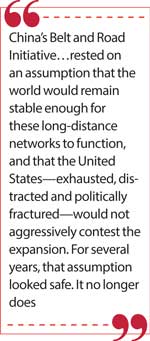
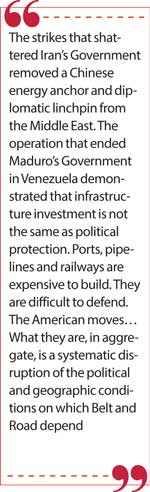
…China’s Belt and Road Initiative…rested on an assumption that the world would remain stable enough for these long-distance networks to function, and that the United States—exhausted, distracted and politically fractured—would not aggressively contest the expansion. For several years, that assumption looked safe. It no longer does. The strikes that shattered Iran’s Government removed a Chinese energy anchor and diplomatic linchpin from the Middle East. The operation that ended Maduro’s Government in Venezuela demonstrated that infrastructure investment is not the same as political protection. Ports, pipelines and railways are expensive to build. They are difficult to defend.
The American moves…What they are, in aggregate, is a systematic disruption of the political and geographic conditions on which Belt and Road depend… (Newsweek, March 20, 2026, pp. 26-31)
History records what happened when China and India were rising economic powers and Asia the rising continent. Western colonialism used overwhelming military force and coercive economic constraints to smash the peaceful, natural advancement of these Asian powers. That is how the 500 years of Western domination of the world that Marco Rubio nostalgically celebrated and lamented the end of at the most recent Munich Security Conference, was built. The US openly seeks to restore Western domination of the world and US domination of the West, through the same methods.
At the recent Raisina dialogue the US representative openly said that America would not allow India to do as China did and use the present world economic order to rise peacefully to become an economic challenge to the West. India would be naïve to think that being an uncritical buddy of Israel and junior partner of the US, will save it.
Hopefully China is currently revisiting the thought of Mao Zedong, leader of the Chinese Revolution, founder of the People’s Republic, great philosopher and military genius. Mao:
The US gives Israel advanced weapons as ‘assistance’; it doesn’t sell them. Whatever the faults of the USSR and PRC, they aided Vietnam militarily, enabling the latter to defend its airspace and contest the US Air Force. That has not been so with Iran.
If a Third World War targeting China is to be avoided down the road, one of three outcomes is needed in Iran:
Sri Lanka’s vulnerability
All this is far from an abstraction for Sri Lanka. It is a matter of the most pressing and glaringly obvious relevance. As the Newsweek cover story about the USA against China concludes:
‘…The struggle over a remote atoll [Diego Garcia]with no inherent value of its own is a preview of that contest: a world where every piece of ground is a move in a game whose endgame no one can fully see. The great powers are not competing over ideology anymore, or even primarily over trade. They are competing over the physical map—the atolls, the shoals, the ports, the chokepoints through which everything that matters passes. Geography, long taken for granted by a nation that spent three decades as the world’s only superpower, is once again destiny. And in the new great game taking shape between Washington and Beijing, it may be the loneliest dots on the map—the ones nobody wanted, until suddenly everyone did—that tip the balance.’ (Newsweek, March 20, 2026, pp. 26-31)
This is a perfect geostrategic categorisation of Sri Lanka.
President Anura Dissanayake’s choice of India and the UAE to develop the Trincomalee oil tank farm, and India to develop the ‘greater’ Trincomalee-Mannar zone, is utterly unwise. The UAE is unobjectionable, but India is a player in the Great Power competition in Asia and therefore its preponderance could make Trincomalee a target. We should invite countries outside of Asia’s great power competition, e.g., Saudi Arabia, Nigeria, etc.
Manacles of mediocrity
Despite claims of neutrality, nonalignment etc., an uncontradicted news report states that in a phone call to the Emir of Qatar, President Anura Kumara Dissanayake tilted against Iran, expressing:
“…his country’s solidarity and support in light of the ongoing Iranian aggression against Qatar and other countries in the region.”
The report discloses:
‘Amir of the State of Qatar Sheikh Tamim bin Hamad Al Thani received a telephone call from President of the Democratic Socialist Republic of Sri Lanka Anura Kumara Dissanayake.
At the beginning of the call, the President inquired about the situation in Qatar, expressing his country’s solidarity and support in light of the ongoing Iranian aggression against Qatar and other countries in the region...’
(https://www.newswire.lk/2026/03/19/president-akd-speaks-to-qatar-amir/)
Anura did not utter a word of condemnation of the unilateral US-Israeli war on Iran which caused the Middle-East conflict. His reported criticism of “ongoing Iranian aggression” demonstrates his and the NPP Government’s utter inability to maintain a posture of even-handedness or equidistance, still less what Namal Rajapaksa, SLPP National Organiser correctly commended in his WION World Pulse lecture 2026, as ‘strategic balance’. (https://youtu.be/lDO3H35bNYE?si=Sz7It2J2AEgfxcWW)
Meanwhile in the first 10 minutes of his powerful speech responding to the President’s Parliamentary address on 20 March, Opposition leader Sajith Premadasa gave AKD a master class about the Law of the Sea, the amorality of shrugging-off the US submarine attack on the Iris Dena in our Exclusive Economic Zone, and the need to denounce unilateral aggression which violates the UN Charter. (https://youtu.be/s05odEexwbk?si=uyrzBW6fK7e_l2cs)
With the US targeting of China and India’s partnership with Washington, we need a leadership and Government conceptually capable of thinking our way through the coming times. In the vital interrelated domains of international relations and the political economy of development AKD and his Cabinet are hardly the sharpest knives in the Lankan cutlery set.
Thanks to their fathers who reached the pinnacle of their political profession, were exceptionally gifted elected leaders of this country, and managed complex wartime crises plus external challenges, Sajith Premadasa and Namal Rajapaksa have been confidently familiar from boyhood with the world and world leaders, as with successful domestic development models. (Sajith studied International Relations at the LSE.) By contrast the AKD Presidency navigates the world system in crisis with as much knowledge, easy familiarity and accumulated skill as an untrained trawler captain commanding SLNS Samudra or Sayura in stormy submarine-infested seas.
Substantiating my indictment is the Oxford University’s World Happiness Report which shows that Sri Lanka has been happier (despite austerity) during Ranil Wickremesinghe’s tenure–112th of 147 countries in 2023—than under Anura Dissanayake. Of course, this runs parallel with and is confirmed by the data on the accelerated, unprecedented exodus of State university graduates in 2025, with 80% emigration from the elite faculties. On AKD’s watch we have been on a dramatic downward spiral as regards citizens’ collective happiness: 128th in 2024, 133rd in 2025, 134th in 2026. We are the unhappiest in South Asia. To prevent Sri Lanka becoming the unhappiest country in the world, we must free ourselves of the manacles of mediocrity.
https://dayanjayatilleka.webflow.io/




