Thursday Oct 15, 2026
Thursday Oct 15, 2026
Monday, 6 April 2026 03:35 - - {{hitsCtrl.values.hits}}
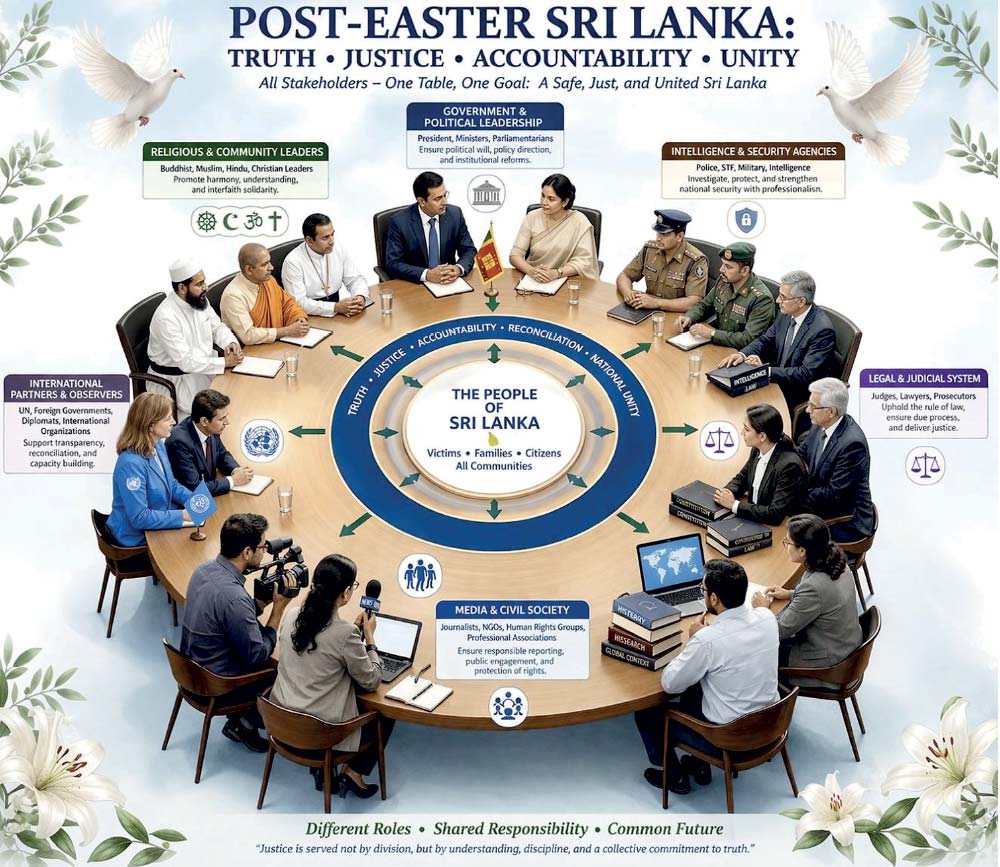
 Findings highlighted a complex web of failures: lapses in intelligence sharing, breakdowns in inter-agency coordination, and serious deficiencies in political oversight. Importantly, it underscored that the attacks were not the result of a single point of failure, but a systemic collapse across multiple levels of governance
 As Sri Lanka approaches the seventh commemoration of the Easter Sunday Attacks, the national mood is once again marked by grief, reflection, and an enduring sense of incompleteness. Nearly seven years later, the tragedy continues to cast a long shadow not only over the victims and their families, but over the institutions and narratives that have since emerged.
Commemoration, however, must go beyond ritual. It must be anchored in clarity, accountability, and restraint. What is increasingly evident in the post-Easter landscape is not merely a search for truth, but a contest over how that truth is framed, interpreted, and presented to the public.
In recent times, public discourse has been shaped by book launches, panel discussions, and media interventions that claim to offer new insights into the attacks. While such contributions are not inherently problematic, the manner in which certain narratives are advanced raises legitimate concerns. The selective disclosure of information particularly when it touches on intelligence operations demands careful scrutiny.
Legal and institutional framework
Sri Lanka’s legal and institutional framework is clear on the sensitivity of such matters. The Official Secrets Act (No. 32 of 1955) places strict obligations on the handling of information related to national security. Similarly, the Police Ordinance and internal administrative regulations governing intelligence units emphasise confidentiality, chain of command, and the responsible use of information. These are not mere formalities; they exist to safeguard both operational integrity and national interest.
When individuals, particularly those with prior access to intelligence structures enter the public domain with claims that are not subject to verification, it raises critical questions. Are these disclosures contributing to justice and accountability, or are they inadvertently compromising institutional credibility and future operational capacity?
The challenge lies in distinguishing between constructive transparency and selective exposure.
The Presidential Commission of Inquiry into the Easter Sunday Attacks provided one of the most comprehensive official examinations of the attacks. Its findings highlighted a complex web of failures: lapses in intelligence sharing, breakdowns in inter-agency coordination, and serious deficiencies in political oversight. Importantly, it underscored that the attacks were not the result of a single point of failure, but a systemic collapse across multiple levels of governance.
Yet, despite the existence of such detailed institutional findings, public discourse often gravitates toward simplified narratives. There is a tendency to identify singular “masterminds” or to attribute responsibility in ways that align with prevailing political or ideological positions. While such narratives may be compelling, they risk obscuring the deeper structural issues that enabled the attacks to occur.
As Sri Lanka reflects on the events of April 2019, it must resist the temptation to reduce a national tragedy into competing narratives or political instruments. The pursuit of truth must be methodical, inclusive, and grounded in law. Easter is not only a moment of remembrance. It is a test of institutional maturity and societal resilience
Fragile intercommunal relations
Equally significant is the broader socio-political context in which these narratives are unfolding. Sri Lanka today remains a society marked by fragile intercommunal relations. The aftermath of the Easter attacks saw heightened suspicion, polarisation, and, in some instances, collective blame directed at entire communities. Although there have been efforts toward reconciliation, these fault lines have not entirely disappeared.
In this environment, the language and tone of public discourse carry immense weight. The framing of terrorism whether as a localised phenomenon or as part of a broader ideological construct must be handled with precision and responsibility. Overgeneralisation or the uncritical use of labels can have far-reaching consequences, including the marginalisation of communities and the erosion of social cohesion.
At the same time, it is essential to acknowledge that the global discourse on terrorism is itself contested. Competing narratives, geopolitical interests, and selective historiography often shape how events are interpreted. For Sri Lanka, the challenge is to avoid becoming a passive recipient of external frameworks that may not fully reflect its own realities.
A professional and unbiased approach requires a commitment to evidence-based analysis. This includes:
It also requires intellectual discipline, the willingness to question assumptions, to resist convenient conclusions, and to remain open to complexity.
A professional and unbiased approach requires a commitment to evidence-based analysis. Justice is not served by noise or conjecture. It is served by patience, rigour, and an unwavering commitment to truth
A fine balance
The role of former officials and subject-matter experts in this discourse is particularly important. Their experience can provide valuable insights, but it also carries a responsibility. Public interventions must be guided by professional ethics, respect for institutional boundaries, and an awareness of the potential impact on national ssecurity.
There is a fine balance to be maintained. On one hand, democratic societies require transparency and accountability. On the other hand, the premature or uncontextualised release of sensitive information can undermine the very systems that are meant to protect the public.
As Sri Lanka reflects on the events of April 2019, it must resist the temptation to reduce a national tragedy into competing narratives or political instruments. The pursuit of truth must be methodical, inclusive, and grounded in law.
Easter is not only a moment of remembrance. It is a test of institutional maturity and societal resilience.
The real question is not whether new narratives will emerge, they inevitably will. The question is whether Sri Lanka has the capacity to engage with them critically, responsibly, and in a manner that strengthens, rather than weakens, the foundations of its national security and social harmony.
In the end, justice is not served by noise or conjecture. It is served by patience, rigour, and an unwavering commitment to truth.
(The author is a former Senior Law Enforcement Officer National Security Analyst; Former Head of Counterintelligence, State Intelligence Service)




