Monday Oct 12, 2026
Monday Oct 12, 2026
Tuesday, 30 June 2026 05:33 - - {{hitsCtrl.values.hits}}
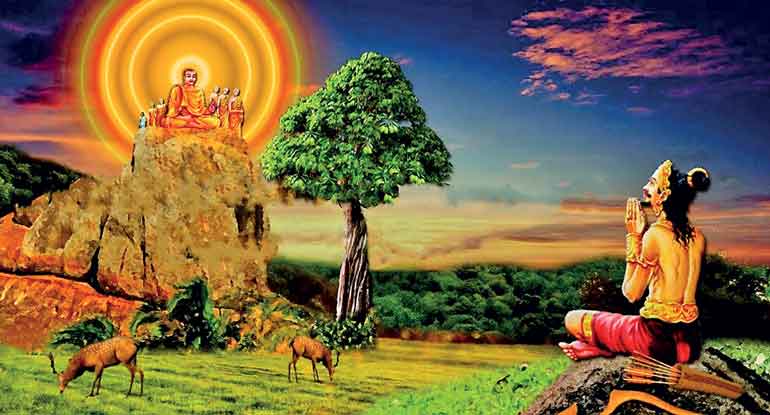
 There are encouraging signs of ending the exhaustive Middle-eastern enmity. It proved how destructive and devastative when disillusioned leaders deploy resources for rampage. We just witnessed a serene Poson Poya in Sri Lanka with signs of solace. It is an opportune time to reflect on battling in a BANI world drawing inspirations from Poson.
Overview
BANI has increasingly become relevant, global, and local alike. As Jamais Cascio, an American anthropologist argues, the world today is Brittle, Anxious, Non-Linear, and Incomprehensible. He proposed BANI world, arguing that VUCA (Volatility, Uncertainty, Complexity and Ambiguity) is obsolete and with a new world order we need a new language. His work focuses on the importance of long-term, systemic thinking, emphasising the power of openness, transparency, and flexibility as catalysts for building a more resilient society.
The way I see it, BANI is a reality check of what is happening around. The gruelling scenes of Gaza strip and trembling scenes of Humus strait are both realisations of the brutality of a BANI world. It is also an invitation to fathom the illusions associated and focus on the ignitions required. “Systems that appeared strong were suddenly on the verge of collapse; processes that were becoming increasingly critical to our daily lives were becoming less and less understandable.” What Jamais Cascio highlighted as a futurist is so true in the current context.
Bane of BANI world
BANI is more of a bane than a boom. The four illusions are worth exploring in detail.
Brittle - The illusion of strength
Brittle means being fragile, breakable, while seeming firm. It refers to something that is not as strong as it seems. It is illusory strength, the belief that “everything will be alright” and the assumptions that “we all know are true,” except that they are not. Brittle refers to the myths that people tell themselves and each other to feel better and more secure.
The world has been around for eons; we tend to negate its indestructibility and durability because of its seemingly infinite lifespan. But it is fragile, and it has always been. The fact that people did not want to see this, and instead assumed that it was unbreakable, does not change that. And that is what this “new” concept really reveals: that people finally discover that the world, especially its nature, economy, and peacefulness is a fragile, convoluted interconnected ecosystem. Embracing Brittle means letting go of this first illusion, the illusion of strength.
Anxious - The illusion of control
Anxiety refers to a feeling of helplessness, of being overwhelmed by everything that one faces. It comes with stress and worrying and a fear of not being able to cope with what the world asks—and not really knowing what will come in the first place, thereby making it hard or impossible to make the “right” decisions.
Anxiety can be viewed as a by-product of information. The more people hear and see, especially bad news, the more anxious they get. Because there is only so much one can do. And with real-time news coming from all over the world, bombarding us 24/7, it is no surprise that people become anxious—because they are not in control anymore.
Like the Brittle concept, this says more about people than about the world. Anxiety is a subjective feeling caused by a gap between what one expects and what one experiences. People expect control and for a long time they have been able to hold on to that illusion. The last decades may have been relatively quiet in the Western world, but unrest, war, and crises have always been a normal part of life on this planet.
Non-linear - The illusion of predictability
Non-linearity has already been a popular concept for a longer time. In innovation, for example it basically says: there is no simple straight route from A to B. Instead, there are detours, dead ends, and unexpected outcomes. It is also part of the common vocabulary in statistics, where it refers to a relationship between two or more variables that is not a straight line.
The fact that people increasingly talk about non-linearity again does not say anything about the world in which they live. Non-linearity has always been there, and it is a natural feature of any complex system. It is commonly known as the “butterfly effect,” the fact that a chain of cause-effect relationships started by a small event (a butterfly flapping its wings) can result in highly unexpected and disruptive events (a tornado at the other side of the ocean).
This is not something new. It is a default characteristic of any complex system. What is new and highlighted by the BANI concept is that there is now increased awareness of the non-linearity of our world. This breaks a third illusion, the Illusion of Predictability.
Incomprehensible - The illusion of knowledge
Finally, incomprehensible refers to people’s experience that they do not understand what is going on. They cannot oversee it, cannot grasp it, cannot interpret what happens, and why. This means they cannot find the answers they are looking for and, as far as they do get answers, they cannot make sense of the answers either.
This comes with a fourth illusion, the Illusion of Knowledge. People might have thought they understood the world. But they never have. It is for this reason that experts and scientists frequently say things as “the more I know, the more I realise I do not know.” The world is a mystery, despite the carefully built-up illusion that we understand it. And that is not something to worry about. On the contrary, it makes the world and our lives worthwhile. Or as Einstein told us: “There are only two ways to live your life. One is as though nothing is a miracle. The other is as though everything is a miracle.”
BANI and Sri Lanka
Having moved from the COVID-19 “frying pan” to Chaos “fire,” Sri Lanka is a casing point for manifesting BANI. We have a brittle political setup that is supposed to be stable with democratically elected representatives. Needless to state the dire consequences we experience as someone called it a “chase study” rather than a “case study.”
Anxiety is nothing new to us Sri Lankans. Being indecisive from the leadership end, has resulted in anxiety among masses on multiple fronts. Shortage of vital drugs on one hand, and exorbitant prices of them on the other hand have jointly created much anxiety among suffering millions.
Non-linear path is also becoming increasingly familiar to us Sri Lankans. We have seen that many things do not happen in a straight-forward manner. The delays in post-recovery attempts of cyclone Ditwah is a timely example where the associated complexities create delays and frustrations resulting in a bumpy ride.
Incomprehensible with the illusion of knowledge is also having a very high relevance here. How some so-called experts came forward to handle economic challenges and failed to deliver is a case in point. The sad truth is that the lack of understanding of the grave issues we face as a nation by the political leaders and their mixed priorities blended with perks and privileges.
BANI 2.0 ignitions against BANI 1.0 illusions
It is in this context that I would propose BANI 2.0 Ignitions which essentially describe four mature responses required. It involves being Bold, Assertive, Neutral, and Innovative.
As the old adage says, fortune favours the bold. It encourages people to push the limits of what is achievable. acknowledge the risk involved in pursuing a winning gambit. If the risk is deemed acceptable, commit to the strategy, and never look back. In doing so, one needs to be assertive, by way of showing confidence. Communicating with clarity in being authentic is also in it.
Being neutral is the opposite of demonstrating biasness, subjectivity, or partiality. Such an approach ensures one’s openness to new possibilities without being prejudiced. As the culmination of all above, being innovative will pave the way not only for product or service developments but also improvements possible in multiple spheres.
Pertinent lessons from Poson
Poson Poya is associated with the arrival of Buddhism in Sri Lanka. It is widely hailed as the beginning of a new era in Sri Lankan civilisation. It commemorates the occasion of Arahat Mahinda, son of Emperor Asoka of India arriving here. The way he converted King Devanampiyatissa to Buddhism is an amazing story to depict the subtle difference between an “owner” and a “servant.”
When referring to the dialogue that took place between the King Devanampiyathissa and Arahat Mahinda, a logical testing of the intelligence of the king can be seen.
“…And are there, besides other mango trees and those trees which are not mango trees, yet other trees?”
Drawing inspiration from Poson, in becoming authentic leaders, we need BANI 2.0 ignition, as individuals and institutions alike. The starting point could be a committed move from “ego” to “eco” with much consciousness of sustainability as a true servant in action. That is what Poson tells us in becoming authentic in using authority sensibly for the greater benefit of humanity
“There is this mango tree Sir.”
With that insightful answer, Arahat Mahinda has apparently appreciated the king’s wisdom in advising him, as a ruler, to act more as a servant of the land than the owner of it.
“O King, mighty as you are, it is well to remember that total ownership of the environment is not yours. You are, but the trustee of the mountains, the rivers, the forests, and the oceans which enrich our lives, and it is your bounden duty to hand these down to posterity in the condition in which you inherited them from your forefathers.”
Do we see such a mindset among the modern-day managers and administrators, particularly in the governing circles? Much soul-searching is required in the spirit of Poson towards the search of not only being authoritative but authentic.
Way forward
“Nobody’s going to fix the world for us, but working together, making use of technological innovations and human communities alike, we might just be able to fix it ourselves,” says Jamais Cascio. Drawing inspiration from Poson, in becoming authentic leaders, we need BANI 2.0 ignition, as individuals and institutions alike. The starting point could be a committed move from “ego” to “eco” with much consciousness of sustainability as a true servant in action. That is what Poson tells us in becoming authentic in using authority sensibly for the greater benefit of humanity.
(The author, a Senior Professor in Management, and an Independent Non-Executive Director, can be reached at [email protected], [email protected] or www.ajanthadharmasiri.info.)



