Monday Oct 12, 2026
Monday Oct 12, 2026
Monday, 20 April 2026 03:25 - - {{hitsCtrl.values.hits}}
 Philip was signalling that consensual statecraft is the way forward for the nation’s progress and prosperity of its people. The motto was that what is best ideologically should not stand in the way of what is consensually good for the nation and the common man
 Philip Gunawardena, a combination of staunch socialism and pragmatic modernism
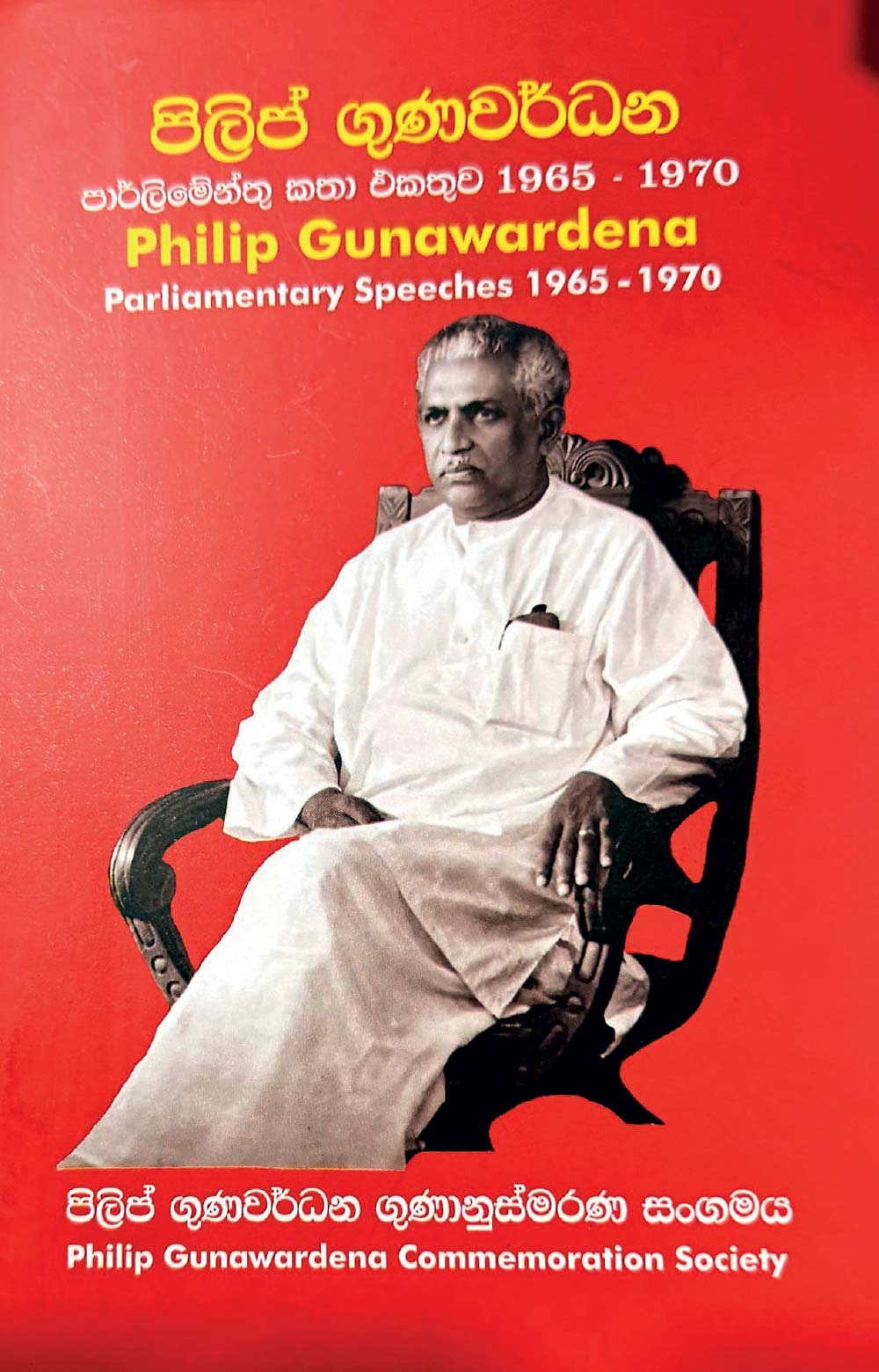
The Philip Gunawardena Commemorative Society has released Volume III of the speeches of Philip Gunawardena in Parliament from 1965 to 1970. Previously, the Commemorative Society had issued a compilation of his speeches in the State Council during the colonial period as Volume I, and those in Parliament in independent Sri Lanka as Volume II.
The present volume completes all his speeches as a people’s representative during his long political journey in the country. The lead speech at the launch of the present volume was delivered by the ex-Foreign Secretary H M G S Palihakkara, who had started his decades-long civil service career in 1965 as a cadet in Philip’s Ministry that had covered industries and fisheries. Palihakkara paid high tribute to Philip by naming him a visionary, reformer, and a fearless voice for the common people. Though Philip was an iconic figure and a staunch socialist, said Palihakkara, he remained a pragmatic modernist.
Quoting the civil servant-turned-politician Sarath Amunugama, he remarked that Philip’s firm belief was that poverty cannot be socialised and only plenty can be done so. Therefore, the ground condition for establishing socialism was that people should work and produce more. What this meant was that both economic development and socialism should come hand in hand. Without development, no socialism; without socialism, development is meaningless. In my view, this was the principle which Philip allowed himself to be guided by when he held Cabinet portfolios in two distinctive Governments.
Philip’s motto: Join the Devil or even his grandmother to serve people
This was further elaborated by Palihakkara as follows. ‘The decision by Philip to join the “National Government” of Dudley Senanayake was a much-debated but little-understood affair. Optics were basically reduced to a celebrated socialist icon joining a gentle capitalist to form a National Government. It was inevitably a controversial move. Equally, it was also a bold manifestation of that consensus-building spirit. More so because his decision was predicated on his unwavering support for a fundamental human right—the freedom of expression—and opposition to nationalisation of the free press, a fundamental tenet of the democratic-socialist binary, leaving aside the unfinished or open-ended debate about democracy or socialism.’
By doing so, said Palihakkara, Philip was ‘signalling that consensual statecraft is the way forward for the nation’s progress and prosperity of its people. The motto was that what is best ideologically should not stand in the way of what is consensually good for the nation and the common man.
When Philip famously said that I will work with the “Devil or even his grandmother”, if that brings about the common good, he in a way articulated the inherent quality of consensus on key public policy matters like press freedom and other fundamental issues.’
|
Book cover of Philip Gunawardena’s Parliamentary speeches 1965 to 1970
|
A swipe at aberrated political culture
Palihakkara used the opportunity to take a swipe at the current aberrated political culture in Sri Lanka. He said: ‘Consensus is not about making any or all contending parties happy about the issue at hand; it is about dispensing managed unhappiness among all parties to advance a common cause benefitting the people at large. It is the “equitable distribution of reasonable unhappiness” among all parties concerned. When that occurs, consensus happens. It is the most potent political algorithm to produce win-win solutions in human relations within or among States.’
In Palihakkara’s words, ‘the great lesson in statecraft and public policy-making for present-day politicians in our country, who seem to quarrel like street vendors on a rainy day on all issues. They have thus reduced the grave responsibility of democratic governance to a trivial zero-sum formula of the Government proposing and the Opposition opposing most of the time—if not all the time. They are either unable or unwilling to explore and reach a consensual middle ground to advance the national interest on a host of public policy issues ranging from economic reforms, security and foreign policy, the rule of law, accountability, reconciliation, and so on.’
Palihakkara: Don’t play the game of toppling Government
The way out, according to Palihakkara, was that both sides should consult, compromise, and reach optimal common ground on critical issues of vital national interest. They should, therefore, abstain from playing the political game of toppling the Government whenever there is an issue cropping up.
He elaborated as follows: ‘If our politicians do not embrace a culture of consensus on such public policy issues of foundational importance, yet another crisis will embrace us in due course, perhaps sooner than they expect. Templates of statesmanship provided by the likes of Philip to reach consensual grounds through informed and timely compromises, shedding ideological or parochial interests, might come in handy here.’
When Philip famously said that I will work with the “Devil or even his grandmother”, if that brings about the common good, he in a way articulated the inherent quality of consensus on key public policy matters like press freedom and other fundamental issues
Marxism with a national flavour
I found that what Palihakkara had remarked about Philip is reflected in the speeches which the latter had delivered in Parliament as a Minister of the Dudley Senanayake Government. It has been the tradition to divide countries and people in accordance with their level of development, access to resources, or ability to grasp subjects. These are known as various ‘divides’ in the world. The ‘development divide’ among countries has classified developed countries as the Global North and poor countries as the Global South. By resource endowment, the divide has been between the haves and the have-nots. This has been the traditional global divide used by Marxists.
However, Philip’s Marxism had been redeveloped with a ground-level national flavour well imbibed by the country’s cultural and historical heritage. Hence, he designed a new divide—a knowledge divide arising from a language divide—for Sri Lankans when he participated in the Budget debate in 1960. He recalled that there was a high degree of political illiteracy among people in the country. On one side, he argued, there were a few educated elites. On the other side, there was a larger segment of the populace that was politically or economically ignorant. The complex problems in the modern world needed a cultivated understanding. But when knowledge came through a foreign language, and in Sri Lanka’s case that language had been English, there emerged a new divide that could be classified as the language divide.
The English-educated few had access to new ideas, but those ideas did not naturally seep down to the unsophisticated common men and women. Therefore, they were deprived of access to new knowledge. Thus, new knowledge remained the monopoly of a few. To make knowledge available to all on an equitable footing, it was necessary to nationalise modern knowledge, which was a must for effective democracy and meaningful socialism in the country. What Philip noted in 1960 is still valid for Sri Lanka even after the passage of more than six decades.
If our politicians do not embrace a culture of consensus on such public policy issues of foundational importance, yet another crisis will embrace us in due course, perhaps sooner than they expect
Importance of culture
Referring to the importance of culture, Philip often said in his speeches that, like the never-ending quarrel between chastity and beauty, there should not be a quarrel between socialism and culture. This was because, in his opinion, the socialist was the heir to the varied cultural practices of a country. Seeking to establish socialism by abandoning that heritage, Philip said, was like using a moth-eaten obsolete book for guidance. It would create an unreal socialism floating in a dream world on one side and establish an alien ideology with no local roots and, therefore, lacking the ability to sustain itself on the other. Hence, there should not be a divide between the words spoken and their relevance to real-life applications.
What this meant was that words should not be abused to falsely convince others, thereby corrupting their true meaning, a practice usually adopted by many extant politicians. It amounts to the destruction of language and, therefore, those who do so are like counterfeiters of money who would destroy the real economy of a country with false promises made on a piece of paper. Both types of destruction, of the real economy and the linguistic system, will be the root cause of losing the public’s confidence in the system. Without public confidence, no regime, however much initial support it receives, can survive in the long run. Philip’s advice to politicians of all hues was that they should do what they mean, and they should mean what they plan to do.
Politician of humbleness and humility
Philip was a politician of humbleness and humility. He did not want to seek credit for what others had done. In addressing the House in the debate for the Budget of 1965–66, Philip admitted that the fisheries plan being implemented had been placed before the people just a few weeks after forming the National Government of which he was the Minister in charge of industries and fisheries. He did not want to take credit for that plan because it had been prepared by the previous regime.
Drawing laughter from the members of the House, he said that it was not his policy to claim fatherhood for other people’s children, though he loved all children without discrimination just as he loved his own. Paternity rights should be given to those who fathered the children. But he, as the Minister in charge of industries and fisheries, would implement that plan which had been prepared by experts in the subject. Since it was a rolling plan to be implemented over a ten-year time span, after experience in the first year, he would revise the targets and other components of the plan to eliminate its weaknesses and incorporate emerging developments.
Philip, with his training in economic policymaking at both the University of Wisconsin-Madison and Columbia University, knew exactly how a plan should be prepared, progress reviewed, and targets revised in accordance with experience in implementing the plan.
Philip’s orientation toward international trade, which is not a feature upheld by other leftist politicians, makes him a distinctive figure within the traditional club of leftist politicians
A modern governance system
His governance system was also remarkably modern. It had been the practice of many Ministers to call the top management of Government corporations to the Ministry and advise them on day-to-day operations. Addressing the House, he said that he did not want to do that. He said that he would leave such matters to the management of the corporations, who were experts in their respective areas. But if anything went wrong, he would summon them to the Ministry, discuss the matter, and point out where they had erred and what the position of the ministry was. If they still blundered, the Ministry would intervene fully and correct the errors. This operational autonomy, exercised under the watchful eye of the Ministry, was essential for Government bodies to attain efficiency and deliver value to the people, who are the true owners of such entities.
An industrial policy based on hardcore economics
Philip’s industrial policy was also based on hardcore economic principles.
Addressing the House in the same Budget debate, he referred to the importance of establishing backward and forward linkages, the need to ensure economies of scale, and the full harnessing of by-products arising from a given industrial process when investment decisions are made. This policy strategy would ensure efficiency in investment, delivering maximum value to the people.
The first would help Sri Lanka compete effectively with other producers in the same line of business. The latter would deliver maximum value addition, thereby increasing the wellbeing and prosperity of the people. Philip, who believed in a mixed economy where the Government sector should play the leading role, said that investments by both private businessmen and the public sector should meet these criteria alike.
He observed in his speech: ‘Apart from the industries set up in the public sector which, as indicated above, do not appear to have been determined on the basis of proper economic criteria, the lack of an industrial plan has resulted in a lopsided development of industries in the private sector where industries which should normally take low priority have been fostered at the expense of more important industries. Neither the Ministry of Industries nor the Development Division appears in the past to have attempted to guide or control industrialisation in the private sector on a properly planned basis.’
He also observed that when private businessmen were given licences by the previous Government, it had been done without reference to the volume of domestic demand. As a result, sophisticated machinery had been brought to Sri Lanka which could produce several times the local demand required to operate optimally. This was true of the chocolate industry, razor blades, wire nails, matches, and other industrial plants that had been set up. He therefore emphasised the need to seek external markets to help local producers harness maximum gains from their current investments.
Philip Gunawardena, the economist
This was a serious situation which could be understood only by an economist and not by a politician. Though Philip was a politician, he had been trained by reputed US universities in the fine art of economic policymaking. Therefore, it was not surprising that this policy direction came from him. When excess investment has been made in machinery at undue cost to the country’s scarce foreign exchange reserves, it is necessary to operate those machines at optimal levels. If the country fails to attain this goal, it results in lower productivity not only in capital but also in labour resources. This is a perennial problem faced by Sri Lanka. Successive Governments, even today, have failed to ensure this requirement. Philip’s orientation toward international trade, which is not a feature upheld by other leftist politicians, makes him a distinctive figure within the traditional club of leftist politicians.
Words should not be abused to falsely convince others, thereby corrupting their true meaning, a practice usually adopted by many extant politicians. It amounts to the destruction of language and, therefore, those who do so are like counterfeiters of money who would destroy the real economy of a country with false promises made on a piece of paper
Release of Volume III, a commendable work
The work done by the Philip Gunawardena Commemorative Society to present to Sri Lankans the speeches delivered by the veteran politician Philip Gunawardena is commendable. In my view, it should be read by all Sri Lankans who are interested in learning about the political, economic, and social history of the country.
(The writer, a former Deputy Governor of the Central Bank of Sri Lanka, can be reached at [email protected])