Friday Nov 13, 2026
Friday Nov 13, 2026
Friday, 13 November 2026 05:01 - - {{hitsCtrl.values.hits}}
 In Sri Lanka’s recovery, the salaried employee has been the most reliable taxpayer. Tax comes out of their pay every month before they receive it. In the hardest years of the crisis, when prices rose far faster than salaries, they paid their share in full and on time. The personal income tax revision is the centrepiece of this year’s tax proposals. It won’t fix every problem in the system, but it is a meaningful step towards a fairer deal for people who carry the most visible part of the burden
 The Budget Speech, constituting the Second Reading of the Appropriation Bill for 2027, was delivered in Parliament yesterday. This will be followed by seven allotted days for the Second Reading debate, culminating in the Second Reading vote at 6.00 p.m. on 20 November. The Committee Stage debate will then run through to 14 December, when the Third Reading vote is scheduled for 6.00 p.m.
Budget 2027 therefore arrives at an important juncture. This article focuses on the key budget proposal in relation to revision of personal income tax rates and slabs.
In Sri Lanka’s recovery, the salaried employee has been the most reliable taxpayer. Tax comes out of their pay every month before they receive it. In the hardest years of the crisis, when prices rose far faster than salaries, they paid their share in full and on time. The personal income tax revision is the centre-piece of this year’s tax proposals. It won’t fix every problem in the system, but it is a meaningful step towards a fairer deal for people who carry the most visible part of the burden.
What has changed
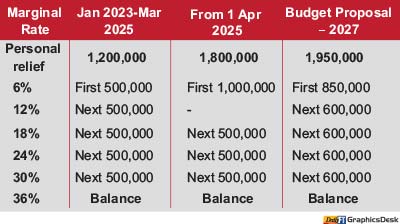
From 1 April 2027, the annual tax-free threshold goes up from Rs. 1.8 million to Rs. 1.95 million. An individual earning up to Rs. 162,500 a month will pay no tax.
Under the current system, the rate jumps straight from 6% to 18%. That has been one of its harshest features, because a modest pay rise can push an employee into a much higher bracket. The new 12% band smooths that jump. The 18%, 24% and 30% bands have also been widened from Rs. 500,000 to Rs. 600,000 each.
As a result, the 36% top rate now starts at a monthly salary of about Rs. 433,333, compared with about Rs. 358,333 today. The Government estimates the cost of the revision at Rs. 16 billion a year.
The relief comes at a cost. The Budget estimates that all income tax revisions together will reduce revenue by Rs. 16 billion a year. The personal income tax changes are expected to make up a large part of this, although the Budget does not show them separately.
 What it means in your pay
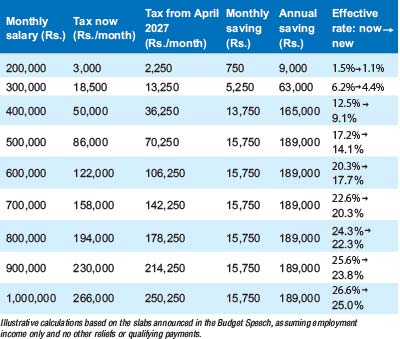
For a salaried employee, the table below shows the monthly tax for employees whose only income is salary, before and after the revision.
Who benefits most
For an employee earning Rs. 300,000 a month, tax falls by more than a quarter, from Rs. 18,500 to Rs. 13,250. Their marginal rate drops from 24% to 18%.
The biggest proportional gain goes to people earning around Rs. 400,000 a month. They save Rs. 13,750 a month, or Rs. 165,000 a year. Their effective tax rate falls from 12.5% to 9.1%, and their marginal rate drops from 36% to 30%. Many of these people are mid-career professionals: engineers, accountants, doctors, IT specialists and managers. They have felt the steep progression of the current slabs most sharply, and many of them are the people Sri Lanka can least afford to lose to migration.
Above about Rs. 433,333 a month, the saving is fixed at Rs. 15,750 a month. For someone on Rs. 1 million a month, the effective rate falls only modestly, from 26.6% to 25%. This is a deliberate and sensible choice. The proportional relief is greatest in the middle, and the cost of relief at the top is contained.
At the lower end, the relief is smaller. An employee earning Rs. 200,000 a month saves Rs. 750. That reflects how little tax they were already paying, but it is a reminder that for lower-income households, the cost of living, VAT and indirect taxes matter far more than income tax.
 Why this matters beyond the payslip
Rs. 15,750 a month won’t change anyone’s life. But the revision matters for three reasons.
First, it builds on previous relief without putting revenue at risk. Even after the threshold was raised from Rs. 1.2 million to Rs. 1.8 million, PAYE/APIT collections grew by 6.1% to Rs. 152.7 billion in the first eight months of 2026. A fair tax system and an adequate one are not in conflict.
Second, it improves retention. Skilled professionals compare their take-home pay across countries, not tax rates in isolation. Widening the bands and pushing back the point at which the 36% rate starts improves Sri Lanka’s offer at the margin.
Third, it supports tax morale. Salaried employees can’t avoid tax, so they notice when the burden falls unevenly. Relief for compliant taxpayers, together with the Budget’s move to bring crypto assets, high-value jewellery and other wealth into the Capital Gains Tax net, sends a signal that the system aims to ask a fair share from everyone.
 What still needs to be done
This revision is a good start, but there is more to do.
The threshold needs to be indexed. Without regular, predictable adjustments for inflation, relief given today will gradually be eroded as nominal salaries rise. Reviewing thresholds periodically against inflation would give employees certainty and make policy less dependent on any single Budget.
The 36% rate still starts early. At about Rs. 433,000 a month, it remains a high marginal rate for senior professionals. As fiscal space improves, the starting point of the top band should be reviewed.
The base needs to widen. Salaried employees / Individuals shouldn’t keep carrying the burden of people outside the system. The revenue to fund future relief must come from bringing in people who earn taxable income but don’t pay tax. Better data matching, digital tax administration and stronger compliance enforcement are the levers to use here, rather than higher rates on people who already comply.
Implementation must be smooth. Employers and payroll providers will need revised APIT tables and clear guidance well before April 2027, so that the relief shows up in pay from the first month.
A credible step
Budget 2027 begins to return some of that contribution in a way that is targeted, affordable and fiscally responsible. The next step is to make that fairness permanent, through indexation, a broader tax base and a system in which the people who pay their taxes most reliably are not the ones who pay the most.
(The views and opinions expressed in this article are those of the author in her personal capacity.)




