Thursday Oct 15, 2026
Thursday Oct 15, 2026
Friday, 26 June 2026 03:23 - - {{hitsCtrl.values.hits}}
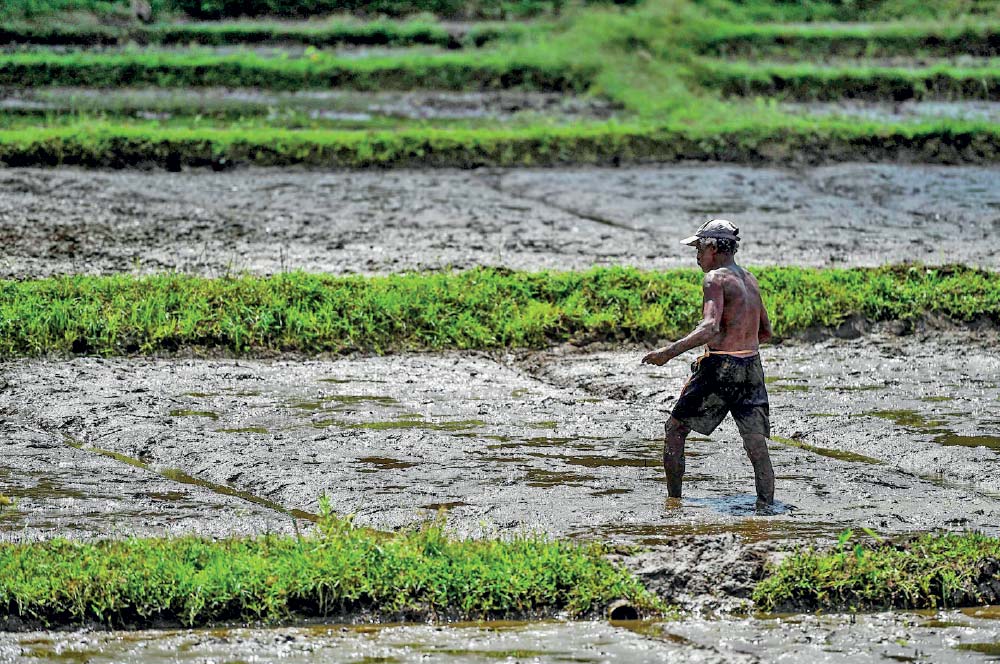
 What the agricultural crisis demands today is a new package. Such a package should reduce production costs, increase returns to farmers, and be environmentally friendly—protecting soil and water resources. This is fundamentally a political question
 Lenin once wrote: We not only do not know which spark will ignite the fire, but neither can we know it in advance. Over the past several weeks, what we have seen and heard are continuous protests taking place across virtually every farming region in Sri Lanka. A peasant uprising has begun. This is a welcome development.
Farmers helped bring the NPP Government
The arrogance of the National People's Power (NPP) Government, especially that of its Minister of Agriculture, must be challenged by mobilising this force. Farmers possess sufficient strength to do so. At present, the most immediate problem is that farmers are unable to sell their paddy at a fair price. The Government has no answer to this. Two ministers claim that the Government has acted in the “normal way.” If that is true, what does it reveal? It reveals that the so-called normal way is no longer adequate. If so, it must be changed. Farmers helped bring the NPP Government to power precisely for that reason—because the old normal way was unsuitable.
Farmers, who constitute the majority of the population and occupy most of the country's land area, possess ample strength to bring about such change. Throughout history, in every country, we hear of peasant protests and peasant rebellions. The puppet Government of Chiang Kai-shek was overthrown through the struggle of an armed peasantry. A few years ago, Indian farmers compelled Narendra Modi’s Government to withdraw three agricultural laws it had introduced. Similar examples can be found throughout the world. The history of Latin America is filled with peasant struggles. Although not every peasant movement has been victorious, farmers have fought throughout human history. The peasants of Uva-Wellassa waged a massive struggle against British colonial rule. As Hannah Arendt once observed, a revolution or a struggle is a real historical event in itself; whether it ultimately succeeds or fails is secondary.
Three major developments
Three major developments have shaped the lives of farmers in Sri Lanka. The first was the establishment of agricultural colonisation schemes in the early part of the last century which gave rise to a middle-level landowning peasant class. The second was the transformation of rice into a commodity. By commodity, following Marx, we mean a product produced for sale. Most farmers now sell the rice they produce and later purchase rice from the market for their own household consumption. The third development was the Green Revolution.
Although these developments can be discussed separately, they are interconnected. Today, all three are in crisis. Agriculture unit has become fragmented and cultivation units have shrunk. Most farmers cultivate less than half an acre and cannot sustain their families through farming alone. Alongside them, another class of farmers has emerged, leasing land and cultivating 20–25 acres. With these changes, the agrarian economy has evolved into a market economy. The most decisive factor in this transformation has been the Green Revolution.
During the 1970s, Governments presented farmers with a package—the Green Revolution solution. It was expected that this package would neutralise the possibility of left-wing or “red” revolutions arising from rural unrest, protests, and rebellions. Even left-wing intellectuals were alarmed by the Green Revolution phenomenon. I first heard about it in a lecture delivered by my teacher, Professor Buddhadasa Hewavitharana, at a Lanka Sama Samaja Party forum in Kandy. In that lecture, he emphasised high-yielding varieties of rice. These varieties matured quickly, required abundant sunlight, and used relatively less water. Professor Hewavitharana summarised the prevailing understanding of the Green Revolution and highlighted the challenge it posed to the political Left.
The issue extends beyond technology and becomes a political challenge. Instead of accepting this political challenge and addressing the problem, the NPP Government is attempting to continue along the same “normal path.” For this reason, the country's 19,000 farmer organisations should take this issue into their own hands
Green Revolution
The Green Revolution promised higher yields and better incomes for farmers around the world. The Sri Lankan Government also made considerable efforts to make this package attractive to farmers. Through the expansion of agricultural extension services, Green Revolution technologies were disseminated widely. As a result, global production of rice and wheat increased significantly.
However, after some years, the shortcomings and contradictions of the Green Revolution became evident. If I remember correctly, Professor Terry Byres of the University of London published an excellent article in the Journal of Peasant Studies on the operation of the Green Revolution in India. Yet he focused primarily on one dimension: the way production relations changed within Indian agriculture alongside the emergence of a new agrarian mode of production. He examined class differentiation in rural society and the increasing use of agricultural machinery.
Nonetheless, to the best of my recollection, he paid less attention to the agro-ecological changes associated with the Green Revolution.
As the Green Revolution expanded, maintaining high yields required increasing quantities of agricultural chemicals, partly because the new seed varieties had limited resilience. Today, the Green Revolution package has become obsolete. Yields have declined. The soil has been degraded. Farmers have become subject to the exploitative practices of multinational and domestic corporations. In this context, rice production has become dependent on imported inputs. Moreover, production costs are now closely tied to global prices. Under these conditions, there is no longer any room for a politics that continues to treat the Green Revolution package as the “normal way” of doing agriculture.
Three major developments have shaped the lives of farmers in Sri Lanka. The first was the establishment of agricultural colonisation schemes in the early part of the last century which gave rise to a middle-level landowning peasant class. The second was the transformation of rice into a commodity. The third development was the Green Revolution
New package
What the agricultural crisis demands today is a new package. Such a package should reduce production costs, increase returns to farmers, and be environmentally friendly—protecting soil and water resources. This is fundamentally a political question. I am not an expert on the subject. Nevertheless, agro-ecology has developed sufficiently to provide the knowledge necessary to design such a package and make it attractive. Yet this would also require transforming rural production relations. That is why the issue extends beyond technology and becomes a political challenge.
Instead of accepting this political challenge and addressing the problem, the NPP Government is attempting to continue along the same “normal path.” For this reason, the country's 19,000 farmer organisations should take this issue into their own hands.




