Friday Oct 09, 2026
Friday Oct 09, 2026
Friday, 9 October 2026 00:02 - - {{hitsCtrl.values.hits}}
By Richard R.
I congratulate the Editor for publishing one of the best articles in a while titled; The Colombo courtier: Corporate sycophancy and political power in Sri Lanka. (See https://www.ft.lk/opinion/The-Colombo-courtier-Corporate-sycophancy-and-political-power-in-Sri-Lanka/14-798182). You have several people writing, but few have the courage to expose this disgusting truth. I would like you to publish this in good faith and without sanitising the argument.
Sri Lanka has a peculiar political ritual after every election. Politicians change sides, parties change colours and, almost magically, some of the country’s most prominent corporate personalities change colours with them. They do not contest elections or appear on party platforms. Yet they seem to know instinctively where power has moved.
The same corporate bigwigs who once celebrated yesterday’s political leadership suddenly appear beside today’s winners, praising their vision, economic wisdom and commitment to national development. Yesterday’s politician was indispensable. Today’s politician is indispensable. Tomorrow will produce another. This is not political conviction. It is corporate survival dressed up as patriotism.
The politics of access
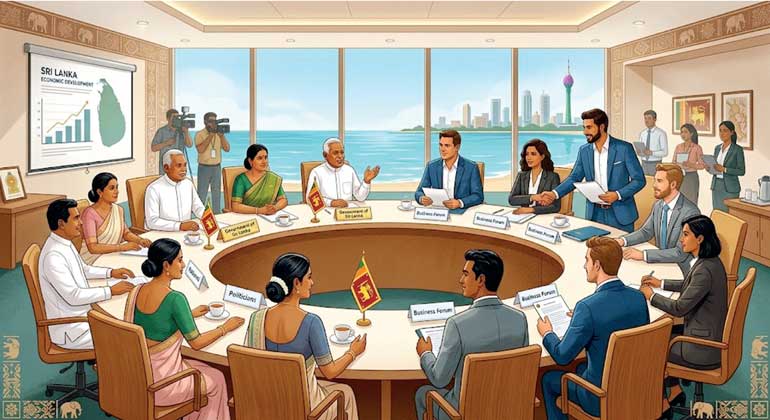
There is nothing wrong with business engaging Government. In any functioning economy, business and Government must communicate. The problem begins when access becomes an asset, political proximity becomes a competitive advantage and corporate leaders start treating the State as an extension of their business strategy.
For some, the most valuable investment is not technology, people or productivity, but relationships.
A Government appointment provides prestige. A board seat provides influence. An advisory role provides access. A photograph with a powerful politician provides credibility. A Government contract provides revenue.
Some corporate personalities have demonstrated remarkable political longevity, serving or advising administrations from Mahinda Rajapaksa and Maithripala Sirisena to Gotabaya Rajapaksa, Ranil Wickremesinghe and now Anura Kumara Dissanayake. Among those who have moved comfortably across administrations are Dr. Hans Wijesuriya, Duminda Hulangamuwa, Parakrama Dissanayake, Malik Fernando, Hanif Yusoof,Suresh Shah,Pravir Samarasinghe, Sujeewa Mudalige, Vish Govindasamy, Dhammika Perera, Arjuna Herath, Krishantha Cooray, more recent Eran Wickramaratne and Deshal De Mel.
Experience is valuable. But when the same faces repeatedly occupy influential positions regardless of who governs, the public is entitled to ask whether expertise alone explains it. That is where legitimate engagement can cross into crony capitalism.
The great corporate migration
Sri Lanka’s elections produce a secondary phenomenon: corporate migration.
Political parties may lose power, but some corporate relationships appear remarkably resilient. Business leaders who were close to the previous administration suddenly reinvent themselves as champions of the new one. Old photographs disappear. New photographs emerge. New committees are joined. New initiatives are praised.
It is a remarkable demonstration of adaptability. But adaptability is not the same as integrity. A responsible corporate leader should be able to work with any Government without becoming its political mascot. He should congratulate a new administration without pretending everything it does is brilliant.
Who tells the President he is wrong?
Governments need uncomfortable advice. Sri Lanka’s economic crisis demonstrated the consequences of allowing policy mistakes to accumulate. The sweeping tax reductions introduced after the 2019 election should have attracted serious scrutiny from the business community. Yet organised business was either supportive or insufficiently vocal. Perhaps some genuinely believed the policies would stimulate growth. Perhaps others feared antagonising the Government. Whatever the reason, the lesson is clear: when everyone in the room tells the powerful person that he is right, the country eventually pays the price. A corporate leader serving on a Government advisory body has a responsibility to provide independent judgement, not applause.
The Political–Business Leader
The ultimate victims of political-business cronyism are rarely the people in the photographs. They are the small entrepreneur who cannot obtain a contract, the young graduate who leaves because merit appears secondary to connections, the taxpayer who pays for inefficient projects and the consumer who pays more because competition has been distorted. Sri Lanka cannot build a modern market economy if boardrooms and political offices become revolving doors.
Business leaders should engage with every Government. But they should not belong to any Government. Their loyalty should be to shareholders, customers, employees and, ultimately, the health of the economy—not to whoever happens to occupy the Presidential Secretariat.
The real mark of a corporate bigwig is not how quickly he can identify the new centre of power. For some, the pursuit of political proximity becomes almost an addiction—a need to be seen in the right rooms, to gossip about what is happening inside Government and to give the impression that they are “in the know.”
The irony is that those who constantly seek such proximity may not realise that they are sometimes being used for their names, networks or influence, while being privately dismissed or even laughed at by the very people whose company they desperately seek. Access is not influence. Being invited into the room does not necessarily mean your advice is valued.
The real test of a political-business leader is therefore much simpler: when power moves somewhere else, does he move with it—or does he have the courage to remain standing on his principles?




