Friday Oct 16, 2026
Friday Oct 16, 2026
Wednesday, 3 June 2026 00:21 - - {{hitsCtrl.values.hits}}
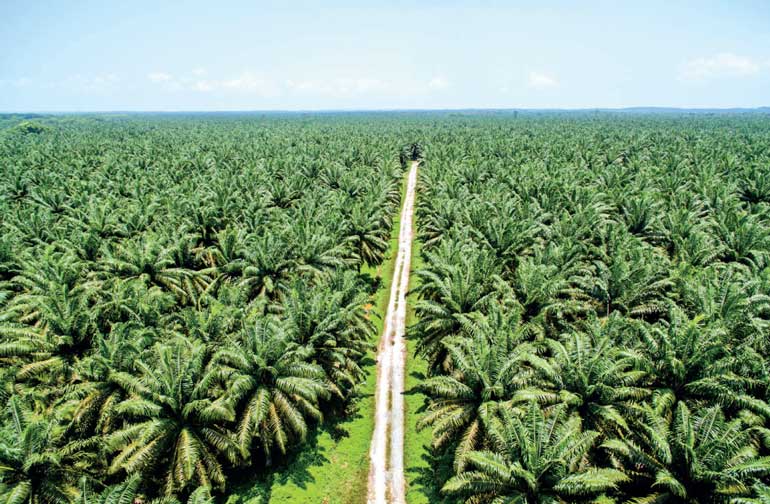
 Sri Lanka’s plantation sector has always been a cornerstone of our economy, shaping livelihoods, exports, and rural development. Yet, debates around palm oil continue to stir controversy, often clouded by bias rather than evidence. Too many discussions pit palm oil against rubber or coconut, as if one crop must be superior to the others. This approach is not only misleading but also harmful to rational policymaking. It is time to move beyond myths and embrace a balanced, science-based understanding of our plantation crops.
Palm Oil and Coconut: Same roots, different yields
One of the most overlooked facts is that both coconut and palm oil belong to the same palm family. Both produce nuts, whilst coconut triangular in the intermediate zone and thrive as a commercial crop palm oil thrive in wet-zone conditions, and both share similar root systems. The difference lies in productivity. Oil palm produces far higher yields of edible oil per hectare compared to coconut, making it a more efficient crop in meeting Sri Lanka’s growing demand for edible oil.
Moreover, oil palm’s larger leaf area index allows it to absorb more carbon dioxide, making it a powerful ally in cleaning the atmosphere. In an era of climate change, this ecological service cannot be ignored. Coconut remains vital for traditional diets and industries, but palm oil’s yield advantage makes it indispensable for food security and foreign exchange savings.
Rubber: A victim of climate, not crop weakness
Rubber, on the other hand, is often unfairly compared to oil palm in Sri Lanka’s wet zone regions. Critics frequently highlight its lower productivity and the reduction of cultivated extents. However, the underlying reason is straightforward, frequent rainfall significantly reduces tapping days, thereby limiting latex harvests. This climatic constraint has resulted in persistently poor yields. Consequently, both smallholders and large estates have shown reluctance to undertake replanting, further exacerbating the decline in rubber cultivation. This is a climatic constraint, not a biological weakness of the crop. Rubber remains indispensable for global industrial supply chains, ranging from automotive tires to medical equipment. To criticise the reduction of rubber extents in Sri Lanka misses the central point, it is the prevailing climate, not the inherent capacity of the crop, that dictates output.
The monocrop myth
Perhaps the most persistent argument against palm oil is that it is a monocrop, unlike rubber where intercropping is supposedly possible. Yet in Sri Lanka, almost all rubber estates are monocrop plantations. The claim that palm oil is uniquely restrictive is therefore misleading. with proper management, intercropping can be practiced in palm oil as well, though its dense canopy requires careful planning. The monocrop argument is not unique to palm oil, and using it selectively undermines the credibility of the debate.
Why bias hurts science and policy
 Academics and professionals have a responsibility to remain objective. Favoring one crop while criticising another based on personal preference or ideology weakens scientific discourse. Palm oil addresses Sri Lanka’s edible oil demand and reduces dependence on imports. Coconut sustains traditional diets and industries. Rubber supports global manufacturing and provides industrial raw materials. Each crop has its place, and each contributes to national prosperity.
When academics or policymakers dismiss palm oil as “harmful” without acknowledging its ecological and economic benefits, they risk misleading the public. Balanced, evidence-based strategies are essential if Sri Lanka is to maximise the potential of its plantation sector.
A call for balanced land use
Sri Lanka’s future lies not in crop rivalry but in crop diversity. Palm oil, rubber, and coconut are not enemies; they are complementary pillars of our plantation economy. Each crop thrives under specific ecological conditions and serves distinct market demands. The challenge is not to choose one over the other, but to design land-use strategies that balance productivity, sustainability, and community needs.
This requires moving beyond myths. Palm oil is not inherently destructive, nor is rubber inherently weak. Coconut is not outdated, nor is palm oil a threat to tradition. Each crop has strengths and limitations, and acknowledging these honestly is the first step toward a rational plantation policy.
Conclusion
Sri Lanka’s plantation sector deserves a fair, evidence-based discussion. Palm oil, rubber, and coconut should be seen as complementary, not competitive. The debate must move beyond selective criticism and focus on sustainability, productivity, and national economic priorities. Our academics and policymakers owe the nation neutrality and clarity, not bias and myth.
If Sri Lanka is to secure its agricultural future, we must embrace diversity, respect science, and end the plantation crop bias once and for all.
(The author is a Plantation and Management Consultant)




