Wednesday Nov 18, 2026
Wednesday Nov 18, 2026
Tuesday, 17 November 2026 04:30 - - {{hitsCtrl.values.hits}}
 It is the job of the Government, not of the Supreme Court, to ensure that Bills are consistent with international norms set out in international conventions that Sri Lanka has ratified, such as the International Convention on Civil and Political Rights (ICCPR). The Court’s determination on the Protection of the State against Terrorism Bill (PSTA) only addressed questions of consistency with the Constitution, based on some curious rationalisations. That is within the authority of the Court.
In its determination, the Court did not mandate any changes to section 27 that empowers the Secretary of the Ministry to issue detention orders nor change the word “shall” to “may” in section 26(3), preserving the ability of the Executive to deprive a person of liberty without judicial oversight. The review committee established under section 30 was mentioned in positive tone, without proposing any changes to its appointment by the Minister without Constitutional Council concurrence and its powers being only recommendatory (section 30(8)). The broad powers given to the President to indefinitely proscribe organisation were discussed but no material changes were mandated.
This leaves it up to the Executive, headed by the President, to make the necessary changes. Indeed, the President has stated that the Government will consult with civil society on the PSTA and on the even worse Prevention of Organised Crimes Bill (POCA). The Bills cannot be taken up by Parliament until the budget debate has been concluded in any case.
Minimum changes
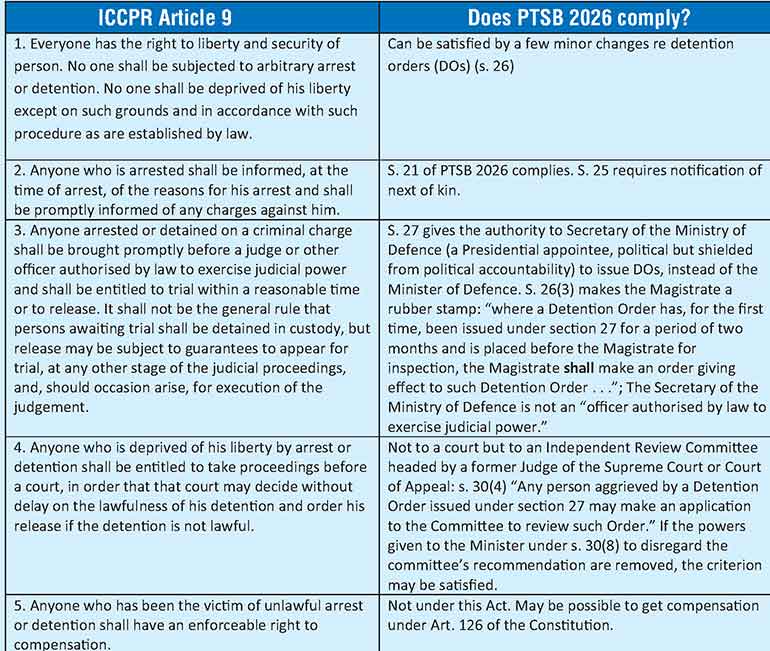
The Government should use this window to listen to the reasoned arguments that have been made and make the necessary changes on political and economic grounds. They have already paid the political price for reneging on an explicit manifesto promise. They may be able to remedy part of the damage by making changes even at this late stage. The economic reasons are much stronger. The GSP+ application is endangered by the Bill in its current form. It can be denied if Sri Lanka retains the Prevention of Terrorism Act or enacts new law that does not meet the norms set out in the International Covenant on Civil and Political Rights (ICCPR) that Sri Lanka acceded to on 11 June 1980.
The Executive should step back from the insistence that the decision to incarcerate a person suspected of having committed an offence under the PSTA for up to two months is its alone and does not involve the judicial branch. The Government does not appear to trust Magistrates with decisions on granting bail. Perhaps the decisions to detain a person should also be moved up the judicial hierarchy to the High Court and out of the Executive. This action will make the PSTA compliant with ICCPR Article 9(3).
The requirement of an appeal of a detention order under ICCPR Article 9(4) may be met easily. The review committee proposed in section 30(4) should be made truly independent and its decisions final. Independence can be strengthened by having the Constitutional Council approve the appointments. Amendment of section 30(8) removing the powers of the Minister to disregard the committee’s recommendations will complete the remediation.
The most puzzling aspect of the Supreme Court’s determination is that relating to the President’s untrammeled powers to proscribe organisations (section 59). Article 155 of the Constitution allows the Executive to take urgent measures under the Public Security Ordinance (No. 25 of 1947) but requires Parliament to concur every month. As the Court notes, it may be necessary to take prompt action on terrorist organisations. That is the purpose of the Public Security Ordinance.
Why the Court has allowed the Constitutional safeguard on the actions of the Executive in conditions of exception to be bypassed is puzzling. While this may not directly affect GSP+, it is hoped that the Government will reconsider giving the President the power to proscribe without the involvement (even after a month) of the legislature. Merely substituting the Supreme Court for the Court of Appeals does not cure the harm caused by granting of sole authority to the President.
Avoiding the core issues
The Presidency is a political position. From the time of the 17th Amendment, the trend has been to introduce checks and balances on the enormous powers granted the President by the original 1978 Constitution. An organisation that has been unjustly proscribed by the President is asked to appeal to the Supreme Court instead of the Court of Appeals, as though that is a practical solution in that the organisation is unable to use its own resources even to launch the appeal because its bank accounts are frozen by the proscription order. In the same way that the addition of a phrase to section 29(2) does not remedy the core problem of the Executive depriving persons of liberty, this too makes changes at the margin, without addressing the core issue.