Saturday Oct 03, 2026
Saturday Oct 03, 2026
Tuesday, 12 May 2026 00:47 - - {{hitsCtrl.values.hits}}
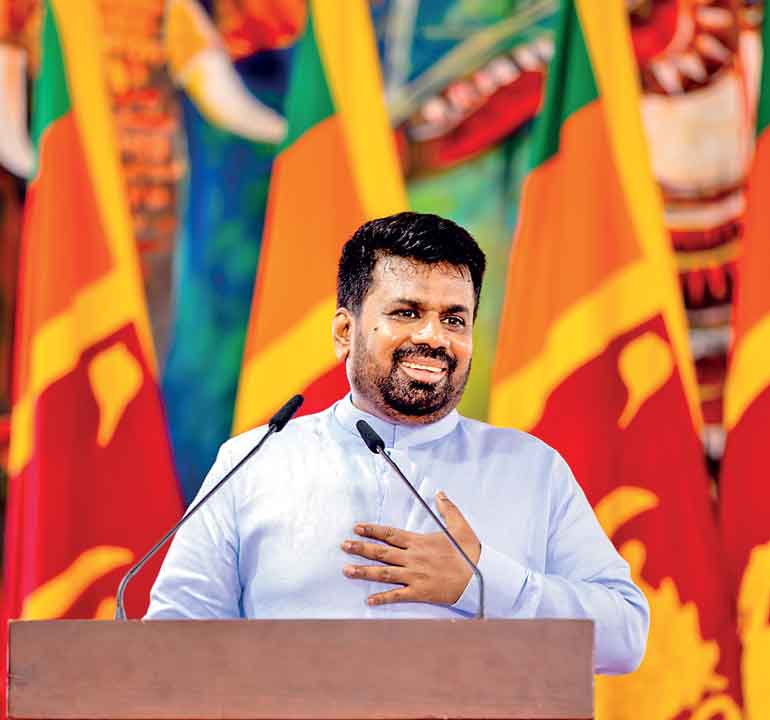
President Anura Kumara Dissanayake
 “A good state relies on virtuous citizens for governance, while the state’s institutions cultivate virtue in them, forming a reciprocal relationship of ruling and being ruled.” — Aristotle.
Aristotle’s political philosophy reminds us that governance is not merely about authority, but about cultivating civic virtue and public trust. The state, in his conception, exists to help citizens achieve eudaimonia—a flourishing and dignified life rooted in wisdom, justice, and participation.
That classical insight offers a useful lens through which to examine Sri Lanka’s contemporary political climate.
When President Anura Kumara Dissanayake and the National People’s Power (NPP) rose to power, they did so with the momentum of a historic anti-establishment movement. Their political message resonated deeply with a public exhausted by corruption, economic collapse, and elite impunity. They positioned themselves not as custodians of the existing order, but as its corrective force.
However, nearly two years into governance, the moral clarity that once defined the movement appears increasingly complicated by the realities of statecraft.
What many critics now describe as “organised hypocrisy” is not simply a matter of broken promises. Rather, it reflects a deeper structural tension between political idealism and the practical demands of governance.
In truth, this tension is not unique to Sri Lanka. Across democracies, anti-establishment movements often discover that governing requires compromise with the very institutions and constraints they once denounced.
Yet the NPP’s evolution is particularly striking because of the absolutist nature of its earlier rhetoric.
Consider economic policy. During the 2024 campaign, NPP leaders strongly opposed austerity measures associated with the International Monetary Fund program. Tax increases, subsidy reductions, and fiscal tightening were framed as burdens imposed on ordinary citizens in service of international creditors.
Major paradox
Today, however, the administration has largely maintained the same reform trajectory, citing the need for macroeconomic stability, debt restructuring, and international confidence.
This represents the first major paradox of the present administration: a Government that continues to speak the language of resistance while administering many of the policies it once condemned.
Cuts or delays in social spending, cautious labour reforms, and continued fiscal discipline are now defended as unavoidable “structural necessities.” Whether these policies are economically prudent is a legitimate matter for debate. But politically, they sit uneasily beside the promises of social justice and economic transformation that powered the NPP’s rise.
The issue, therefore, is no longer whether compromise has occurred—it clearly has—but whether such compromise was inevitable, and more importantly, whether it has been honestly communicated to the public.
When President Anura Kumara Dissanayake and the National People’s Power (NPP) rose to power, they did so with the momentum of a historic anti-establishment movement. Their political message resonated deeply with a public exhausted by corruption, economic collapse, and elite impunity. They positioned themselves not as custodians of the existing order, but as its corrective force.
However, nearly two years into governance, the moral clarity that once defined the movement appears increasingly complicated by the realities of statecraft
A second contradiction concerns governance ethics.
The NPP built much of its legitimacy on promises of meritocracy, institutional reform, and the dismantling of political patronage networks. Yet controversies surrounding key appointments, questions over qualifications and competence in certain sectors, and allegations of political influence within state institutions have raised concerns that old political habits may not have disappeared entirely. Instead, critics argue, they risk being reproduced under new management.
More sensitive still is the question of anti-corruption credibility.
The “Clean Sri Lanka” narrative formed the moral centre of the NPP campaign. It successfully tapped into widespread frustration over decades of corruption and political nepotism. However, investigations and allegations involving individuals associated with the current administration have inevitably complicated the image of moral exceptionalism that the movement cultivated.
This does not mean the present Government is equivalent to previous administrations in either scale or intent. Such comparisons require caution and evidence. Yet in politics, perception matters as much as policy. Once a movement defines itself primarily through moral superiority, even limited controversies can carry disproportionate political consequences.
There is also growing unease regarding the treatment of dissent and independent criticism.
The NPP emerged partly from the political energy of the Aragalaya, a movement that championed democratic accountability, protest rights, and freedom of expression. Consequently, concerns expressed by journalist associations, civil society actors, and critics regarding pressure on media spaces or intolerance toward dissent have generated disappointment among sections of the public who expected a clearer democratic departure from the past.
If these concerns continue unchecked, they risk reinforcing a troubling pattern in Sri Lankan politics: the persistence of institutional reflexes regardless of which party occupies power.
Yet reducing all these developments to simple betrayal would be analytically shallow.
Modern political hypocrisy is often less about deliberate deception and more about the contradictions inherent in democratic governance. Electoral politics rewards certainty, moral clarity, and uncompromising rhetoric. Governing, by contrast, requires negotiation, ambiguity, and adaptation to economic and geopolitical realities. In that sense, what appears to be hypocrisy may partly reflect the unavoidable cost of transitioning from protest movement to governing administration.
However, this does not absolve the Government of responsibility. The central problem is not necessarily that the NPP adjusted its policies, but that it has struggled to openly acknowledge the reasons for those adjustments. Organised hypocrisy becomes politically corrosive when leaders continue to invoke the language of purity while practicing pragmatic compromise.
Growing disillusionment
Citizens are often more politically mature than parties assume. Most voters understand that Governments operate under constraints. What they demand is not perfection, but candour.
Indeed, the deeper danger facing the NPP may not be policy failure alone, but narrative collapse.
Its political identity was constructed around the claim of being fundamentally different from the traditional political class. If that distinction weakens, the movement risks becoming indistinguishable from the administrations it once opposed—managing crises while still speaking in the language of transformation.
This growing disillusionment is increasingly reflected in public sentiment.
There appears to be a widening gap between the Government’s reform ambitions and public confidence in its ability to deliver meaningful change. Rising expectations, economic hardship, administrative inefficiencies, and communication failures have all contributed to a climate of frustration.
Policy systems frequently suffer not only from resource limitations, but from inflexibility, poor implementation, information deficiencies, and declining institutional credibility.
In his influential work ‘Why Government Fails So Often: And How It Can Do Better’ (2014), Peter H. Schuck argues that Government failures are rarely accidental. Rather, they emerge from systemic weaknesses: unrealistic ambitions, weak incentives, bureaucratic rigidity, and an inability to learn from mistakes.
Modern political hypocrisy is often less about deliberate deception and more about the contradictions inherent in democratic governance. Electoral politics rewards certainty, moral clarity, and uncompromising rhetoric. Governing, by contrast, requires negotiation, ambiguity, and adaptation to economic and geopolitical realities. In that sense, what appears to be hypocrisy may partly reflect the unavoidable cost of transitioning from protest movement to governing administration
Partisan polarisation
Sri Lanka’s political environment continues to exhibit many of these characteristics.
Meanwhile, partisan polarisation has become a substitute for genuine policy discourse. The current administration blames past regimes for inherited crises, while opposition forces attribute every present difficulty to Government incompetence. Yet polarisation itself is not the root cause of national dysfunction; rather, it is often the consequence of unresolved structural failures and declining public trust.
The broader lesson extends well beyond Sri Lanka.
Anti-establishment movements derive much of their strength from moral absolutism. But once in power, that same absolutism can become a political liability. Unless protest movements evolve into transparent governing institutions capable of honestly communicating limitations and trade-offs, they risk becoming trapped within their own rhetoric.
In today’s political culture—defined increasingly by polarisation, image management, and performative certainty—openly acknowledging compromise may itself be a radical democratic act.
Honesty about compromise rejects the superficial demand that leaders always appear ideologically pure and politically infallible. It recognises that governance is not the art of perfection, but the difficult practice of balancing competing realities.
Compromise, when principled and transparent, is not weakness. It is often the mechanism through which democratic societies avoid paralysis and sustain coexistence.
Progress rarely emerges from absolutism alone.
The NPP Government still has the opportunity to redefine its political trajectory. Doing so would require moving beyond the rhetoric of moral exceptionalism toward a politics of institutional honesty and democratic maturity.
In an era where political hypocrisy has become increasingly normalised across ideological lines, honesty about compromise may indeed be the most radical act remaining.
(The author is communications professional with an academic background spanning leading international institutions. A graduate of RMIT University in Australia, and postgraduate studies at Bournemouth University in the United Kingdom)



