Saturday Oct 03, 2026
Saturday Oct 03, 2026
Saturday, 3 October 2026 00:15 - - {{hitsCtrl.values.hits}}
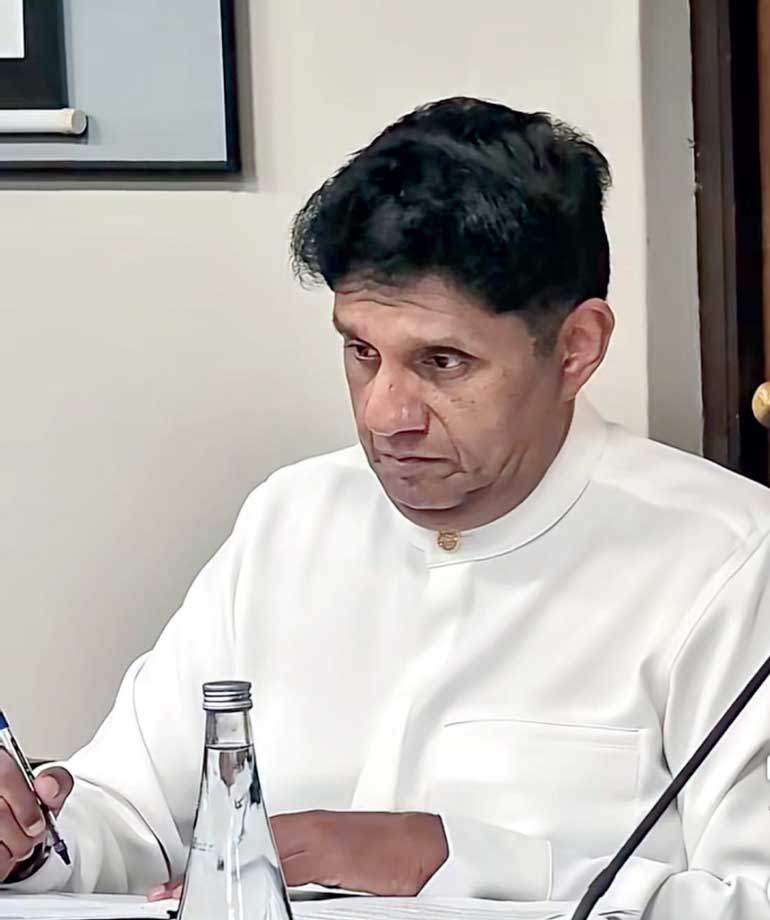
Opposition Leader Sajith Premadasa
 A recurring critique of the Main Opposition party, Samagi Jana Balawegaya (SJB) and its leader, Sajith Premadasa, is that they are insufficiently engaged with the economic and social questions affecting ordinary citizens; that it becomes animated by constitutional or institutional controversies, like the 22nd Amendment, while neglecting household incomes, taxation, jobs and the cost of living.
Various essays and thought pieces also make this critique. ‘Sri Lanka, Beyond 22’, published in the DailyFT on the published on 2 September 2026 by Tisaranee Gunasekara, takes it to its starkest formulation, writing, “If the Opposition had a grain of sense, it would have focused on economics”. The article suggests “unwillingness to confront the Government on matters economic”. That is a serious claim but also one that is remarkably difficult to reconcile with the parliamentary record.
Most recently, during a panel discussion, United Nations Resident Coordinator Marc-André Franche suggested that there was a disconnect between civil society and the political system, referring specifically to the Leader of the Opposition and questioning why Sajith Premadasa was not focusing on “certain issues” despite having “ample material”. The Opposition Leader has since released the full 41-minute recording of his 3 September meeting with the Resident Coordinator and invited the public to judge the conversation on its merits. (Available on Youtube channel @sajithpremadasalk)
The SJB economic and political critique
Since the NPP came to office, Sajith Premadasa and the SJB have raised, challenged or sought answers on the following, through addresses and questions raised in parliament, in the media and through social media. (References provided):
This is not an exhaustive history of every speech or intervention and it is vitally important that the political commentariat not confuse a failure to dominate the narrative with a failure to engage with the issues.
Substance over style
The suggestion that attention to the 22nd Amendment demonstrates misplaced Opposition priorities is particularly difficult to sustain given the intervention of the international legal community. The Commonwealth Lawyers Association does not oppose increasing judicial retirement ages in principle. Its President, Steven Thiru, made that distinction explicitly. What concerns the CLA is altering the tenure of sitting judges, through an ad hoc constitutional amendment, without a sufficiently broad and transparent consultative process. The proposal would raise the Supreme Court retirement age from 65 to 67 and Court of Appeal retirement age from 63 to 65, while introducing a particular tenure provision for the Chief Justice.
Thiru’s warning is worth taking seriously because it goes directly to what constitutional governance means: “public confidence is the judiciary’s ultimate currency”. He warned that changing the terms of office of sitting judges can create the appearance of a political benefit being conferred upon particular members of the judiciary. The CLA urged Sri Lanka to avoid piecemeal amendments, undertake proper public consultation and protect confidence in judicial independence.
By September, 67 petitions had been filed against the proposed amendment. The CLA President travelled to Sri Lanka to observe the Supreme Court proceedings, subsequently sought meetings with Government representatives, and met the Leader of the Opposition specifically to discuss judicial independence.
Whatever position one ultimately takes on 22A, this is plainly not a frivolous diversion from “real” issues.
Understanding the SJB IMF critique
There is a similar problem in the way the post-2022 economic argument has often been narrated. The debate was repeatedly reduced to two camps: those responsible enough to understand the necessity of the IMF program and those supposedly resisting painful but unavoidable reform. Tisaranee Gunasekara writes in April 2023: “The IMF facility is no panacea. Nor is it the poisoned chalice of the Opposition’s fervid imagination.”
But the substantive SJB critique was never simply “anti-IMF”, it was the SJB that initially insisted that Sri Lanka required an IMF program, debt restructuring and restoration of Government revenue after the destruction of the tax base. The dispute concerned the architecture of adjustment which the IMF’s own program described as an “ambitious and primarily revenue-based fiscal consolidation strategy”. It required the primary balance to move from a deficit of 3.8% of GDP in 2022 to a surplus of 2.3% from 2025, while raising tax revenue through PIT, CIT, withholding taxes, VAT reform, reduced exemptions and other measures.
Once that is understood, saying afterwards that the Wickremesinghe recovery became “tax heavy” is not by itself a revelation, it was designed precisely to be revenue-heavy. The real political questions were always: which taxes; imposed upon whom; at what thresholds; how rapidly; with what protection for household consumption, SMEs, investment and skilled labour; and against what expenditure priorities?
Protests against the 2023 APIT regime by professional groups, including the Government Medical Officers’ Association (GMOA) and the Federation of University Teachers’ Associations (FUTA), illustrate the point. They were often portrayed simply as affluent middle-class resistance to taxation after benefiting from Gotabaya Rajapaksa’s tax cuts.
Self-interest undoubtedly played a role, but the objections were more substantive: the Rs.100,000 monthly threshold after severe inflation and currency depreciation, compressed tax slabs, the relative ease of taxing salaried professionals compared with asset-rich or informally remunerated individuals, and the risk of accelerating skilled emigration. These were arguments about tax incidence and design, not a demand to return to Gotabaya-era fiscal policy.
Analytical blindspots
Sri Lanka’s collapse manifested itself as a balance-of-payments and external-debt crisis. Fiscal sustainability unquestionably matters but is not synonymous with external sector sustainability. A country can run a primary surplus while imports outrun exports and Public debt-to-GDP can decline while future foreign-currency debt service remains onerous. Consumption can recover without an equivalent expansion of tradable production and fiscal consolidation does not by itself generate the dollars required to repay external creditors.
The IMF recognises this distinction: its program contains separate objectives for fiscal sustainability, debt restructuring, rebuilding reserves, exchange-rate flexibility and structural reforms to unlock growth. The SJB’s emphasis on exports, tradable production, productive investment, external balances and growth therefore represented a substantive criticism of the path of the program but not a rejection of the need for macro-stabilisation.
Subsequent evidence makes that distinction increasingly important; The World Bank says Sri Lanka’s recovery remains incomplete: Poverty remains around twice its 2019 level; food prices more than doubled between 2021 and 2024; real wages remain below 2019 levels; and the very reforms that helped stabilise the economy, including utility-price adjustments and revenue measures, in fact also placed substantial pressure on household budgets. The Bank specifically warns that further regressive indirect taxation could worsen the poverty outlook.
Contradiction in the commentary
This is where a tension in Sri Lanka’s liberal and economic commentary becomes apparent. Many commentators welcomed the Wickremesinghe-era stabilisation program and treated adherence to the IMF framework as a test of responsible stewardship of the economy. Gunasekara herself wrote that “Ranil Wickremesinghe was more correct than his opponents when he opted for direct taxation,” even suggesting he had briefly stood up for poorer Sri Lankans by reversing the earlier tax policy. One only needs to analyse the previous Wickremesinghe regime’s Income Tax Act (2018), which failed to meaningfully reform the IRD and Sri Lanka’s tax-to-GDP reached a peak of 11.8% under that Wickremesinghe Government.
Restoring direct taxation or reversing ruinous tax cuts are merely fiscal corrections, not proof of a fundamentally redistributive settlement or sentiment. Many of the outcomes now used to criticise the NPP: weak household purchasing power, limited wage recovery, inadequate investment, regressive indirect taxation and slow productive transformation, are linked quite literally to the very post-crisis architecture inherited from the Wickremesinghe administration and praised by the liberal media consensus.
That same commentary still insists that the NPP remain within that framework, thus there is no contradiction in supporting macroeconomic stability while criticising its distributional consequences. Once that distinction is accepted, so too is the central SJB argument: the question was never “IMF or no IMF”, but what kind of adjustment, who bears its cost, and what economic structure emerges from it.
The SJB’s post-2022 record also deserves more careful treatment: it did not join the SLPP bloc sustaining the Wickremesinghe presidency under the banner of “saving the country”, neither did remaining in Opposition translate into indiscriminate obstruction of reform. It supported or constructively engaged with important reforms while using Parliament and its committees to challenge measures it considered defective.
That distinction has been consistent: the SJB accepted the need for higher revenue, electricity-sector reform and continued IMF engagement, while contesting tax slabs and thresholds, the burden on retirement savings, tariff design and particular program parameters. The same approach extends to governance: supporting necessary reform does not require acquiescing in measures that raise concerns over judicial independence.
Of substance and merit
Many of the concerns raised by Sajith Premadasa and the SJB more broadly, are now increasingly reflected in the wider economic and institutional debate. IMF officials have themselves stressed the need to expand manufactured exports, while others have drawn attention to the distributional costs of adjustment, pressures on professionals and SMEs, and the limits of treating fiscal consolidation as a substitute for external-sector upgrading.
Has the SJB been adequately engaged with vital issues of economics, social policy and governance? The parliamentary and public records cited above, provide the evidence, sections of the intellectual class and mainstream media are invited to pay sufficient attention.
(The writer is a political commentator, media presenter, and foreign affairs analyst. A former banker, he spent 11 years in the industry in Colombo and Dubai, including nine years in corporate finance, working with some of Sri Lanka’s largest corporates on project finance, trade facilities, and working capital. He holds a Master’s in International Relations from the University of Colombo and a Bachelor’s in Accounting and Finance from the University of Kent (UK). He currently serves as Advisor on Political Economy to the Leader of the Opposition of Sri Lanka, and is a member of the Working Committee of the Samagi Jana Balawegaya (SJB), and can be reached via [email protected], Twitter: @kusumw)



