Thursday Oct 15, 2026
Thursday Oct 15, 2026
Wednesday, 18 March 2026 00:26 - - {{hitsCtrl.values.hits}}
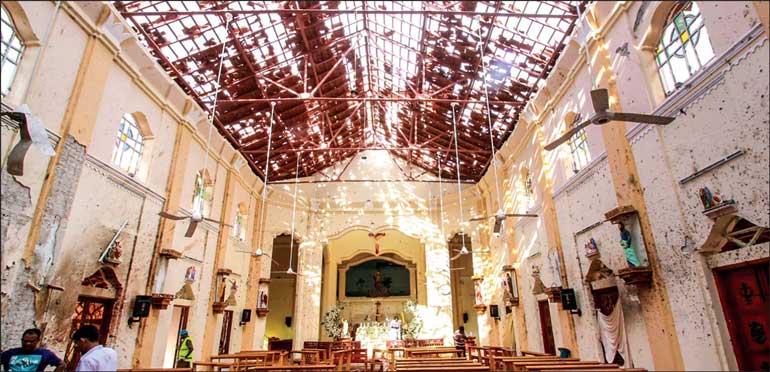
Easter Sunday attacks in 2019
 “Crime butchers innocence to secure a throne, and innocence struggles with all its might against the attempts of
crime” – Maximilien Robespierre
The ripple effect of civil society agitation ceased with the deadline of 28 February 2026, along with the representation and resolution by various interested groups. Civil societies appeared to have made their demand the complete withdrawal of the draft and the total repeal of the existing Prevention of Terrorism Act (PTA). I am skeptical that the draft “The Protection of the State from Terrorism Act Bill” will eventually be shelved by the Government. Nonetheless, it is unpredictable to what extent the public comments and recommendations will be incorporated into the law.
The National People’s Power (NPP) rode to power on waves of hope, pledging systemic change: the abolition of the executive presidency and the repeal of draconian laws. But as former JVP General Secretary Lional Bopage recently reminded us, that promise has been broken.
Page 129 of the NPP’s presidential manifesto, A Thriving Nation, A Beautiful Life, explicitly promised the “Abolition of all oppressive acts, including the PTA, and ensuring civil rights of people in all parts of the country.”
To date, the only “abolition” the Government has managed is the removal of parliamentary pensions—a populist move that costs them little. When it comes to the PTA, they’re not abolishing it. They’re rebranding it.
In legal terms, “abolition” means complete abrogation. The Government, however, is pursuing a replacement. By introducing the Protection of the State from Terrorism Act (PSTA), they are preserving the architecture of state surveillance and detention, merely dressing it in new language.
The very title gives the game away. “Protection of the State from Terrorism Act” places the state—not its citizens—at the centre of protection. Legal analyst and a member of the Right to Information Commission, Kishali Pinto Jayawardena draws a stark comparison with South Africa’s Constitutional Democracy against Terrorist and Related Activities Act, 2004 is noteworthy. South Africa learned from its apartheid past that laws should protect the people and the democratic order, not the ruling regime.Sri Lanka’s draft, by contrast, seems to have forgotten this lesson entirely.
 Despite having enacted terrorism legislation (Terrorism Act No 83 of 1967) under British colonial rule to oppress the native majority, post-apartheid South Africa ensured that its new laws prioritised people over the state. Sri Lanka’s draft PSTA, by contrast, seems to have forgotten this lesson. By aiming to protect “the State,” it signals a continuation of the doctrine that the security of the Government is synonymous with the security of the nation—a doctrine that has historically justified the targeting of minorities and political dissenters.
Breaking international commitments
The Government’s actions also contradict its international obligations. At the 60th Session of the UN Human Rights Council, Sri Lanka agreed to Resolution A/HRC/RES/60/1, which:
“Welcomes the commitment made by the Government of Sri Lanka to repeal the Prevention of Terrorism Act,. while expressing concern at reports that detentions under that law continue, and have disproportionately affected individuals from Tamil and Muslim communities, and urges the Government to apply a moratorium on the use of the law, to expedite its repeal and to ensure that any legislation on combating terrorism complies fully with the State’s obligations arising from international law, including international human rights law.”
The resolution sets a strict condition: any new law must comply with international human rights law. The draft PSTA fails this test on multiple grounds. UN Rapporteurs and the EU have already submitted detailed responses pointing out that the definition of terrorism in the proposed act does not conform to international standards.
However, OCHR conveyed its preliminary comments on the draft PSTA through its 10-page comments and recommendations to the Ministry of Justice on 24th February, with a note that multiple provisions of the draft bill are contrary to international human rights law and domestic constitutional guarantees.
More troubling still: the UN resolution explicitly notes that the PTA disproportionately affected minorities. By subscribing to this resolution and then introducing a law with similar sweeping powers, the Government is effectively preparing a new legal baton to continue beating the same communities.
 Arrests and detentions of Muslim individuals—including Mohamed Suhail Mohamed Rushdi in 2024, Ahnaf Jazeem under the notorious Prevention of Terrorism Act (PTA) for different alleged offences, and Momed Mihlar in connection with the Easter Sunday attack—all of whom were released without charges after prolonged detention, serve as a warning of how the new PSTA could be misused.
From victims to perpetrators: The unlearned lesson
Since its inception in 1979, the PTA was the weapon of choice against the JVP during their first and second insurrections. JVP members were not just arrested under this act; they were disappeared, tortured, and killed. Their bodies floated in rivers and lay in mass graves.
The public expected that the JVP, having endured the brunt of the PTA, would be the one party capable of ending it for good. They understood its gravity. They knew what it felt like to be the “suspected terrorist.” Yet, despite this lived experience—and despite their manifesto promise—they are now bringing in a new version of Terrorism Act- is more than an old wine in a new bottle.
The justification for retaining the PTA has always shifted to suit the state’s enemy du jour. Initially, it was the JVP’s southern insurgency. Then, it was the LTTE’s separatist struggle. After the LTTE’s military defeat, the narrative pivoted to global jihadism, culminating in the 2019 Easter Sunday attacks carried out by local Muslim extremists.
This is the uncomfortable truth the NPP Government must confront. The party that was once the primary victim of the PTA is now complicit in perpetuating a law that disproportionately affects Tamil and Muslim communities.
 State terrorism: The unacknowledged perpetrator
The discourse around terrorism in Sri Lanka has always been one-sided. We label non-State actors as terrorists, but we refuse to apply the same scrutiny to the actions of the State. When minorities are subjected to harassment, arbitrary arrest, and persecution under the guise of security, that is not law enforcement—it is state terrorism.
The new PSTA exacerbates this by empowering the police and the military—institutions that are not civil enforcement agencies—to arrest anyone on “reasonable suspicion.” But what constitutes “reasonable suspicion” in a country where the police force is tarnished by allegations of hierarchy-based impunity and bribery.
If the police have been implicated in murder and criminal enterprises, why should the public trust their ability to fairly assess who is a “suspected terrorist”? By giving these institutions unchecked power without robust, independent oversight, the PSTA doesn’t just permit state overreach; it legislates the potential for state terror.
The recent arrest of Suresh Salley , the former head of the State Intelligence Service (SIS), has raised questions about possible State involvement behind the scenes of the 2019 Easter Sunday attacks. If Salah and others are found guilty, it would suggest that the terrorism inflicted on innocent worshippers was not solely the act of Muslim extremists, but potentially an act of State terrorism as well.
Coincidentally, the indictment of former SIS chief Suresh Salley may eventually open the lid of the genie’s bottle, exposing the masterminds behind the Easter Sunday attack. It may lead to the arrest and indictment of several others connected from within the Government intelligence apparatus. Against this backdrop, it is quite interesting that the Attorney General has ordered the CID to study the Presidential Commission’s recommendations to probe former presidents Sirisena and Ranil, as well as some other top brass in the police force.
Whether this indicates possible criminal proceedings against them remains to be seen. Regardless of whether they are implicated or indicted in a court of law, the fact that an investigation is underway is itself a solace to the victims and the Muslims who suffered enormously in the aftermath of the incidents at the hands of the Sri Lankan police and military—under the control of the very same two presidents.
 The last hearing in the case of Salley also sought to uncover the missing link concerning former President Gotabaya’s alleged involvement in gagging some intelligence officers at the request of Salley . This should not end there, as it seems to be—the former security minister Saratha Wijesekara’s repeated claim of the death of Sarah Jesmin and the meeting of Prof. Rohan Gunaratna with Pilliyan in the Batticaloa Prison { “Easter Massacre-Ethno Religious Coexistance and Undersatnding by Siv. Chandrakanthan (Pillaiyan) } warrant an explanation too, relating to their unusual interference in the conduct of the Easter Sunday attack. If anything transpires from the proceedings involving these former presidents and some other top brass, it may reveal nothing less than state involvement—and the acts committed and omitted may amount to state terrorism.
All these lines of inquiry and investigation through the legal mechanism point to the fact that connivance within the Government intelligence sectors—though singling out two individuals from minority communities, Saley and Pillaian—brought state terrorism into play with a handful of Muslim terrorists, at the time of the heinous act of terrorism against the Christian community, with Muslims also on the receiving end.
A cycle of stigma
At the end of the day, the sting of terrorism has been felt by every community in Sri Lanka. The LTTE targeted Buddhist temples in the South. Armed forces and Sinhalese extremist elements have targeted churches, temples, and mosques. Fringe Muslim extremist groups attacked churches in 2019. All three major communities—Sinhalese, Tamil, and Muslim—have been scarred by terrorist violence.
Yet the stigma of “terrorism” has been weaponised to profile and persecute specific groups based on the political needs of the moment. In the 1980s, it was JVP youth. Between the 1980s and 2009, it was Tamil militants. After 2019, the suspected terrorists have been predominantly Muslim.
This revelation exposes the deeper truth about Sri Lanka’s counter-terrorism architecture. It was never truly about defeating terrorism—it was about preserving power. When the LTTE was defeated, the apparatus did not dissolve. It simply searched for a new enemy. When the JVP was integrated into democratic politics, the laws that once crushed them were not repealed. They were held in reserve, waiting for the next target.
 The NPP had a chance to break this cycle. They had the moral authority, the historical credentials, and the electoral mandate to abolish the PTA entirely. Instead, by introducing the PSTA, they are signaling that the state’s security—and the military-intelligence apparatus that protects it—is more important than the civil rights of the people.
The NPP Government stands at a crossroads. It can honour its manifesto promise and its international obligations by truly abolishing the PTA and drafting a security framework that prioritises citizens and constitutional democracy. Such a law would: define terrorism with precision to exclude legitimate dissent; mandate immediate judicial oversight for all detentions; and ensure that security forces are held accountable for misconduct.
The people of Sri Lanka deserve a law that protects them from the State, not one that protects the State from them. For a party born from the victims of the PTA, introducing the PSTA is not just a political failure. It is the ultimate betrayal.
If any law is enacted to protect the public from terrorism or terrorism-related acts, it should clearly define what constitutes a terrorist act while safeguarding the constitutional rights of people of all ethnicities. The state should also be held accountable for any violation of constitutional guarantees.




