Monday Oct 12, 2026
Monday Oct 12, 2026
Thursday, 20 August 2026 00:21 - - {{hitsCtrl.values.hits}}
 In the early 1990s, the Central Bank of Sri Lanka published maximum lending and deposit rates differentiated by sector one rate for agriculture, another for exports, another for housing and expected banks to show, sector by sector, how their loan books were growing. Credit had to reach the sectors the country needed to grow, not merely the sectors easiest to lend to. It was administered and unsubtle, a product of a more controlled economy Sri Lanka went on to liberalise through the 1980s and 1990s, dismantling the very credit ceilings I am describing. But it rested on an instinct liberalisation arguably discarded too completely: that a Central Bank’s job is not only to set a single number the whole economy must live under, but to ask who is being financed, at what cost, and whether that serves the recovery the country needs.
What makes this worth revisiting is that the Central Bank never actually lost the legal power to do it. Section 76 of the Monetary Law Act still gives the CBSL broad authority to regulate interest rates and direct credit by sector. What has gone missing over three decades is not the tool but the will to use it.
Why interest rate management is mission-critical to recovery
A Central Bank’s headline policy rate is, by design, a blunt instrument. Raise it, and every borrower feels it. The SME exporter fighting for a shrinking margin, alongside the borrower possibly fueling an asset bubble. Cut it, and the same indiscriminate relief flows to both. That is what a single rate can and cannot do. It was never built to distinguish a garment exporter earning foreign exchange from a speculative property developer or a luxury vehicle importer.
That is precisely why the sharper recoveries reaching employment and export earnings, not just headline GDP have rarely relied on the policy rate alone. They paired it with a second layer: targeted credit facilities, development-bank rates moving independently of the benchmark, sector-specific tax relief, and guarantees directing capital toward industries with the greatest capacity to generate jobs and foreign exchange. What follows is what four very different recoveries - Spain, Greece, Brazil, and a cluster of Asian economies did with that instinct.
Spain, Greece, and Brazil: three ways to target the credit
Spain’s post 2012 recovery is often told as a story of austerity; it is more accurately one of surgical financial-sector repairs. SMEs make up 99% of Spanish firms and roughly two-thirds of employment and gross value added not far from Sri Lanka’s own economy. Yet it was precisely these firms that faced the steepest borrowing costs while large corporates borrowed at AWPLR +/- , retained bond-market access. Spain closed that gap deliberately: the Bank of Spain and the ECB forced a stress test, then moved over EUR 100 billion in distressed real estate assets into a dedicated bad bank, Sareb, isolating the rot; the state-owned ICO ran counter-cyclical, SME-targeted lending throughout, including a EUR 10 billion guarantee facility during the 2022 - 2023 rate shock; and the ECB’s Targeted Longer-Term Refinancing Operations conditioned funding explicitly on banks continuing to lend, not hoarding liquidity. Spanish credit to smaller firms began growing again from 2014, years ahead of the broader eurozone recovery. Greece pursued the same instinct through tax policy: a corporate tax cut from 28 to 22%, but more tellingly, a 50%, seven-year tax break for returning professionals to reverse the brain drain, and targeted lending and exemptions for tourism and shipping, still roughly half of Greek export earnings. The ECB’s 2010 intervention to buy Greek government bonds did the same job as Spain’s TLTROs (Targeted Longer-Term Refinancing Operations) repairing the transmission mechanism so that when Greek banks lent again, rates reflected improving fundamentals rather than panic pricing. Greek exports have since risen from 21 to over 35% of GDP. Brazil shows the same logic operating permanently, not just in crisis: alongside a Selic rate ((Sistema Especial de Liquidação e Custódia - is Brazil’s benchmark policy interest rate) that has swung from below 2% to above 15% chasing inflation, the national development bank BNDES ( Brazil’s National Development Bank) has for decades run a second, quieter interest rate systematically below the Treasury’s own borrowing costs channeled specifically into infrastructure, capital goods, and export financing, reinforced by Brazil’s Reintegra program refunding tax burden directly to exporters. The result: in 2024, with Selic at 15%, bank credit still grew over 11% and corporate bond issuance by 30%, because a meaningful share of that credit was never really pricing off Selic at all.
Asia: the precision instruments already at work in the neighbourhood
South Korea runs SME-targeted lending facilities alongside its policy rate. Most recently a Won 30 trillion program weighted toward smaller firms squeezed out by an uneven, semiconductor-led boom. When exporters were hit by a strong dollar this year, Korea’s Eximbank launched an emergency facility at roughly 3%, ring-fenced for currency-exposed SMEs. India’s RBI mandates, through Priority Sector Lending, that banks direct a defined share of credit toward agriculture, MSMEs, export credit, and housing; when a punitive US tariff hit specific export industries this year, it layered a sector-specific moratorium atop conventional rate cuts.
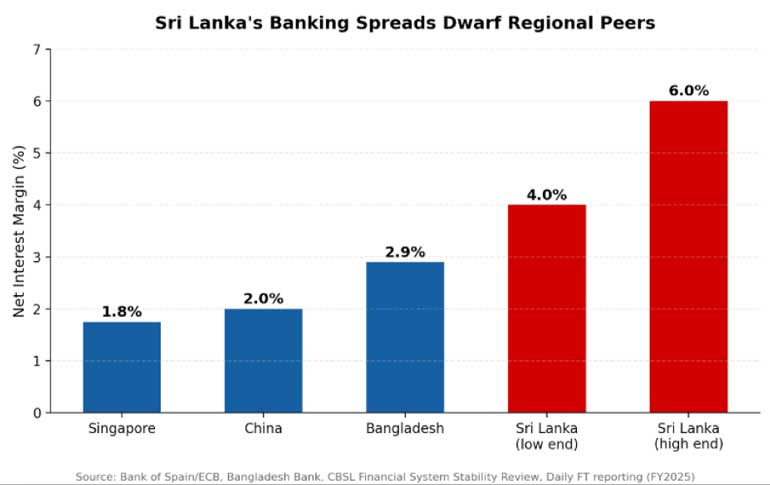
Closer to home, the contrast is instructive. Bangladesh Bank has capped lending rates on specific sectors to protect SMEs. Bangladesh’s banks run net interest margins of around 2.9%. Bank Negara Malaysia publishes credit allocation by sector, holding banks publicly accountable for where lending goes. Sri Lanka’s banks, without either kind of oversight, run NIMs of 4 to 6%, two to three times Singapore’s, while SME working capital is rationed and household gold-pawning portfolios swell past Rs. 1.3 trillion. Neither Dhaka’s caps nor Kuala Lumpur’s disclosure regime is radical. They are the ordinary toolkit of a developmental Central Bank the same toolkit Sri Lanka once had.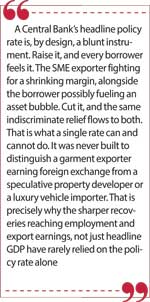
The synthesis
Across these cases, a pattern repeats. The headline policy rate manages the macroeconomic weather, inflation, currency stability, aggregate demand. Recovery that reaches employment and export earnings, not just headline GDP, has consistently required a second layer: targeted credit, development-bank rates moving independently of the policy rate, and tax incentives calibrated to the sectors with the greatest capacity to generate jobs and foreign exchange.
Sri Lanka once understood a version of this and never actually lost the legal authority to practise it again. Section 76 has sat largely unused through an IMF program rightly focused on stabilisation, exchange rate management, and fiscal consolidation. Those were urgent priorities, but they are not transformation. An economy that has stabilised its fiscal position while leaving its banking sector free to extract maximum interest from its most vulnerable borrowers elevated non-performing loans, the aftershocks of Parate execution, the compounding blow of Cyclone Ditwah on agriculture and SMEs has not recovered. It has merely stopped bleeding.
Parate execution illustrates the same blind spot in miniature. Banks justify their heavy reliance on Parate auction fairly: delinquent loans are depositor funds, and recovering them is a fiduciary duty. But a large share of these properties do not sell at auctions. Bidders stay away, valuations are disputed and the bank ends up taking ownership itself rather than recovering cash. At that point the depositor-protection justification quietly stops holding: an unsold property is depositor funds converted into an illiquid asset the bank must maintain, secure, and insure indefinitely, with no fixed date for turning it back into cash. Does the Central Bank track what banks spend each year holding these properties? If it does, the figure has never been made public. If it does not, that is a gap in exactly the oversight this article has been arguing for.
A single policy rate cannot simultaneously nurse a battered SME sector back to health and cool an overheating property market and vehicle import market. It was never designed to do both at once. Spain, Greece, Brazil, Korea, India, Bangladesh, and Malaysia show, each in their own idiom, that a Central Bank’s most powerful tool may not be the rate it sets, but the precision with which it decides who feels that rate first, and who is shielded from it a little longer.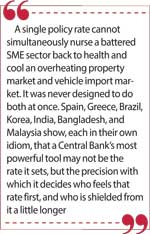
That precision requires a Central Bank willing to do three things it has largely stopped doing. First, be more engaged than surface policing. Capital adequacy confirms the system is solvent, not that it serves the economy, and Section 76 gives the CBSL power to ask where credit is actually going. Second, align itself to the national economic agenda, rather than reacting to inflation alone while staying silent on whether recovery-critical sectors can access affordable credit. Third, act as consumer protector, not spectator, against interest and non-interest income that has drifted past what any competitive market would sustain. Fee and commission income alone running at close to 29% of total bank income (2025) plausibly among the highest such ratios in the world. None of this requires new legislation, only a regulator that remembers protecting depositors and protecting the economy were never meant to be different jobs.
Recovery is rarely a single act of macroeconomic will. It is hundreds of smaller, deliberate decisions about which sectors get to breathe first and a Central Bank willing to make that call, and to police what happens to those it doesn’t, is one that understands recovery is not a number. It is a sequence of second chances, handed out with intention.
(The author holding DBA IBAS, MBA Sri J; FIB, is a former senior banker, educationist, transformation strategist, and certified coach with extensive experience in both public and private sector leadership. He has served on the boards of state and private institutions and was formerly Chief Operating Officer of a Public-Private Partnership unit, bringing a unique perspective on governance, institutional reform, and economic development in Sri Lanka)




