Friday Sep 18, 2026
Friday Sep 18, 2026
Friday, 18 September 2026 00:21 - - {{hitsCtrl.values.hits}}
 Saudi Arabia has ceased to export oil because of damage to its East-West Pipeline that will take more than a month to repair. The Bab el-Mandeb Strait is controlled by pro-Iranian Yemeni forces. Ships are under attack as they try to navigate the Strait of Hormuz. World (and especially Asian) oil supplies will continue to be constrained and prices will remain elevated, at least until the midterm elections in the US (first week of November).
The oil coming through the two straits is mostly destined for rapidly growing and energy-hungry Asia. That means that Asia is affected more by these developments than Europe or the US. Already diesel prices are at historical highs in the US. Crude oil from the Gulf is said to be optimal for producing diesel, so the effects are likely to be stronger for diesel and for Asia.
Diesel is important for several reasons. Most industrial and agricultural products are transported using diesel. When other cheaper energy sources such as hydro and coal fall short, diesel tends to be used for generating electricity. Diesel price increases will ripple through the entire economy. Problems with availability can cripple the functioning of society.
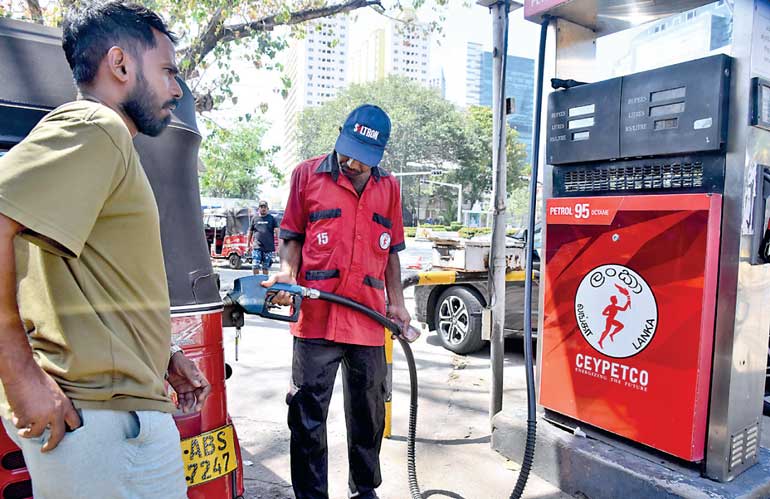
Private distributors in Sri Lanka are already feeling the pain. “No diesel” signs are up. They are saying they cannot sell at a loss of Rs. 170 per liter. State-owned Ceypetco has stated that it is planning to maintain supplies absorbing the losses. For people in the North and the East where Ceypetco stations are scarce, it’s beginning to feel like 2022.
Cost-recovery pricing
The IMF Staff Report of the fifth and sixth reviews (13 May 2026) stated: “Fuel. Cost-recovery pricing (continuous Structural Benchmark 1) has not been met since April as increases only partially reflected the higher costs following the Middle East conflict. Authorities will compensate CPC for past losses through an explicit on-budget transfer and published a cabinet decision ensuring fuel subsidies are on budget, limited, and fully phased out by end-September 2026 (prior action and proposed Structural Benchmark 22, end-September).”
Constrained supply from private distributors is evidence that retail prices are not enough to recover costs. If the Government does not ask for a further waiver, this means that subsidies must end by the end of September. However, Ceypetco may be planning to cross-subsidise the diesel losses from higher prices on petrol. Does this make sense in the face of rapidly increasing prices and the dangers of restricted supply?
It is evident that there is massive bypass of the QR-based rationing scheme. Higher prices rather than rationing explain the minimal demand contraction that has occurred (10% for diesel and 9% for petrol, according to the Cabinet Spokesperson). Unless the Government is serious about demand destruction through higher prices and/or better enforcement of rationing, the fuel import bill for 2026 is likely to be crippling. A total of $2,703.7 million was spent in the first five months of this year (62% higher), compared to $1,664.2 million in the same period in 2025. President Trump has reason to get world prices down before the November elections, but it is doubtful that he can. 
The IMF Staff Report (13 May 2026) stated: “Electricity. Cost-recovery pricing (continuous Structural Benchmark 2) has not been met since January as the tariff was not revisited despite higher costs. The 10.9% average increase for Q2 approved on March 31 does not fully incorporate higher fuel prices and the expected change in the composition of energy generation. To restore cost recovery, a new tariff revision reflecting these factors will be issued by the regulator (prior action).”
Low-quality coal has resulted in less electricity being generated from Norochchalai. Meeting the shortfall from increasingly expensive diesel will increase electricity costs. Cost-recovery pricing for diesel will result in consumers having to pay more for electricity as well.
Problems with pricing formulae
From being ridiculed when Mangala Samaraweera introduced it, formula-based pricing is now seen as a cure-all. The private fuel distributors want one for diesel. Even three-wheeler drivers want a formula.
Formula-based prices imposed by Government are alien to competitive markets. Competition in these kinds of commodity markets is supposed to drive down prices by creating incentives to secure lowest-cost inputs and efficiency. But fuel and electricity markets are far from competitive. Here, the incentive is to gouge the consumer who has no alternative. If the gouging can be done with Government blessing even better.
It is one thing to use cost-based formulae in regulated industries, where the regulator ostensibly has the capacity to assess the reasonableness of costs. But the root cause of problems in both electricity and fuel markets in Sri Lanka is the use of a cost-plus formula in the unregulated fuel market. Here, there are no incentives for the purchasers of oil to negotiate for the lowest prices because whatever costs are incurred, they will be automatically transmitted to the consumer of fuel for transport and through electricity bills. There is no one, other than the media, to question whether the prices paid for oil imports were reasonable.
The accepted solution is to base the formula on a benchmark price, such as Brent or Singapore Platts. If a purchaser negotiates a price that deviates on the high side, the formula will punish them by preventing the passing on of the extra costs to consumers. If the deviation is on the low side, the company can keep the difference. Incentives are created for low-cost inputs.
This solution is effective for private firms, but not necessarily for state-owned firms such as Ceypetco. In a state-owned firm, the effects of the incentives are muted. The state as the owner, fearful of public unrest, may compel the firm to buy scarce fuel even as excessive cost (as is reported to have happened in April when Sri Lanka bought at $286 a barrel, according to the Chief Executive of HSBC). The Government is both the price setter and the owner who would have to absorb the loss. Management in SOEs are unlikely to work as hard as those in private firms to get lower-priced inputs and earn higher profits. The customer will pay one way or another because there is no private owner to take the loss.