Friday Oct 02, 2026
Friday Oct 02, 2026
Monday, 22 June 2026 00:20 - - {{hitsCtrl.values.hits}}
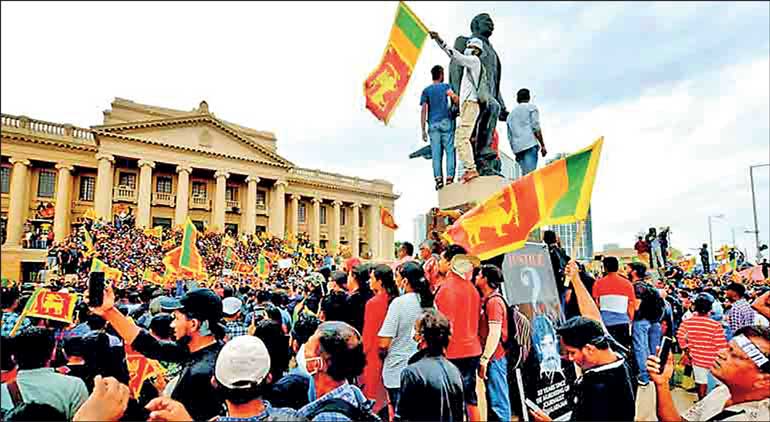
The 2022 Aragalaya was the angry expression of an awakened generation of young voters who demanded an end
to this political culture
 The post-World War II economic and monetary order, structured on the edifice of Keynesianism but driven by conspicuous consumption led by Veblen’s leisure class and Marcuse’s one-dimensional man, has produced the world’s first trillionaire while an estimated 847 million people, or 8% of the world’s population, are left to live in abject poverty.
In this contrasting scenario, is the world going to celebrate and glorify the success of one man for his trillion-dollar AI investment, or rebel against this order and demand an alternative system that would be more egalitarian, humane and ethical? This debate is an old one and has remained largely academic, but it is now being articulated with vigour by a new generation of young activists.
In the meantime, there is a more immediate problem facing economies that are left to grapple with recent developments in the Global North. If there were to be any distinct contribution to the world economy this year and probably next, particularly from Donald Trump’s trade and economic policies, it would be an unavoidable slowdown leading to recession. However, the IMF’s World Economic Outlook has projected a growth rate of just 3.3% for this year, falling to 3.2% in 2027.
While keeping in mind Kenneth Galbraith’s sarcasm about economic predictions when he wrote that they make astrology respectable, Trump’s mercantilist tariffs, regressive taxes and imperialist adventures, which benefited the wealthiest 1%, large corporations and the financial and fossil fuel sectors at the expense of the working poor, have created fertile ground for economic pessimism. That pessimism prevails throughout the Global North, and its fallout will be felt in many parts of the Global South.
Sri Lanka will be among several developing economies in Asia, Africa and Latin America that would face an economic setback largely because of developments outside its control. 
The two wars, one in Europe and the other in the Middle East, show no sign of ending soon, although in the case of the latter, a 14-point memorandum of understanding has been signed between Iran and the US, to the disappointment of Israel, and it is expected to be ratified within 60 days.
If ratified, this deal would at least reduce the energy-related component of the supply constraint that is one of the factors contributing to this recession. But what of the share borne by the climate crisis and the El Niño effect, a phenomenon marked by periodic warming of oceanic surface temperatures, which is causing prolonged droughts, floods, earthquakes and wildfires with catastrophic consequences for developing economies?
The inflationary effect of this war-driven and supply-side recession is beyond the control of central banks using their conventional monetary tools. Raising interest rates to counter inflation would reduce investment, which, in combination with AI-backed automated technological transformation, would cut employment and cause stagflation.
For countries like Sri Lanka, which are burdened with heavy foreign debt, servicing that debt and maintaining fiscal balance would become more expensive and difficult. Even if the wars were to end, the climate crisis is bound to create unexpected supply shocks, as Cyclone Ditwah did in Sri Lanka in 2025.
Unless the country restructures its economy by allocating sufficient resources to domestic production and introducing reforms to achieve greater efficiency in utilising those resources, the system changes that the new leadership promised voters cannot materialise, at least in the economic arena. This is the challenge facing the Government today.
System change: A change at the top
The ruling coalition inherited an economy that had been financially bankrupted by decades of economic and financial mismanagement under successive governments and presidents. The 2022 Aragalaya was the angry expression of an awakened generation of young voters who demanded an end to this political culture. 
Those protesters not only forced then-President Gotabaya Rajapaksa to resign and flee the country but also voiced their loss of confidence in the entire 225-member legislature.
The immediate consequence of their revolt was not a system change but a change at the top, with stop-gap President Ranil Wickremesinghe, who was then the only elected representative of the UNP in Parliament. His first task was to bring the Aragalaya to an end through police action. However, the most sensible step he took to reduce the country’s economic pain was to invite the IMF, for the 17th time, to undertake the task of economic recovery.
The IMF began its program with $ 3 billion in funding under its Extended Fund Facility arrangement, to be released over nine tranches depending on how well the Government cooperated with the institution in implementing its agenda.
President Anura Kumara Dissanayake and the NPP Government also decided, on pragmatic grounds, to continue with the IMF program although their ideological orientation had dictated otherwise.
Eighteen months have passed since the new leadership took control of the situation. Economically, the country has stabilised and is moving along a tolerable growth path. World Bank data show that Sri Lanka registered a growth rate of 5% in 2025, driven by increased consumption, higher exports, fiscal discipline, increased foreign remittances and difficult reforms.
However, largely due to factors beyond the Government’s control, the IMF expects that growth rate to dip to 3.1% in 2026.
The troubling aspect of this growth, however, is the unequal burden carried by middle- and low-income groups.
With the expected recession, this burden is likely to worsen unless the Government enters into serious dialogue with the IMF to ease the constraints that have contributed to this disparity, such as the program’s theoretical bias towards broadening the tax structure. It is time for the more affluent classes to bear a greater share of the burden required to fund higher growth.
Ending corruption
One area in which the new Government has registered remarkable success is in its battle against corruption, which had become a cancer that not only bankrupted the economy but also made Sri Lanka fertile ground for the growth of the underworld.
Political corruption entered the public administration, made the security forces subservient to the will of presidents, prime ministers, ministers and parliamentarians, invaded the judiciary and undermined its independence, and ultimately turned the country’s democracy into a mockery.
To the credit of President Dissanayake and the NPP Government, records of past corruption are now being brought to light through judicial investigations, and the revelations are shocking. The election promise of clean governance is progressively being translated into action, and according to Transparency International’s Corruption Perceptions Index, where 0 represents the most corrupt and 100 the cleanest, Sri Lanka improved from 32 in 2024 to 35 in 2025.
However, there are blemishes, marked by delays in taking corrective action against allegations of misconduct involving members within the governing group. The controversial release of 323 containers without mandatory inspection and the losses incurred through the import of low-quality coal by a minister are examples of such blemishes.
Another pre-election promise was to achieve ethnic reconciliation, but the record so far has been disappointing. No effort to reconcile politically nurtured inter-ethnic animosity can succeed without a constitution founded on the principles of secular democracy. It is time for the new leadership to take constructive action on this fundamental issue. Unfulfilled promises are the real setbacks for a Government elected with a record mandate.
The Opposition is trying to capitalise on these shortcomings without presenting an alternative and constructive agenda. Former President Ranil Wickremesinghe, who is facing corruption-related legal challenges, is predicting a total collapse of the economy and attempting to lead a campaign against President Dissanayake and the NPP. His campaign is not really against the new leadership but against the Aragalaya generation. He belongs to an old political order that has lost credibility among these awakened Sri Lankans.
There is no turning back from the new era despite its setbacks, and the caravan will continue moving whether the dogs bark or not. Time remains on its side.



