Saturday Oct 03, 2026
Saturday Oct 03, 2026
Wednesday, 20 May 2026 05:02 - - {{hitsCtrl.values.hits}}
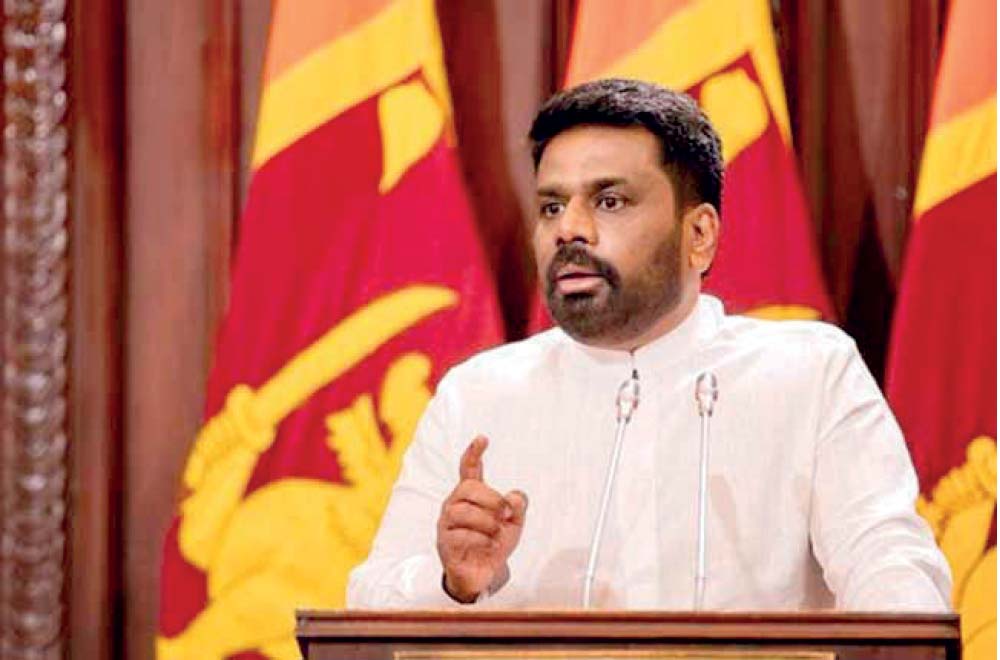
President Anura Kumara Dissanayake
The new anti-money laundering, countering financing of terrorism and (even) inland revenue and microfinance laws have provisions that increase authoritarian power
 Recent legal developments show that Sri Lanka is continuing to strengthen powers for authoritarian rule rather than curb these. This year, in March alone, the Government moved on five laws that expanded executive power - the Microfinance and Credit Regulatory Authority Act, the Inland Revenue Amendment Bill, Suppression of Terrorist Financing Amendment Bill, Financial Transactions Reporting Amendment Bill and a Money Laundering Amendment Bill. Whilst their titles suggest that they aim to protect us, these laws contained provisions for increased executive power over ordinary transactions of citizens, removal of judicial oversight over executive actions, increased powers of citizen surveillance, increased regulatory and overburdensome administrative obligations and increased criminal offences and administrative penalties. Provisions of this nature are oppressive and bolster authoritarian rule. Such power must be subjected to scrutiny by the citizens of this country, and by the judiciary, which is the only check on Parliament on behalf of the people.
I have been part of work that has been broadly tracking legal developments since the debt crisis in 2022. During the aragalaya or mass people’s protest, we saw all manner of laws mobilised against protesters - the last count was 89 sections in nine different laws (the Penal Code, Police Ordinance, Offences against Public Property Act, Antiquities Ordinance, Public Security Ordinance, Judicature Act, Prevention of Terrorism Act and the Computer Crime Act) - by the then Government against people who came on to the streets. This serves as a reminder of the ability of the ruling executive to mobilise the full force of the law against people legitimately protesting the Government. Four years on, some of these cases are still awaiting a conclusion, thereby continuing to oppress and punish public protestors. Once the party in Government managed to stay in power towards the end of 2022, we also saw several problematic laws impacting rights and liberties of citizens proposed and some passed into law. These included the proposed Bureau of Rehabilitation Bill (2022), the two Anti-Terrorism Bills (2023), the Contempt of Court, Tribunal or Institution Act (2024), the Sri Lanka Telecommunications (Amendment) Bill (2024), the Online Safety Act (2024), the Economic Transformation Act (2024) and most recently the Protection of the State from Terrorism draft law (December 2025). All these laws proposed or effected expansions of executive power over citizens. By contrast, they did not expand protections and rights, failed to establish criteria for the use of expanded powers, checks on the use of new powers, and better access to redress when new powers violate citizens’ rights.
NPP yet to deliver on promise to abolish all oppressive Acts
With the introduction of the executive presidency in the 1978 constitution, Sri Lanka has had an overly powerful executive. Executive power has grown tremendously and has been increasingly tolerated over the subsequent decades – largely due to colonial power structures and a prolonged war. The corresponding growth of checks on executive power has been much slower and steeped in contestation – such as the introduction of the constitutional council and expanding fundamental rights jurisdiction over presidential acts. Narratives of national security, economic security, measures against corruption or criminality have shielded from scrutiny the growth of executive power. Promising a change from the status quo, the NPP’s 2024 election manifesto made several promises to remove bad laws and bring in pro-people laws. Some were much awaited legal reforms that included laws to protect against gender-based violence and harassment in workplaces, public transport, and other places, repealing discriminatory penal code provisions, broadening the constitutional law about the rights of children, women, and people with disabilities. On civil liberties specifically, the current Government was voted in with a mandate to abolish ‘all oppressive acts including the Prevention of Terrorism Act (PTA) and ensuring civil rights of people in all parts of the country’ (pg. 129 of A Thriving Nation, A Beautiful Life, the NPP election manifesto of 2024), to regularise ‘civil administration in a way that the civil rights of the people in all parts of the country including the North and East are guaranteed’ (pg. 129) and to establish ‘A Commission Against Discrimination’ (pg. 128). It is therefore doubly alarming that whilst the Government is visibly slow on legal reforms promised, it is actually rushing through potentially authoritarian legislation.
Two key structural issues, which this Government has still failed to address, are (1) the lack of routine public consultations prior to any legislation made public by gazette and (2) the failure to set evidence-based Government policy that frames any new law being proposed. What appears to be happening today is that laws proposed by previous Governments are being tinkered with and passed in parliament without serious policy evaluations. The new microfinance law is an example of a Bill proposed by the previous Government being tweaked but failing to be reviewed for fundamental policy direction and the impact it would have on communities, and women in particular, before it was passed.
Recent legislative developments, in this year alone, show us that the trend of oppressive law making has not stopped. Failure by the NPP Government to recognise, impede and reverse the growth of authoritarian power betrays an inability to address the capture of power by vested interests. These elites have long worked against the interest of the people, from whom sovereignty - power for the state - emanates. The interests of the people are found in the concerns over the growing household indebtedness, increasing dispossession from land, increasing pressures of poverty, increasing food insecurity, already low wages losing value, commodification of basic essentials, continued and growing exclusion from public health and education and fighting within a justice system that exhausts the poor. ‘Stability’ for powerful political and economic elites does not account for these concerns. It protects the influence and wealth of the few, and damns the masses trying to make a living. It sidesteps questions of inequality and extraction and is comfortable compromising dignity, freedom and rights. Oppressive laws are a tool in achieving this.
Financial Laws - the new frontier for expanding executive power
The new anti-money laundering, countering financing of terrorism and (even) inland revenue and microfinance laws have provisions that increase authoritarian power. The Microfinance Act introduces an overburdensome regulatory framework, administrative penalties, new offences which criminalise non-compliance with administrative directions and grants broad powers to an Authority over even the most informal and basic of community credit practices. The Inland Revenue Amendment Bill also introduced offences, and among other things the Supreme Court found Clause 31(4) to be inconsistent with the Constitution as it permitted a taxpayer to be sentenced to imprisonment even while they had a request for administrative review or appeal to the Tax Appeals Commission pending. The Convention on the Suppression of Terrorist Financing (Amendment) Bill No. 59 of 2026 introduces new offences, while simultaneously expanding police powers of surveillance which allows for the use of ‘any investigation technique’ without requiring judicial permission to be first obtained (Clause 12). The Prevention of Money Laundering (Amendment) Bill No. 60 of 2026 inserts an identical section which also expands police power of surveillance without judicial oversight (Clause 18) and permits statements to the police to be used as evidence. This provision relating to statements to the police is eerily familiar to the confessions provision in the Prevention of Terrorism Act which saw coercion and torture used on persons arrested to obtain ‘confessions’ which would thereafter be used against the person in the trial. The Financial Transactions Reporting (Amendment) Bill No. 58 of 2026 - introduces new offences including the offence of financing proliferation of weapons of mass destruction and connects the offence to overburdensome and blanket administrative or compliance obligations. The head of the FIU is given power to suspend a transaction or an account based solely on a suspicious transaction report and may also impose administrative sanctions. These types of powers are ordinarily the domain of a judge. The Bill also provides for the imposition of administrative penalties as high as Rs. 100 million zwithout judicial process.
 Recent legislative developments, in this year alone, show us that the trend of oppressive law making has not stopped. Failure by the NPP Government to recognise, impede and reverse the growth of authoritarian power betrays an inability to address the capture of power by vested interests
Authoritarian emergency powers are creeping into ordinary law
Vague definitions of offences, broad powers, dismantled judicial power are all the aspects of authoritarian power that this country has experienced. The implementation of the Prevention of Terrorism Act (PTA), the International Convention on Civil and Political Rights Act (ICCPR) are the most striking examples of this. The misuse of these laws saw individuals suffer, communities marginalised, and fear and uncertainty sown into state relations with minoritised populations and political opponents of the day. We, as a country, have done very little to roll back these bad laws and build systems that protect citizens, all citizens. Instead, we are introducing more laws with broad police powers, power to control citizen conduct through directions and regulations, and power to impose penalties without the judiciary.
The ordinary law, especially ordinary criminal law, is often weaponised by the ruling class. One way is by normalising laws with extraordinary powers. The PTA and the Public Security Ordinance (under which the armed forces are called out every month and declarations of a state of emergency accompanied by the broadest of emergency powers) have been routinely deployed at taking control over citizen management - be it protests or natural disasters. Citizens’ tolerance of harsh laws and readiness to give up one’s rights is manufactured when news cycles are flooded with drug busts, suspected terror activities, and even the narrative of an administration and political culture steeped in corruption. For all these reasons, we are told we need strong, often vague and broad, state powers to counter the social malaise. We are also increasingly told that blanket monitoring of all citizen activity is necessary to arrest and prevent these crimes. This narrative is prominent in the justification of laws - for example to control all forms of non-Governmental organisations or activity and supervise all financial transactions. It even manifests in controlling executive conduct such as the attempt to declare ‘police curfews’ during the COVID-19 pandemic and the more recent police announcement that citizens should report information to the police every time they rent out a premises. Reasonable suspicion prior to police intervention is being whittled away - we are made to feel cautious of anyone we do not know. Governmentality - citizens themselves being employed in the assertion of Government power - has set in.
Lawmaking for real human security
Without immediate steps to review and evaluate policies influencing new laws and the impact of law making on state-citizen relations, the consequences on the real lives of people are very likely to lead to suffering, discontent and social upheaval. There are other law-making priorities that directly improve human security - some of which are priorities that this Government has promised to deliver on. Reform to family laws, strengthening laws addressing domestic violence, sexual and other violence in the workplace, repealing criminal laws that marginalise women and identity, accessible consumer protection against exploitation of low-income households by credit facilities, laws protecting decent wages and occupational safety, and laws to advance social protection are amongst these promises. There is a visible absence of action on these priorities in law-making today. We may see some of these priorities lightly touched through social programs such as Aswesuma, policy negotiations such as in daily wage agreements, or even the promise of future law making as the long public consultative processes on family laws. However, such initiatives do not have the enduring commitment of a law passed. Without this, programmatic and policy changes are easily reversible. With increasing problematic laws and little progress on laws that will make meaningful changes to people’s lives, a real opportunity to build public trust and deliver on a progressive manifesto is slipping away for the NPP Government. For citizens, a failure to be vigilant and oppose these laws means we are implicitly consenting to the building of a legal system that further undermines democracy and erodes our sovereignty.
(The author is an Attorney at Law with an LLM from SOAS (London) in Law, Governance and Development. This piece draws on her experience with law reform work, the study of legal developments in collaboration with the Law and Society Trust and her affiliation with the Feminist Collective on Economic Justice, Sri Lanka. Please direct any response or clarification to [email protected])



