Thursday Oct 22, 2026
Thursday Oct 22, 2026
Monday, 19 January 2026 03:17 - - {{hitsCtrl.values.hits}}
 Sri Lanka has long struggled with an unacceptably high rate of road traffic accidents, with little evidence of sustained improvement, despite repeated and highly publicised claims by the authorities that exceptional efforts are being made to address this issue
 The Sri Lankan Traffic Police are now believed to possess more advanced speed cameras. This is a positive development, undertaken at significant public expense. As ordinary citizens, we have both the right and the responsibility to express our views on how such systems can be implemented more effectively. If properly designed and enforced, speed cameras can help reduce road traffic accidents and ultimately save lives, public funds, and property by minimising avoidable losses on our roads. This is especially important at a time when the country is striving to reduce its debt burden, at least for the benefit of future generations.
This brief opinion is offered for the consideration of policymakers, policy implementers, road users, and the general public.
Excessive or inappropriate speed is a well-recognised contributor to road traffic accidents, resulting in serious injuries, fatalities, and extensive property damage. Sri Lanka has long struggled with an unacceptably high rate of road traffic accidents, with little evidence of sustained improvement, despite repeated and highly publicised claims by the authorities that exceptional efforts are being made to address this issue.
Effective solutions in any field require reliable data, credible analysis, identification of contributory factors, and the implementation of corrective measures that do not unnecessarily harass the public. While many issues deserve attention—most notably poor road discipline among all categories of road users—speed remains a critical and well-established risk factor worldwide. It is therefore reasonable to conclude that excessive speed is also a major contributor to Sri Lanka’s persistently high accident rates.
 Although speed cameras have been in use in Sri Lanka for over three decades, drivers have witnessed no meaningful transformation in the enforcement system. Manual roadside detection, selective and biased enforcement, unequal treatment of offenders, exemptions for politically influential individuals, and the absence of a reliable mechanism to identify repeat offenders have collectively undermined the effectiveness of speed control measures. As a result, despite the visible presence of traffic police on the roadside, there has been little demonstrable impact on accident reduction.
In countries where speed cameras have been shown to significantly reduce road traffic accidents, enforcement practices differ markedly from those commonly observed in Sri Lanka. Drivers are not stopped at the roadside to issue fines or to retain driving licences until payment is made. Instead, offences are processed centrally and independently of roadside officers, with penalties communicated to vehicle owners through official postal or electronic channels.
Locally, concerns have been raised that in some police divisions, formal or informal expectations regarding the number of fines issued per shift may exist. This creates the perception that traffic fines are treated primarily as a revenue-generating exercise rather than as a road-safety intervention. In certain instances, roadside enforcement has also created opportunities for unofficial concessions and personal gain.
Historically, weaknesses in traffic law enforcement in Sri Lanka have not stemmed from a lack of technology, but from biased and inconsistent implementation. Individuals have often avoided legal consequences due to political influence, social status, or on-site corruption
It is essential that all stakeholders—including enforcement officers, drivers, and other road users—clearly understand that traffic fines exist to deter repeated dangerous behaviour and to promote safer roads. Road safety, not revenue generation, must remain the primary objective of enforcement.
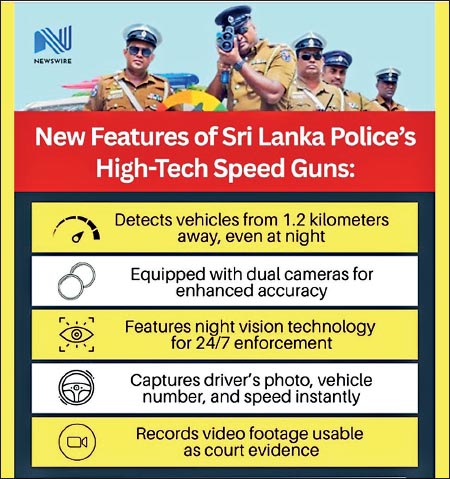
In recent years, Sri Lanka appears to have invested substantial public funds in importing handheld speed cameras for police divisions nationwide. These devices are capable of recording vehicle speed, registration numbers, location, and the date and time of offences. However, if this technology is deployed using the same flawed practices that have characterised speed enforcement for decades, it risks becoming an ineffective and wasteful use of public resources.
Historically, weaknesses in traffic law enforcement in Sri Lanka have not stemmed from a lack of technology, but from biased and inconsistent implementation. Individuals have often avoided legal consequences due to political influence, social status, or on-site corruption. Furthermore, speed cameras have frequently been deployed in locations with limited relevance to accident prevention, rather than in areas identified through accident data as high-risk zones.
I have personally observed speed enforcement operations conducted late at night—sometimes around 2.00 a.m.—on dark, sparsely populated roads where pedestrian presence and traffic risk are minimal. The deterrent or safety value of such enforcement is, at best, questionable.
Furthermore, as some speed cameras can detect vehicle speeds from up to 1.2 kilometres away, it is essential to ensure that both the camera and the driver are within a road section governed by the same speed limit. It is not a secret that speed cameras positioned in 50 km/h zones are sometimes used to detect vehicles while they are still approaching the reduced speed limit from a higher-speed zone.
In such situations, drivers may already have slowed from, for example, 70 km/h to 50 km/h in accordance with road signage yet remain unaware of why they were stopped or charged. These practices create confusion and undermine public confidence in enforcement. Addressing such inconsistencies would improve fairness and reduce avoidable disputes between the public and law enforcement officers.
Justice must also be ensured for all parties when technological solutions are employed. Speed cameras require regular calibration, and a valid calibration certificate must be available for any recorded evidence to be admissible in court. Accordingly, this information should be uploaded with each charge so that the accused can be assured that validated and reliable equipment was used.
In addition, vehicle speedometers are not always accurate or functional; in particular, some buses’ speedometers may not be working. To address this limitation fairly, enforcement decisions should incorporate a reasonable margin of error. A 10 per cent buffer zone should therefore be considered when enforcing speed limits.
In practical terms, on roads with a speed limit of 50 km/h, enforcement action should be initiated only when the recorded speed exceeds 55 km/h. This approach would provide a fair allowance for measurement variability and reduce unnecessary legal disputes regarding the validity of speed readings.
If newly introduced speed cameras are to achieve their intended purpose, a fundamental shift in enforcement philosophy is required:
1. The primary objective of using speed cameras must be accident reduction, not revenue generation.
2. Camera locations should be determined by an independent authority based on accident data and risk assessment, rather than by officers conducting enforcement.
3. Clear signage stating “Speed Cameras in Operation” should be displayed at least 500 metres in advance, as driver awareness—not concealed enforcement—is what prevents accidents.
4. All captured data should be transmitted to an independent review system, with fines issued through postal or electronic notification rather than roadside intervention.
5. Vehicles should not be stopped at enforcement sites, as roadside stops increase accident risk and create opportunities for corruption.
6. All images and data must be automatically uploaded to a secure, tamper-proof, cloud-based system. Any deletion or alteration should trigger a formal investigation, as such actions are often associated with corrupt practices.
Without these safeguards, even the most advanced technology will fail to improve road safety and will merely perpetuate the systemic failures of the past. Our objective must be to make roads safer—not to turn road enforcement into a revenue-generation exercise accompanied by public harassment.
(The author is Sri Lankan road user)




