Thursday Oct 15, 2026
Thursday Oct 15, 2026
Monday, 23 March 2026 02:11 - - {{hitsCtrl.values.hits}}
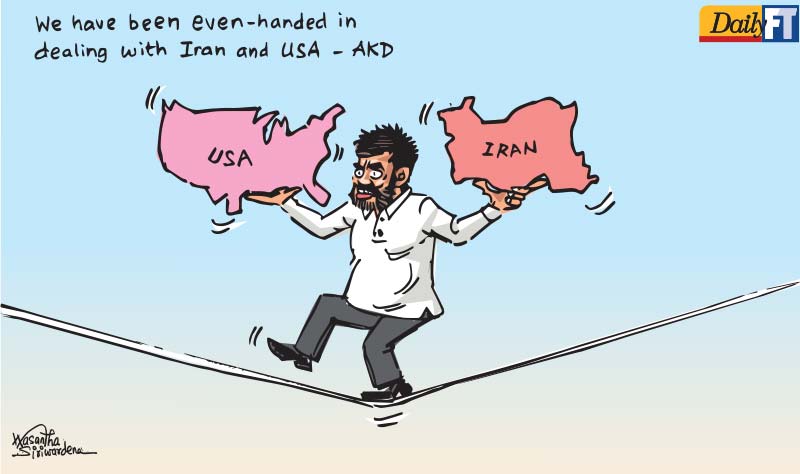
 What Sri Lanka calls non-alignment is, in practice, something closer to strategic ambiguity, a refusal to make choices dressed up as a principled refusal to take sides. In a post-Trump world, where great powers weaponise trade, technology and supply chains as instruments of coercion, the President’s posture leaves us exposed
 On 17 March, during an address to the nation followed by a Q&A session, ITN journalist Sandari Ratnasuriya asked President Anura Kumara Dissanayake a question: Given that world powers are locked in a power struggle, how can Sri Lanka carry forward its non-aligned policy? The President, speaking in his signature Sinhala cadence, responded by insisting that neutrality remains Sri Lanka’s defining posture, that the country had demonstrated this through its handling of the Iranian ship incident and at recent international conventions. He argued it was unsuitable for a country to “play around here and there for the benefit of each respective moment,” and declared non-alignment the “winning path.” Though his conviction was clear, strategic substance was less evident. A study of Canadian PM Carney’s Davos speech, alongside broader shifts in how many countries now frame foreign policy, places in sharp relief how outdated the President’s worldview is - rooted in post-Cold War vocabulary that no longer maps onto the world as it is, and will increasingly be.
Tripolarity
Non-alignment presumed a bipolar order. Two superpowers, two spheres of influence, and, for Sri Lanka, a refusal in principle, though not always exercised through policy, to orbit either one. That architecture no longer even remotely exists. What has replaced it is not a new bipolarity between Washington and Beijing, or even a tripolarity including Moscow to the mix, but something messier, and in constant mutation - a polycentric system in which power disperses across multiple centres, coalitions form and dissolve around specific issues, and no single axis defines the choices available to smaller states. Non-alignment’s foundational logic, the refusal to choose between two blocs, answers a question nobody is asking anymore, because the operational logic, and blocs are gone. What remains are overlapping networks of competition, and cooperation that demand not some outdated notion of equidistance but active, calibrated engagement.
What Sri Lanka calls non-alignment is, in practice, something closer to strategic ambiguity, a refusal to make choices dressed up as a principled refusal to take sides. In a post-Trump world, where great powers weaponise trade, technology and supply chains as instruments of coercion, the President’s posture leaves us exposed. PM Carney, at Davos in January, was quite blunt about all this. “We are in the midst of a rupture, not a transition,” he said. “The old order is not coming back. Nostalgia is not a strategy.” His argument, that middle powers must build “different coalitions for different issues based on common values and interests” - what he calls variable geometry – is important for us to study. Canada has signed many trade and security deals, striking partnerships with the EU, China, India, and Qatar simultaneously, calibrating each relationship to reflect shared values, strategic aims, and mutual interests.
Non-alignment
This is not naive multilateralism. Nor is it the Cold War non-alignment Sri Lanka invokes like an incantation against complexity. Variable geometry is a systemic strategy, an attempt to rewire international cooperation through overlapping, issue-specific coalitions that substitute for weakened global institutions. Non-alignment, by contrast, is positional: it tells you where a country stands but says nothing about what it builds. The distance between the two lies in agency and ambition.
PM Carney’s framework carries its own blind spots. As the New York Times reported recently, his deal-making has drawn criticism for sidelining human rights, cordial meetings with President Xi Jinping, PM Modi, and the Emir of Qatar without pressing the democratic values Canada claims to champion. At its worst, a variable geometry sorts partners by strategic convenience whilst staying silent on repression risks reproducing the very subordination it claims to escape. Sri Lanka, defined by a legacy of egregious human rights abuses over decades, enforced disappearances, allegations of war crimes, colossal corruption without any meaningful accountability, and an incumbent Government that rejected the latest UNHRC draft resolution demands rigorous scrutiny before consideration as a trusted partner.
The question is not whether PM Carney’s model, or any other, is perfect. It is whether Sri Lanka has anything remotely comparable. We do not. The significant controversy surrounding the Rebuilding Sri Lanka fund after Cyclone Ditwah exposed what many already suspected: a damning absence of capacity, coordination, coherent communication, and meaningful post-disaster planning. A Government that cannot marshal a systematic response to a major cyclone has no business invoking neutrality as grand strategy because what a country does in a crisis, not what it proclaims at press conferences, is the only honest measure of its strategic posture.
Strategic autonomy
To wit, Nirupama Rao, India’s former foreign secretary, tweeted recently that “strategic autonomy only has meaning if it shapes how a country actually acts during crises.” Her concluding provocation, that “strategic autonomy is not neutrality and it is not detachment. It has to be a practised and well-honed strategy”, is particularly relevant to, and resonant in Sri Lanka. We sit astride some of the most consequential sea lanes on the planet, a fact underscored (and how!) by recent, consequential, and tragic maritime events. Around 70% of Colombo Port’s transhipment business is linked to India. Hambantota Port operates under a 99-year Chinese lease, and to the Chinese built Mattala Airport. The Colombo Port City is a distinct economic zone with its own regulatory framework. Expanding the country’s contiguous territory into the Indian Ocean, it is a lasting, physical manifestation of how deeply external investment shapes Sri Lanka’s sovereign space. India has also heavily invested in energy infrastructure, port terminals, and connectivity, in addition to the unprecedented post-Ditwah aid programmes, as well as massive outlays on digitalisation in particular. Amongst others, these are (quite literally) concrete, and structural realities that demand dynamic, active management, and not the lethargic, outdated stance non-alignment prescribes. Practising strategic autonomy in this geography, with these dependencies, designs, and debts demands a foreign policy formulation far more analytically rigorous than regurgitating neutrality and non-alignment at press conferences.
Multi-alignment
What alternatives exist? Multi-alignment , the strategy India increasingly prefers, maintains simultaneous relationships with multiple major powers, aligning selectively across issue areas. It drops the pretence of equidistance from two non-existent power centres in the contemporary world and replaces it with calculated engagement calibrated to specific interests. Adaptive balancing, using institutional, economic, and diplomatic means to prevent domination by any single external power, complements this. Neither requires abandoning sovereignty. Both require the institutional capacity to exercise it, which we do not have.
Digital sovereignty is where this exposure becomes most acute. Sri Lanka’s Digital Roadmap 2025–2035 envisions a national digital identity system, a UPI-style payment platform, and a national data exchange. Each carries sovereignty implications neutrality cannot address: payment system dependence on hyperscalers, data storage jurisdiction, the risk that digital infrastructure becomes a vector for subordination rather than autonomy. PM Carney warned that great powers now weaponise the very integration smaller states depend on, including in digital domains. Sri Lanka may be walking into precisely this trap, building digital public infrastructure without the governance frameworks or regulatory capacity to prevent it becoming another lever of external control. Danny Quah and Irene Ng, writing recently in the Straits Times, warned that “sticking to old strategic postures” is “dangerous in turbulent times.” Quoted in the article, the former Deputy Prime Minister of Singapore S. Rajaratnam observed that a great power is like a crocodile, and “one is never quite sure whether it is smiling or baring its teeth.” Sri Lanka can’t stand at the water’s edge insisting the crocodile is irrelevant because we have proclaimed ourselves neutral or non-aligned.
What would a serious Sri Lankan foreign policy look like?
Gap between ambition and apparatus
It would start with an honest audit of institutional capacity, the gap between ambition and apparatus, between the partnerships the world demands and Colombo’s ability to identify, invite and sustain them. It would recognise that AI governance, digital infrastructure, climate resilience, and maritime security are no longer separate domains, but now inextricably entwined, and upon which sovereignty is won or lost. Going beyond notions of neutrality, this is the hard, constant, painstaking work of strategic positioning. The risk of inaction is clear. Countries that cling to purely performative sovereignty are likely to become peripheral, acted upon, priced in, and parcelled out between larger powers with zero interest in their preferences. The opportunity, slender but very real, is that Sri Lanka’s geography, relative sociopolitical stability, and relationships with every major Indian Ocean actor give it a potential, and platform exceeding its size. Converting that into influence requires seriousness Colombo has yet to design, and demonstrate.
The President’s answer to Ratnasuriya’s question suggests we have not yet grasped how much the world, and especially our place in it, has changed - potentially advantageously. What keeps him from this realisation may be an ideological inheritance that treats non-alignment as immutable identity rather than instrument, and a worldview forged in a bipolar era that mistakes the vocabulary of sovereignty for its practice. PM Carney’s variable geometry formulation was not designed for us, and assumes an institutional depth and coalition-building capacity we do not possess. But its core logic, that in a polycentric world, sovereignty is built through purposeful engagement rather than performed through principled distance, is important for us to consider. We must make it our own: investing in the foreign ministry’s analytical capacity, developing issue-specific expertise in maritime governance, digital trade, and climate diplomacy, building the cross-ministerial coordination that coalition participation demands, and cultivating partnerships calibrated not to sentiment but to Sri Lanka’s actual strategic interests. Any nostalgia, to invoke PM Carney, over non-alignment’s heyday is folly. The President must focus on the strategic, hard, unglamorous, and necessary work of building institutions able to navigate the world – invoking the memoir of former White House staffer and writer Ben Rhodes - as it actually is.
That would actually be a winning path.
(The author has a PhD in Social Media and Politics from the University of Otago and is Sri Lanka›s first TED Fellow. He counts over 20 years’ experience in peace building, civic media, and digital security. He is also the founder, and former editor of Groundviews, Sri Lanka›s first, and award-winning citizen journalism website)




