Thursday Oct 22, 2026
Thursday Oct 22, 2026
Wednesday, 24 December 2025 00:15 - - {{hitsCtrl.values.hits}}

 Reforms should increase the autonomy of bureaucrats while enhancing their capacity. This characteristic of reforms can be seen in most developed public services in the contemporary world. This is because “governance innovations” and “entrepreneurial governance” are essential to enhance a country’s public service delivery
 The popular belief about bureaucratic autonomy
Sri Lanka desperately needs a high-quality public sector to attain its development targets. The need to enhance the Government’s quality often appears as an objective of almost every Government. However, this desire is more visible in the activities of the present Government of Sri Lanka. You may have already seen and heard this objective multiple times in policy documents and during speeches of key personnel. In principle, there is nothing wrong with this objective. Indeed, it is essential in the country’s present context. However, what matters more is assessing the actions taken toward this aim, because having a noble objective alone does not guarantee its achievement. Therefore, it is crucial to evaluate the path we are taking toward this goal.
One such action is seen in how the Government influences bureaucrats’ autonomy. This was discussed in detail in a previous article in this series [1]. Bureaucratic autonomy refers to the freedom granted to public servants to act in their official capacity. This is also known as the discretionary power of Government officials. The popular belief regarding bureaucratic autonomy is that higher autonomy will lead to corrupt officials and thereby reduce the quality of the Government. Believers of this argument often tend to use rules and regulations to limit the autonomy of bureaucrats. This was also referred to as strengthening “rule by law” in our previous article. We can see evidence of many reforms in this direction in the actions of the present Government, such as the amendment to the National Audit Act.
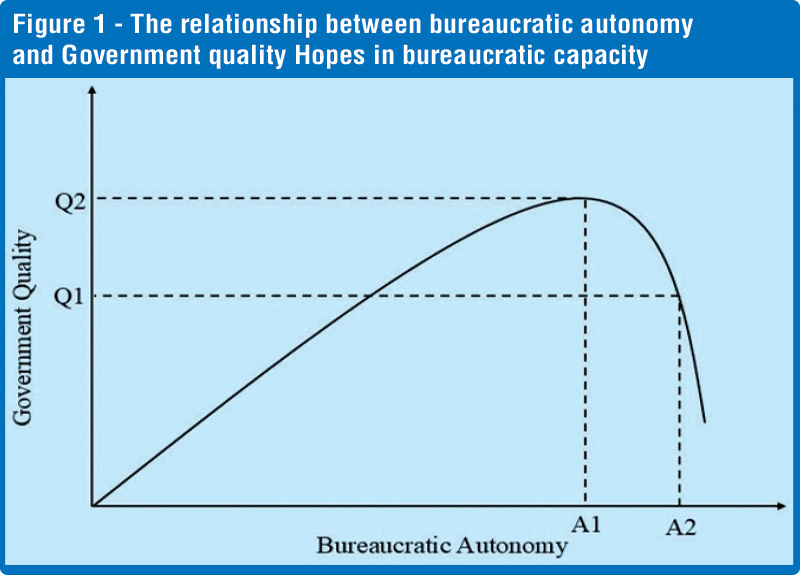
However, according to governance scholars, reducing the autonomy of bureaucrats does not always enhance the quality of Government. The relationship between bureaucratic autonomy and the quality of Government is assumed to be as illustrated in Figure 1. For instance, reducing autonomy from the A2 level to the A1 level will result in an enhancement of Government quality from the Q1 to Q2 level. However, any further reduction of autonomy below the A1 level will continuously reduce Government quality. Therefore, navigating bureaucratic autonomy should be understood as a complex task and must be handled carefully within the public sector reform agenda.
Hopes in bureaucratic capacity
In its effort to improve Government quality, the present administration has also paid attention to enhancing the capacity of the bureaucrats. This commitment is evident in several policy reforms. First, several initiatives showcase the strong emphasis on the digitalisation of public services. This priority is clearly reflected in the 2026 Budget [2]. Digitalisation has the potential to significantly enhance public sector efficiency by improving access to Government services such as payments, documentation, approvals, and information sharing through initiatives such as GovPay and online access to citizen documents.
Second, the Government has also focused on enhancing bureaucratic capacity by developing a more professional public service [3]. Professionalising the public service through merit-based systems, training, and ethical norms is central to building a capable and accountable bureaucracy. Human Capital Theory also highlights that the more an economy invests in human capital, the higher the performance it can achieve.
Third, the Government is also allocating resources to strengthen the capital assets base of the public sector to enhance the capacity of the bureaucracy. This can be seen in the efforts to purchase new vehicles and other assets in the recent budget approved for the year 2026. Such investments in capital assets are crucial for strengthening the operational capacity of the public sector and enabling the bureaucracy to perform its functions more effectively. Altogether, these efforts clearly indicate the steps taken by the present administration to enhance bureaucratic capacity with the aim of improving the quality of Government.
The capacity illusion in public sector reform
When we look at the hopes of enhancing the quality of Government by increasing the capacity of the public sector at the surface level, this strategy always appears very convincing. However, past stories of public sector reforms in other countries reveal the complexities involved in this approach. By the late 20th century, many Governments across the globe realised that many public sectors had a special characteristic often described as “good people trapped in a bad system”.
In the traditional view, public administration systems were designed with many rules, regulations, and layers of hierarchy. The underlying reason for these systems was to create a public administration mechanism that was free from corruption by strictly limiting the freedom of bureaucrats. By the late 20th century, policymakers realised that smart, energetic people in the public sector eventually gave up using their capacity for the betterment of the public service because the rigid system punished innovation. Therefore, expecting to increase the quality of Government solely by enhancing capacity should be understood as an elusive goal.
Path to enhance the quality of the public sector
As seen in the present context of the country, the low capacity of the public sector necessarily leads to a reduced quality of Government. However, as argued above, enhancing capacity itself does not guarantee an improvement in Government quality. Then, what should we do about this?
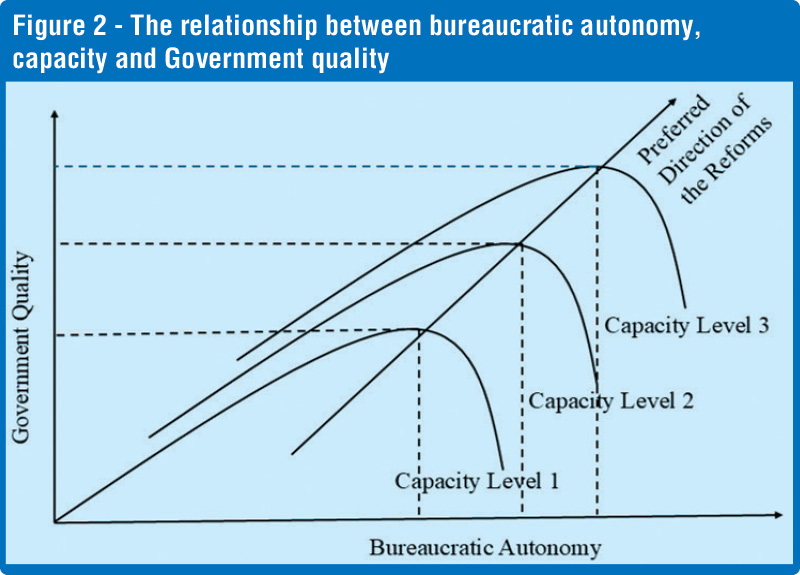
In his seminal work, Fukuyama (2013) outlined the relationship between bureaucratic autonomy, bureaucratic capacity, and Government quality [4]. As illustrated in Figure 2, higher levels of bureaucratic capacity enable officials to operate with greater autonomy while simultaneously enhancing Government quality. A major reason underlying this relationship is that as public servants become more professional, their moral standards also tend to develop.
Therefore, public sector reforms in Sri Lanka should move in this direction to achieve a realistic enhancement of the quality of Government. That is, reforms should increase the autonomy of bureaucrats while enhancing their capacity. This characteristic of reforms can be seen in most developed public services in the contemporary world. This is because “governance innovations” and “entrepreneurial governance” are essential to enhance a country’s public service delivery. This can only be promoted in systems where bureaucrats are accountable for results, rather than for adhering strictly to guidelines or processes.
Footnotes
[1] https://www.ft.lk/columns/Can-Sri-Lanka-enhance-Government-quality-through-strengthening-rule-by-law/4-783263
[2] https://www.dailymirror.lk/business/Rs-30bn-digital-injection-proposed-in-2026-to-spur-economic-transformation/215-324418
[3] https://www.ft.lk/top-story/Govt-commits-to-anchor-recovery-on-fiscal-discipline-reforms-and-digitalisation/26-782619
[4] Francis Fukuyama, “What Is Governance?” Governance: An International Journal of Policy, Administration, and Institutions, Vol. 26, No. 3 (2013): 347–368.
(About the authors: Dhananjaya Madusanka Dissanayaka is a Senior Lecturer in the Department of Public Administration, University of Sri Jayewardenepura, and also serves as an Advisor to the Ceylon Foundation for Economic Policy Analysis (CFEP), Sri Lanka. He can be reached via email: [email protected].)
Ishara Herath is a Lecturer in the Department of Human Resource, KIU Campus, and also serves as an Economic Policy Analyst/ Head of Department of Public Economic Policy at Ceylon Foundation for Economic Policy Analysis (CFEP), Sri Lanka. She can be reached via email: [email protected])




