Thursday Oct 15, 2026
Thursday Oct 15, 2026
Friday, 27 March 2026 00:10 - - {{hitsCtrl.values.hits}}
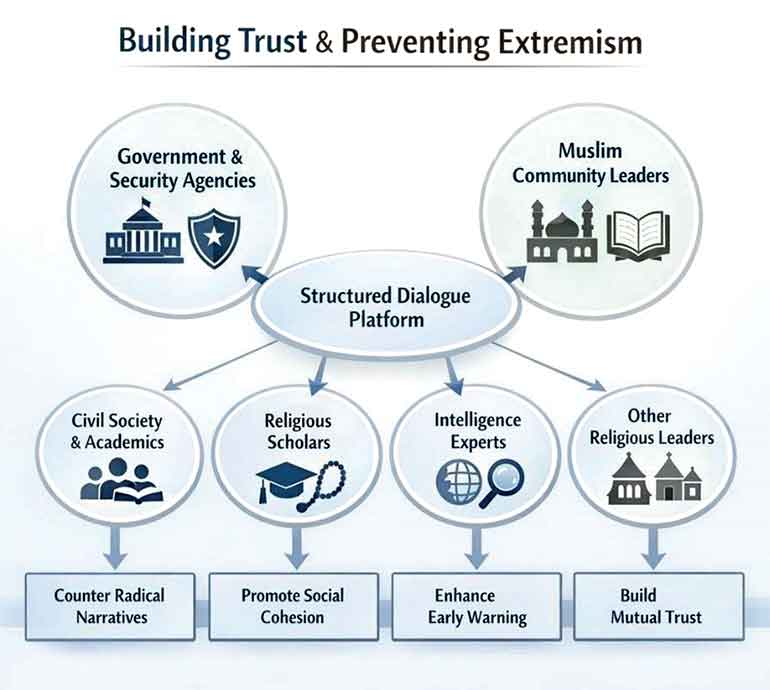
 Sri Lanka today stands at a delicate intersection of security sensitivity and social cohesion, where narratives more than actions are beginning to shape public perception and policy direction. Recent public commentary, including warnings by religious figures about Islamic ideologies and extremism, reflects a growing concern within the majority community. While such concerns cannot be dismissed outright, the manner in which they are articulated risks creating a counterproductive cycle of suspicion, alienation, and reactive identity politics.
Easter Sunday attacks
The memory of the Easter Sunday attacks remains deeply embedded in the national psyche. It justifiably elevated national security priorities and exposed critical intelligence and coordination failures. However, the strategic mistake that continues to linger is the overgeneralisation of threat narratives, where distinctions between extremist networks and the broader Muslim community are often blurred
Sri Lanka’s Muslim community has existed for centuries as a commercially integrated, culturally adaptive, and religiously pluralistic group. Internal diversity ranging from Sufi traditions to reformist movements has historically coexisted without manifesting into violent confrontation. The emergence of extremist elements was not an organic evolution of local religious practice but rather the result of external ideological penetration, digital radicalisation, and geopolitical spillovers.
The current discourse, however, tends to conflate multiple strands Salafi, Wahhabi, Sufi, and Shia into a single security framework. This lack of nuance is not merely an academic oversight; it has operational consequences. When communities perceive that their identity is being securitised rather than understood, they are more likely to withdraw into defensive isolation, reducing cooperation with state institutions. For intelligence and law enforcement agencies, this translates into reduced human intelligence flows, diminished trust, and a widening gap between state and society
At the same time, it would be equally flawed to deny that segments within the community have been exposed to transnational ideological currents that challenge traditional Sri Lankan Islamic practices. These influences amplified through online platforms, foreign funding channels, and unregulated religious instruction have, in certain instances, contributed to ideological hardening among youth. The issue, therefore, is not whether a threat exists, but how precisely it is defined and addressed.
Narrative escalation
The danger lies in allowing narrative escalation to outpace evidence-based policy. Public statements that frame entire ideological schools as inherently dangerous risk legitimising Islamophobia at a societal level, even when the intent is security-driven caution. Such narratives can inadvertently serve extremist objectives by reinforcing a “siege mentality” among vulnerable individuals precisely the psychological environment in which radicalisation thrives.
What Sri Lanka currently lacks is a structured, institutionalised platform for sustained engagement between the Government, security sector, and Muslim community leadership. Dialogue, when it occurs, is often reactive triggered by crises rather than embedded as a preventive mechanism. This absence creates space for misinterpretation, misinformation, and external influence operations to shape both public opinion and intra-community dynamics.
A strategic recalibration is therefore necessary
First, the Government must establish a formal, apolitical engagement mechanism that brings together religious scholars, security practitioners, policymakers, and civil society actors. This platform should move beyond symbolic consultation and focus on problem-solving, risk assessment, and narrative alignment.
Sri Lanka’s post-conflict history offers a critical lesson: security challenges that are misdiagnosed at the narrative level often re-emerge in more complex forms. Preventing this requires moving beyond reactive discourse toward a balanced, informed, and inclusive strategy.
The path forward is not one of denial or confrontation, but of clarity, calibration, and cooperation
Second, there is a need to articulate a national counter-extremism narrative that clearly distinguishes between faith, ideology, and violence. Sri Lankan Islam must be framed within its historical context moderate, plural, and locally rooted while isolating and delegitimising imported extremist interpretations without broad-brush labelling.
Third, communication strategies must be recalibrated. Public messaging from both state and influential societal actors should be measured, evidence-based, and sensitive to societal impact. In an era where social media amplifies every statement, even well-intentioned warnings can produce unintended polarisation if not carefully framed.
Fourth, the Muslim community itself must embrace a proactive role in addressing internal vulnerabilities. This includes strengthening religious education frameworks, promoting credible local scholarship, and actively countering narratives that seek to redefine identity in exclusionary or confrontational terms. Community leadership must recognise that silence or passivity in the face of ideological distortion carries strategic risk.
Finally, both the state and the community must adopt a “give-and-take” approach grounded in mutual accountability. Trust cannot be demanded unilaterally; it must be built through consistent engagement, transparency, and shared responsibility. The state must avoid policies that alienate, while communities must demonstrate visible commitment to national security and cohesion.
Sri Lanka’s post-conflict history offers a critical lesson: security challenges that are misdiagnosed at the narrative level often re-emerge in more complex forms. Preventing this requires moving beyond reactive discourse toward a balanced, informed, and inclusive strategy.
The path forward is not one of denial or confrontation, but of clarity, calibration, and cooperation. If managed wisely, Sri Lanka can transform this moment of tension into an opportunity to strengthen not only its security architecture, but also the social contract that underpins national unity.
(The author is a retired senior police officer and former Head of the Counter-Terrorism Division of Sri Lanka’s State Intelligence Service. With over four decades in policing and intelligence, he has interviewed over 100 suicide cadres linked to extremist movements. He is a graduate of the Asia-Pacific Centre for Security Studies in Hawaii and has received specialist training on terrorist financing in Australia and India)




