Saturday Oct 10, 2026
Saturday Oct 10, 2026
Monday, 4 May 2026 06:06 - - {{hitsCtrl.values.hits}}
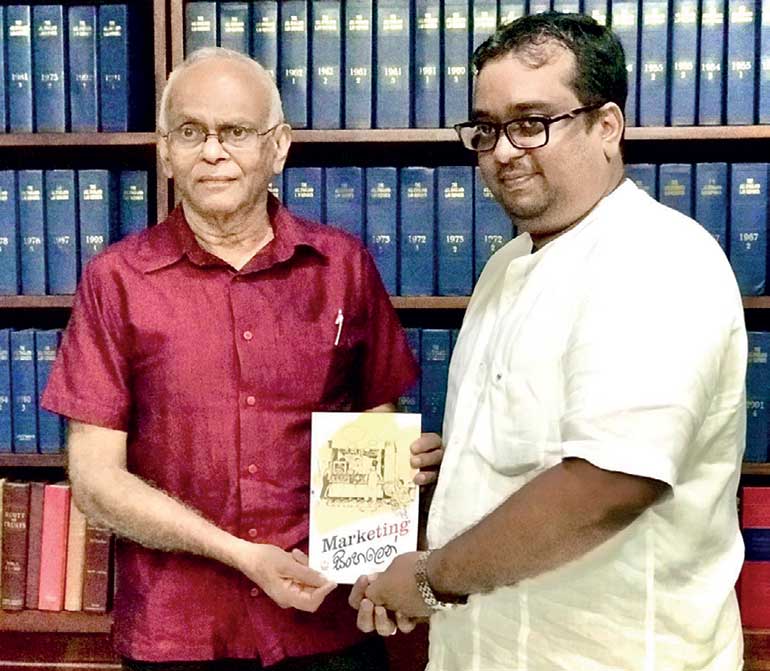
Senior Professor Nalin Abeysekera (right) presenting a copy of Marketing in Sinhala to this writer
Nalin bestowing two legacies to Sri Lankans
 Senior Professor Nalin Abeysekera, a former Dean of Management at the Open University of Sri Lanka, is no longer physically present among us. But his name, his legacy, and some of the physical characteristics unique to him that he displayed in social relations will remain in our hearts forever.
His name is marked by several distinguishing ‘unique to Nalin’ identity tags. One is that he is renowned for his prolific bilingual work in English and Sinhala. His papers in both languages have frequently appeared in professional journals, magazines, and newspapers. Another relates to his verbal command of both languages, which spellbound his audiences. In this way, he had been a highly sought-after public speaker at research workshops, seminars, and webinars. A third was his deep expertise—extending from academic research in management and marketing to subjects like religion—which showcased a rare breadth of intellect.
I recall him appearing on every Poya Day on a TV channel, explaining complex Buddhist philosophy to viewers in layman’s language. The legacy he left with us was that one should always seek to maintain excellence in everything one does, look at issues with an open mind, search for out-of-the-box solutions, be ready to shed old ideas if they are not supported by evidence, and show flexibility in embracing fact-proven new ideas. Nalin was a fine combination of seriousness in academic dealings and light-heartedness in social relations. The broad smile he wore when he met even a stranger was a signature identity unique to him.
Reverse Guru-Gola relationship
Nalin had been junior to me in the academic world by more than a quarter of a century. This age difference did not matter to us when we dealt with academic as well as personal issues. He was a good listener and gave me a patient ear when we discussed serious academic matters. At the same time, I did not consider him a junior whose views should not be reckoned with by me. Like him, I also had a patient ear when he presented his views on issues. We had a cordial relationship in which the conventional ‘Guru-Gola’ roles were played in reverse, where he was the Guru and I, the Gola.
Two important contributions
I can write volumes about Nalin, but I restrict my appreciation to two aspects of his professional work. One is his publication of a booklet titled Marketing in Sinhalese [1]. The other is the public lecture he delivered at the Central Bank on the need for Sri Lanka to move into an innovative economy [2].
Marketing in Sinhala
‘Marketing in Sinhala’, as the title suggests, is not a textbook on marketing to be used by students of marketing. It is a guideline on marketing, presenting both its strengths and weaknesses to ordinary readers in Sinhala.
Nalin was a fine combination of seriousness in academic dealings and light-heartedness in social relations. The broad smile he wore when he met even a stranger was a signature identity unique to him
In a brief thank-you note at the beginning of the book, Nalin states that his purpose in writing it was to introduce marketing to the common man and thereby make it a popular subject, as for decades it had been restricted to certain elite groups in society. His wish was that, after reading the book, Sri Lankans would develop a marketing system unique to the country. The book is dedicated to his wife, Ayanthi Fernando, as a fitting tribute. Nalin has publicly asked how the book could be dedicated to anyone other than his loving wife, who has showered him with love, affection, and protection not just in words but in practice. This is a testimony to the personal side of this young academic and his deep commitment to family life.
Friendly dialogue between son and father
The book contains 11 brief chapters: product, price, place, promotion, marketing environment, market segmentation, marketing research, delighting the customer, making the customer a family member, developing loyal customers, and having a Sri Lanka-based marketing system.
Complex marketing principles are presented in the form of a dialogue on what to do and what not to do between a typical Sri Lankan trader, Appuhamy Mudalali, and his son, Isanka. Appuhamy, with more than 40 years of experience as a trader, represents the old generation, while Isanka, a brand-new graduate in marketing, represents Generation Z. Naturally, they do not see eye to eye on what to do and what not to do.
Marketing 3.0 highlights the need for a value system to guide marketers, recognising that they deal with human beings not merely composed of atoms but guided by consciousness and emotion. Isanka’s article, and thus Nalin’s message, suggests that Hinni Appuhamy had practised this approach long before Kotler formalised the concept
Appuhamy holds the view that selling products with a brand name leads to success in trading. He has a loyalty to brand names because consumers can easily identify them, they help eliminate inferior products, and they provide mental assurance to the consumer. The son, on the other hand, has introduced mobile phone reloading to the grocery business and emphasises the need to consider not only brand names but also product life cycles. Even a product with a strong brand name must go through stages such as growth, maturity, and decline. His view is that even a good brand name should be discarded if it has entered the declining stage of its life cycle. This is why many established brands are periodically rebranded by manufacturers.
Marketing 3.0: Practice adopted by Sri Lankan giants earlier
A key message Nalin conveys in ‘Marketing in Sinhala’ is through an article written by Isanka about global marketing figures such as Philip Kotler and Sri Lanka’s successful marketer Hinni Appuhamy of Maliban. Isanka reads this article aloud so that his father and others at the grocery store can hear it. Kotler visited Sri Lanka in 2011, when marketing had entered its third phase, Marketing 3.0, where the customer is viewed as a human being with a mind, heart, and value system. Accordingly, marketers must design strategies to satisfy this holistic human being. In the earlier phases, strategies were product-focused (Marketing 1.0) or customer-satisfaction focused (Marketing 2.0).
While the Easter Sunday attacks of 2019 and the COVID-19 pandemic of 2020 dealt a severe blow to Sri Lanka’s economy, Nalin argued that they also opened a strategic window that should be utilised before it closes. For example, Sri Lanka’s agriculture, which sustains the nation, continues to rely on traditional methods. It should instead be reimagined to create greater value or be transformed into a creative industry
Marketing 3.0 highlights the need for a value system to guide marketers, recognising that they deal with human beings not merely composed of atoms but guided by consciousness and emotion. Isanka’s article, and thus Nalin’s message, suggests that Hinni Appuhamy had practised this approach long before Kotler formalised the concept.
Nalin on an innovative economy
Nalin’s public lecture on creating an innovative economy in Sri Lanka was delivered in 2021, when the country aspired to become prosperous within a single generation. He identified that the most important requirement for achieving prosperity was to transform Sri Lanka into a creative economy through innovation. At this lecture, the then Governor of the Central Bank, W.D. Lakshman, stated that such an approach required out-of-the-box thinking and strategic planning for the country to compete in global markets. Nalin explained the mechanisms Sri Lanka should follow to realise this goal.
What a creative economy is
Drawing on Shanghai-based British strategist John Howkins, who published ‘The Creative Economy: How People Make Money from Ideas’ in 2001, Nalin defined a creative economy, outlined its components, and explained how it could take root within a society’s cultural ethos.
Today, Sri Lanka remains a divided nation, fragmented along religious, linguistic, cultural, regional, and ethnic lines. Groups often view one another with suspicion. There is limited tolerance of foreigners, with anti-Indian, anti-Chinese, anti-American, and anti-Western sentiments evident across society. Instead of coexistence and mutual enrichment, there is a tendency towards isolation. Groups often praise their own identity while criticising others
According to him, a creative economy re-examines traditional production models to determine how they can be transformed to add more value. This transformation should be driven by positive thinking rather than negative perspectives. While the Easter Sunday attacks of 2019 and the COVID-19 pandemic of 2020 dealt a severe blow to Sri Lanka’s economy, Nalin argued that they also opened a strategic window that should be utilised before it closes. For example, Sri Lanka’s agriculture, which sustains the nation, continues to rely on traditional methods. It should instead be reimagined to create greater value or be transformed into a creative industry.
Fifteen subsectors of the global economy
Howkins described creative industries as those that use knowledge and information to generate income. In 2001, he divided them into 15 sectors based on the global economic structure, though this number may be higher today. These sectors include advertising, architecture, art, crafts, design, fashion, films, music, performing arts, publishing, research and development, software, toys and games, television and radio, and computer games. All belong to the services sector, which relies more on intellectual capability than physical labour.
Emperor Asoka’s edicts warned that praising one’s own faith while condemning others harms one’s own beliefs. This form of bigotry is visible even in the separate celebration of the Sinhala and Tamil New Year, despite it being shared by both communities. There is little effort to celebrate together. Such division limits the potential for creativity, despite Nalin’s aspiration for a unified and innovative society
Nalin linked these creative industries with culture, citing Andy Pratt of the University of London, who discussed the relationship between creative industries and development. He also referred to Jeannette Snowball of Rhodes University, who explored the nexus between creativity, culture, and globalisation. She emphasised the need for equal distribution of creativity among nations to help emerging economies benefit. Many individuals engaged in cultural practices, such as pottery or clothing production, operate in micro and small-scale businesses. Creativity can help them rise above poverty. Therefore, it should be an essential component of any poverty alleviation strategy, with the key requirement being integration into global markets.
Nollywood vs. Ranminitenna
In Nigeria, the film industry, known as Nollywood, has become a global force. In contrast, Sri Lanka’s Ranminitenna TV Village represents a missed opportunity. Nalin proposed three measures to achieve progress: reforming the education system, fostering collaborative creative projects among the Central Bank, higher education institutions, and private businesses, and establishing a dedicated unit for the creative economy. During the question-and-answer session, he suggested that this unit be located within the Central Bank. Deputy Governor Mahinda Siriwardena welcomed the idea but did not commit the bank to it, possibly recognising institutional constraints. It is notable that the idea was not pursued later when he became Treasury Secretary.
Divided Sri Lanka
Today, Sri Lanka remains a divided nation, fragmented along religious, linguistic, cultural, regional, and ethnic lines. Groups often view one another with suspicion. There is limited tolerance of foreigners, with anti-Indian, anti-Chinese, anti-American, and anti-Western sentiments evident across society. Instead of coexistence and mutual enrichment, there is a tendency towards isolation. Groups often praise their own identity while criticising others.
Nalin emphasised that for Sri Lanka to benefit from a creative economy, the gains from innovation must be shared widely. This represents inclusive development. If benefits are concentrated among a few, it results in exclusive development and undermines the goal of becoming an innovative economy
Emperor Asoka’s edicts
This situation contrasts with the teachings of Emperor Asoka, who spread Buddhism to ancient Sri Lanka. His edicts warned that praising one’s own faith while condemning others harms one’s own beliefs. This form of bigotry is visible even in the separate celebration of the Sinhala and Tamil New Year, despite it being shared by both communities. There is little effort to celebrate together. Such division limits the potential for creativity, despite Nalin’s aspiration for a unified and innovative society.
Importance of inclusive innovation
Nalin emphasised that for Sri Lanka to benefit from a creative economy, the gains from innovation must be shared widely. This represents inclusive development. If benefits are concentrated among a few, it results in exclusive development and undermines the goal of becoming an innovative economy.
These two legacies—the need for indigenous marketing strategies and the pursuit of inclusive innovation—were left to us by Senior Professor Nalin Abeysekera. It is our responsibility to carry them forward until the goal is achieved.
(The writer, a former Deputy Governor of the Central Bank of Sri Lanka, can be reached at [email protected])
References
1A digital copy can be downloaded from the website https://www.siyalla.com/marketing-sinhalen-professor-nalin-abeysekera/
2Can be accessed at https://www.youtube.com/watch?v=Wkg91Pev4TM




