Saturday Oct 03, 2026
Saturday Oct 03, 2026
Friday, 15 May 2026 05:48 - - {{hitsCtrl.values.hits}}
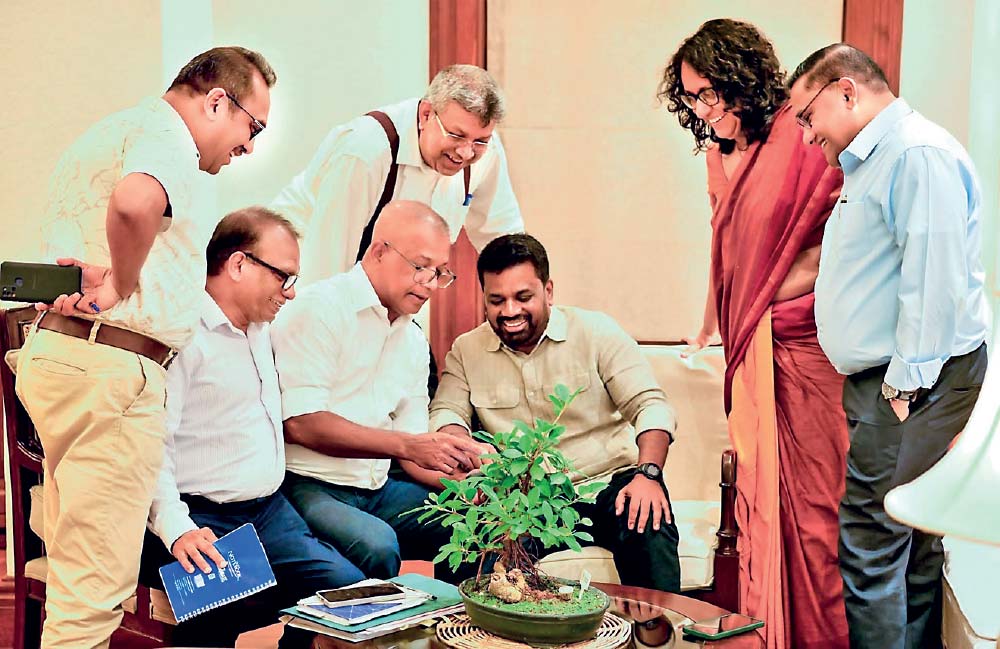
President Anura Kumara Dissanayake with members of his administration in the early days of the NPP Government
 Revolutionary movements that succeed and subsequently assume the mantle of governance often discover to their dismay (and the detriment of the nation at large) that the state is not a protest site
 My column last week was about what the Aragalaya might mean to the NPP Govt. today. In it I wrote that some of the issues which animated the unprecedented people’s movement of 2022 remain unresolved and are perhaps as urgent as ever even four years later. Hints of corruption, incompetence and blunders in policymaking, now the deep state still at work...
And looking back to 9 May 2022, the question was posed again whether people’s sovereignty in Sri Lanka on that halcyon day mistook the catharsis of a moral victory with the ambiguous certainty of a transformation that never came into full effect. After all, why hasn’t the revolution moved ahead into the promised land?
What Sri Lanka has since then discovered is a harder and less romantic ethos than speaking truth to power by taking to the streets. That dismantling the apparatus of corruption, incompetence and the deep state is arguably easier than designing competence.
Last week’s contention was at heart a warning to the National People’s Power: that the moral legitimacy inherited from the Aragalaya is neither permanent nor purposefully self-renewing.
That uprising represented not merely rage against a ruling family or economic collapse, but a collective demand for ethical governance, transparency and accountability, competence at administration and overarching systemic reform.
Yet revolutionary movements that succeed and subsequently assume the mantle of governance often discover to their dismay (and the detriment of the nation at large) that the state is not a protest site.
Rather, it is a labyrinth – procedural, resistant, compromised, slow. The very machinery that the incensed rebels once denounced becomes the apparatus that they must now operate. And they discovered sooner than later that there are gremlins in the engine.
Lessons of history
The NPP’s challenge, therefore, is no longer whether it can inspire hope but whether it can meaningfully survive the transition from oppositional passion (and in their minds at least, purity) to administrative credibility.
And the danger is not simply policy failure. But the gradual erosion of public trust. That happens in initially slow but increasingly rapid degrees when a movement elected to transform the system appears instead to be hamstrung by it. By their own account, the regime in situ has begun to cite poor results despite proper procedure being followed and push-back from State actors for its own recent lapses and lacunae.
The hazard posed to the commonwealth and national interest is that the Aragalaya’s social and emotional capital can be spent quickly if citizens begin to perceive drift, inconsistency, amateurism, or accommodation with entrenched interests. History – and students of Marx as much as the Market are said to have read it – is littered with the wrecks of well-meaning movements that won the streets but lost the state.
And that, I suspect, is where the republic now stands. Or languishes, poised on the edge ahead of a possible slide, though hopefully not a fall... we have had too many of those to even contemplate another?
Stalwarts of the Aragalaya generation have well and truly taken over Government. Now, for them, as well as for those of us who welcomed a sea-change, comes the harder task. Not to diss this regime’s credo or its credentials; but every revolution must eventually confront the filing cabinet and prosecute the case full of box files!
While movements on the street and in town hall-type gatherings thrive on clarity and the clarion calls of their cause, states – and even the best of governments or regimes at that – function, of a necessity, in and through ambiguity. Where protest politics rewarded moral certainty for Anura Kumara Dissanayake and his henchmen, governance – as has been clear – has been rewarding procedure over policy, sequencing over strategy, and patience over practical outcomes.
As activists, AKD and his crew demanded from the then government – and promised us voters whom they wooed – total, utter and entire transformation overnight. But now, as administrators, and novices at it into the bargain, they – and we – are discovering that institutions resist interventions and are not open to transformation as was once thought they would be.
The very machinery that the incensed rebels once denounced becomes the apparatus that they must now operate. And they discovered sooner than later that there are gremlins in the engine
Catalysing the sea-change
The first challenge then is psychological. A movement born in dissent must now master the temperament and the talents of stewardship. It must far more convincingly exchange slogans for systems and strategy, outrage for action and implementation, and symbolic victories for durable reforms. That transition is neither automatic nor assured.
Secondly, revolutionary legitimacy is perishable. The public may forgive the hardship they have to face if they believe that the Government is sincere and that competence exists where the right direction to go in is clear. But citizens who suffered and endured interminable queues, skyrocketing inflation, crippling blackouts, debilitating shortages and economic collapse are not so forgiving. They are unlikely to indefinitely indulge confusion, indecision or internal contradiction merely because a tyro government once represented hope, as well as their best shot at systemic overhaul. Social capital and moralistic goodwill evaporate rapidly when the arrogant (in the past) or the incompetent (as it would seem now) dilly, dally, and grow more defensive daily in office.
Third, the State itself is not neutral terrain. Ministries, mini-bureaucracies, procurement strategies, security networks and commercial ecosystems possess institutional memory and long-embedded loyalties. Some may be professional, while others are possibly compromised or lack the courage to embrace – much less initiate – system change. Even a probably sincerely, initially reformist, administration does not inherit a blank slate. It is handed systems shaped by decades of patronage, fear, corruption and political capture. And those systems rarely capitulate easily overnight or surrender quietly.
Which leads us to the fourth and perhaps most sobering reality: not every failure of governance originates in government. Some arise from the State’s own antibodies fighting rearguard actions of their own.
Falls the shadow
Recent events hint precisely at this tension. The reported phishing attack on State financial systems raised troubling questions – not merely about cybersecurity, but about institutional vulnerability and State preparedness. And the controversy surrounding the allegedly suspicious death of a former SriLankan Airlines CEO reopened unresolved anxieties about political accountability, state capture and elite impunity, and opaque networks of influence.
Meanwhile, episodes of bureaucratic inertia and apparent sabotage increasingly fuel speculation that elements within the deep state remain invested in protecting remnants of the ancien régime – or at the very least invested in resisting disruptive (to them) reform.
Whether these perceptions are wholly accurate is almost secondary. In politics, perception hardens into atmosphere – and atmosphere shapes legitimacy, and eventually legacy.
The danger for the NPP therefore is twofold. If it fails, it risks becoming merely another disappointing government that let us down in a long national cycle of failed administrations. But if it succeeds only partially – enough to expose corruption, and unsettle entrenched vested interests (yet, insufficiently so as to decisively reform the machinery of state) – it may find itself trapped between hostile elites and an impatient public.
Sri Lanka may now be witnessing the collision between revolutionary expectation and institutional resistance. The question is whether the new rulers understand the nature of the terrain through which they are going and taking all of us along for the ride. And it would do well to remember that winning the republic well is not the same as governing the State wisely
Between idea and reality
This is the paradox facing post-Aragalaya governance. The movement was propelled into office (of course, after an interregnum in which it seemed that the establishment in another guise had won) by a citizenry en masse who demanded and agitated for system change. Yet the system being changed possesses its own survival instincts.
Sri Lanka may now be witnessing the collision between revolutionary expectation and institutional resistance. The question is whether the new rulers understand the nature of the terrain through which they are going and taking all of us along for the ride. And it would do well to remember that winning the republic well is not the same as governing the State wisely.
(The writer is the Editor-at-large of LMD and is a senior journalist with a Post-graduate Diploma in Politics and Governance)



