Saturday Sep 26, 2026
Saturday Sep 26, 2026
Saturday, 26 September 2026 00:00 - - {{hitsCtrl.values.hits}}
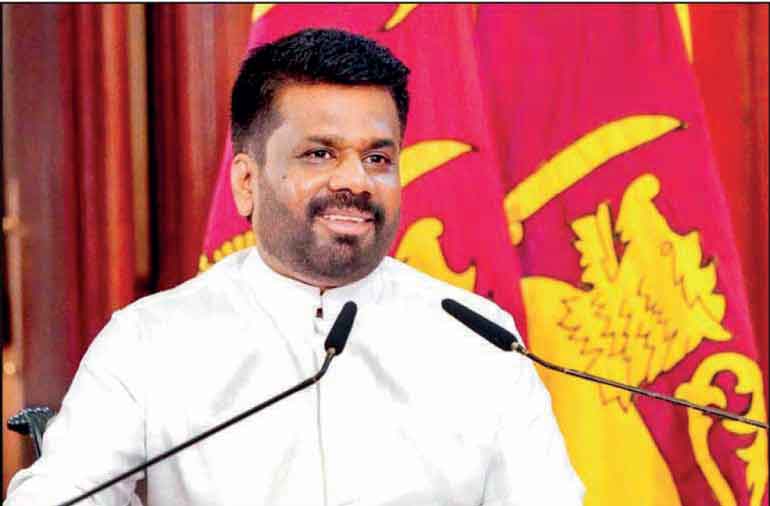
President Anura Kumara Dissanayake
If it merely replaces the people operating the old machinery, then ‘system change’ will eventually reveal itself to have been little more than system succession. The proposed judicial changes make that question particularly urgent. The NPP still has time. What it does with the extraordinary power Sri Lanka gave it will determine whether these first two years become merely the prologue to system change, or the beginning of another turn of the political wheel
 Two years after the NPP swept into power, Sri Lanka is still neither the nation its then-opposition promised, nor the country that the present regime inherited. That may be both its achievement and its dilemma.
Two years ago, Sri Lanka gave Anura Kumara Dissanayake and the National People’s Power an extraordinary mandate to change the system. First, with the Presidency in September 2024; and then, two months later, with a mammoth 159 of 225 parliamentary seats.
Previous presidents had possessed considerable power, but few executives had been handed such political capital to alter the machinery of the State, rather than merely occupy its driving seat.
So, where has the NPP taken us?
Perhaps the savvy summary is this: away from the precipice at which edge we were, but not yet towards that promised land of past and recent manifestoes. That initial accomplishment deserves quite a bit more credit than the Opposition may concede, and rather more criticism than the Government may welcome…
Sri Lanka’s recent political history provides the context for that claim.
The Rajapaksa years combined grandiose borrowing, institutional erosion and extraordinary executive concentration – to say nothing of treating State coffers as the family treasury. Yahapalanaya promised institutional cleansing and constitutional reform, but ran out of political steam – quite explosively at its end. Gotabaya Rajapaksa pushed executive centralisation further, only to discover that even an increasingly powerful presidency could not withstand popular sovereignty. Ranil Wickremesinghe then undertook the electorally thankless task of stabilising the ship of State through IMF negotiations, fiscal consolidation, debt restructuring and the restoration of external stability – albeit under the jackboot.
The NPP inherited that recovery architecture. And its first and least glamorous achievement, therefore, was not to wreck it and ruin the country again.
There had been legitimate anxiety that a JVP-led Government might tear up the IMF agreement, increase spending beyond the State’s means and attempt to cure austerity by spending money Sri Lanka did not possess. It did not. Instead, the NPP broadly continued the stabilisation program, while attempting to give it a more socially redistributive character.
That continuity was politically significant and nationally welcome. The IMF completed its combined fifth and sixth reviews in May 2026, releasing about $ 695 million, and affirming that the program remained broadly on track.
Debt restructuring continued, reserves accumulated, and the economy grew by about 5% in both 2024 and 2025, with 1 2026 growth at 5.1%. Unemployment stood at 3.7%, while reserves reached $ 6.45 billion at end-June.
But let us not confuse inheritance with invention. The NPP did not manufacture this macroeconomic recovery from scratch. It inherited the IMF program and the stabilisation framework constructed under its predecessor. Its achievement was continuity without ideological rupture through an unexpected statecraft rather than revolutionary economics.
Thus kudos to the NPP! But it is not the same thing as creating a new economic model.
And this is where their report card becomes considerably less comfortable.
GDP recovery is not household prosperity. Poverty continued far above its pre-crisis level, while real wages and household welfare remained depressed. People continue to confront high food prices, demanding taxes, depleted savings, damning indebtedness, discouraging migration and debilitating pressure on public services.
By August 2026, headline inflation had risen to 8%, with food inflation at 8.5%. The Middle East energy shock exposed Sri Lanka’s continuing dependence on imported fuel, while the 2026 drought exposed the vulnerability of agriculture and water systems. Rainfall deficits in parts of Ampara and Monaragala reached extraordinary levels, followed by the more recent indiscriminate inundation of El Niño’s advance-guard attack.
The truth be told – none of that can sensibly be blamed on the NPP. Governments, however, are ultimately judged by how they manage the shocks they encounter, not the eloquence of their erstwhile manifestoes.
So economically at least, the verdict after two years is reasonably clear: Sri Lanka has moved from near-collapse through tough recovery towards stability, but not from stability towards a quiet prosperity as before or anywhere near thriving.
A different political culture
Meanwhile, the NPP’s more striking achievement may lie elsewhere.
Sri Lankan politics has long operated by virtue (or lack of it) of patronage. Politicians distributed State resources, cultivated loyalist networks and converted those articulated tentacles into self-serving electoral machinery. The NPP came to power promising to cleanse that culture.
There is evidence that it has done so, to some extent.
Political privilege is less ostentatious. Dynastic politics has receded. The public image of Government is markedly more austere. Politically powerful figures have faced investigation, prosecution and punishment. Public financial disclosure has received greater emphasis.
The arrest of Namal Rajapaksa in connection with the Airbus investigation was symbolically significant. Whatever the eventual legal outcome, a member of a former ruling family being arrested and remanded under a Government opposed to that political tradition would once have seemed improbable.
But an arrest is not a conviction. And more importantly, anti-corruption politics becomes dangerous if it degenerates into selective prosecution. The real test is not how many former politicians are arrested and tried, but whether Sri Lanka constructs institutions strong enough that presidents no longer decide personally whom to prosecute.
The NPP inherited the 2023 Anti-Corruption Act rather than creating the framework from scratch, but it has used the machinery more aggressively. It has pursued old cases, elevated the prominence of CIABOC, increased transparency, and published the financial statements of major State-owned enterprises.
That last development is hardly thrilling cocktail-circuit conversation, but it is precisely the sort of boring institutional reform that matters. SOEs are the barometer of our systemic well-being.
The difficulty is that enforcement is not institutionalisation. Sri Lanka’s structural ecosystem of political corruption still encompasses procurement, appointments, SOEs, land use, State concessions, tax exemptions, political financing, public contracts and discretionary governmental power.
The NPP has also begun moving from a resigned acceptance of impunity towards rigorous investigation of past misdemeanours. Yet, it has still to demonstrate that Sri Lanka can move from investigation to conviction, asset recovery and institutional bolstering.
Some great unfinished works at hand
The biggest broken promise remains the Executive Presidency: the NPP promised to abolish it; it has not.
The Government continues to say that constitutional reform remains on the agenda, but there is a considerable difference between aspiring to a new constitution and fulfilling a specific electoral commitment to abolish the Executive Presidency. And the old excuse of insufficient parliamentary support has largely disappeared.
The same unfinished business extends to decentralisation. Provincial Councils remain unelected. The promised timetable for provincial elections has slipped, entangled in questions of electoral systems and delimitation.
This is not a minor administrative footnote. Democratic decentralisation was part of the promised system change.
Nor is the judiciary question reassuring. The Government has proposed constitutional changes involving the retirement age of senior judges and the number of judges in the higher courts. The administration says the purpose is to reduce judicial delays. Opposition parties, lawyers, unions and civil-society groups argue that the changes could compromise judicial independence.
The issue deserves close scrutiny precisely because of the NPP’s original raison d’être. It does not follow that the proposed reforms are inherently corrupt or authoritarian. But if an administration uses an enormous parliamentary majority to increase its capacity to shape institutions that are supposed to constrain executive power, the appearance of institutional self-interest is itself dangerous.
For a movement elected to change the system, this is the red line to watch. That it is pressing the judges issue without ditching the executive albatross questions its bona fides big time.
Reconciliation: the open wound
The NPP achieved something politically important for a party rooted in the Sinhala south, by winning substantial Tamil support, including an unprecedented breakthrough in Jaffna.
But electoral success is not historical reconciliation.
The harder questions remain: missing persons, political prisoners, military-held land, devolution, accountability for wartime abuses, Tamil political representation, alleged demographic engineering and the Prevention of Terrorism Act (PTA).
The Government has renewed investigations into cases including Prageeth Ekneligoda, Keith Noyahr and Lasantha Wickrematunge, and has permitted the Chemmani investigations to continue. The discovery of hundreds of skeletal remains at Chemmani has, however, created a particularly grave test of whether investigation can develop into a comprehensive accountability process.
The PTA per se presents another acid test. The Government promised reform of the counter-terrorism architecture, yet proposed replacement legislation has itself been criticised for retaining broad counter-terror powers. Changing the name of an institutional problem is not the same as solving it. And only a genuinely rights-compatible legal framework would turn the Government’s rhetoric into reform.
Social State meets fiscal reality
On social protection, the picture is more encouraging.
The NPP did not abolish Aswesuma. It expanded payments, raising the minimum payment for poor households from Rs. 7,500 to Rs. 10,000 and the payment for the ‘very poor’ category to Rs. 17,500. Given Sri Lanka’s fiscal constraints, targeted welfare is more realistic than universal subsidies, although targeting inevitably creates exclusions and administrative problems.
Healthcare is less impressive. The manifesto envisaged Government health expenditure approaching 3% of GDP, but the 2026 allocation was around 1.9%.
Education offers useful changes rather than transformation. The Government has committed to 200 overseas undergraduate scholarships annually for five years, and has increased emphasis on digital education, skills, science and technology, vocational training and schools infrastructure. Yet, the familiar problems remain: limited university access, examination bottlenecks, teacher shortages, quality disparities, English-language limitations, vocational mismatches and the relentless brain drain.
Agriculture presents the same tension between ideological ambition and inconvenient arithmetic. Fertiliser subsidies, irrigation rehabilitation, food security, domestic production, land mapping and tank restoration are all sensible priorities. But fragmented holdings, weak logistics, post-harvest losses, price volatility, inefficient State marketing, water vulnerability and climate change remain formidable obstacles. The 2026 drought has exposed these realities rather brutally. Now, the wreckage of heavy rain may complicate matters.
Energy offers greater structural promise. The expansion of solar power, including the Sampur project and investment in transmission and rooftop solar, matters; because Sri Lanka’s vulnerability is not simply that oil is increasingly expensive: it is that our island imports much of the energy upon which its economy depends. Solar, wind, grid reform and storage are therefore not merely environmental policies; they are national-security policies. But a 2,000 MW promise is a long road from a project beginning to a transformed energy system.
Tourism and remittances continue to sustain the external economy, while the NPP has become more explicitly investment- and export-oriented than its campaign rhetoric might have suggested.
Tourism earned about $ 3.2 billion in 2025 and roughly $ 1.5 billion by July 2026, despite the Middle East disruption. Yet, Sri Lanka remains dependent on tourism, remittances, apparel and a relatively narrow range of exports. The challenge is not simply to attract more tourists. It is to raise productivity and diversify what the country produces.
A surprisingly pragmatic foreign policy
One area in which the NPP has evolved considerably is foreign policy.
The old JVP ethos was nationalist and suspicious of foreign capital and major powers. Fears that a JVP-led Government might make Sri Lanka more insular and isolated have not materialised.
Instead, the Government has pursued a pragmatic balancing policy. Relations with India have deepened while the relationship with China has been maintained, particularly in energy, investment, infrastructure, connectivity, maritime security and tourism.
For a small, strategically located, debt-constrained State, this pragmatism makes sense.
The greater challenge may lie closer to home: the civil service.
Sri Lanka’s problem has never simply been corrupt politicians. The machinery propping them up has itself become politicised, fragmented, inefficient and resistant to reform.
The NPP has begun digitalisation, institutional restructuring and attempts to improve administrative efficiency. But allegations of growing party influence over the bureaucracy are precisely what a movement promising a new political culture should take seriously.
Replacing one patronage network with another, even a more disciplined one, is not system change. It is system continuity under new management.
A mini-SWOT
Strengths: an extraordinary parliamentary mandate; a visibly less privileged and dynastic political culture; meaningful anti-corruption investigations; macroeconomic prudence; expanded social protection; pragmatic foreign policy; and substantial cross-ethnic electoral appeal.
Weaknesses: limited governing experience; shallow institutional reform; constitutional paralysis; incomplete reconciliation; an economic model stabilised more than reinvented; and the tension between expansive social ambitions and severe fiscal constraints.
Opportunities: genuinely independent oversight institutions; a negotiated constitutional settlement; stronger productivity and exports; renewable energy and grid reform; digital Government; and the unusual opportunity created by simultaneous southern and minority electoral support to advance reconciliation.
Threats: renewed inflation and external shocks; imported-energy vulnerability; climate stress; political overconfidence; institutional capture; and, most immediately, any erosion of judicial independence.
The central danger is that the NPP’s greatest strength, its enormous parliamentary majority, could become its greatest weakness.
A Government with overwhelming power has extraordinary capacity to reform institutions.
It also has extraordinary capacity to control them.
So, where are we? After two years, the broad picture looks like this.
Economically: Sri Lanka has moved from near-collapse to relative stability, but not yet from stability to prosperity.
Politically: the country has moved from establishment politics towards a noticeably different political culture.
In governance: the movement is from personalised patronage towards institutional accountability, but only a short distance towards that salutary goal.
On corruption: the country has moved from impunity towards investigation, but the harder work of conviction, asset recovery and prevention remains.
Of democracy: the political culture is cleaner and leaner, but the constitutional architecture remains unresolved. The executive presidency survives, provincial democracy remains suspended and judicial independence is now under scrutiny.
Socially: welfare is more protective, but fiscal reality sharply limits ambition. Aswesuma is a tangible achievement; health and education remain works in progress.
In re reconciliation: progress on individual cases has not yet become a convincing national architecture.
As for foreign policy: pragmatism has prevailed, with India and China both meaningfully engaged.
That is a more than respectable record for a Government inheriting a bankrupt State, sovereign default, institutional dysfunction and an economy only beginning to recover. For a movement that promised system change, however, it is not yet enough.
And perhaps that is the paradox that will ultimately define the NPP’s first term.
Its first phase, 2024-26, has essentially been about recovering and stabilising. On that front, the Government has broadly succeeded: it preserved the recovery, maintained the IMF framework, expanded welfare, began pursuing corruption cases and introduced a markedly different political style.
The second phase, 2026-29, is considerably harder. It requires constitutional reform, independent institutions, judicial independence, a professional civil service, higher productivity, diversified exports, energy security, meaningful education and healthcare investment, reconciliation, decentralisation, private-sector investment and technological modernisation.
That record remains largely unwritten. And here lies the acid test. The NPP was elected because Sri Lankans wanted to smash an odious system. Its greatest achievement so far has instead been learning to operate that system without immediately wrecking it.
That was necessary. But it is not the destination. And the decisive question is no longer whether Anura Kumara Dissanayake is better or worse than the presidents who preceded him. It is whether the NPP will dismantle the machinery of personalised political power now that the machinery is available for the NPP itself to use.
If it builds institutions capable of constraining NPP governments as effectively as any other government, then something genuinely fundamental will have changed.
If it merely replaces the people operating the old machinery, then ‘system change’ will eventually reveal itself to have been little more than system succession.
The proposed judicial changes make that question particularly urgent. The NPP still has time.
What it does with the extraordinary power Sri Lanka gave it will determine whether these first two years become merely the prologue to system change, or the beginning of another turn of the political wheel.
(The writer is the Editor-at-large of LMD and is a senior journalist with a Post-graduate Diploma in Politics and Governance)




