Saturday Oct 10, 2026
Saturday Oct 10, 2026
Saturday, 10 October 2026 00:00 - - {{hitsCtrl.values.hits}}
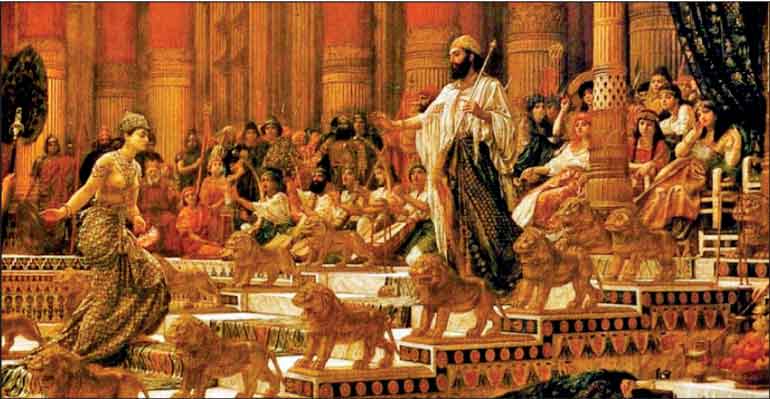
The Visit of the Queen of Sheba to King Solomon painting by Edward Poynter
(Wikimedia Commons)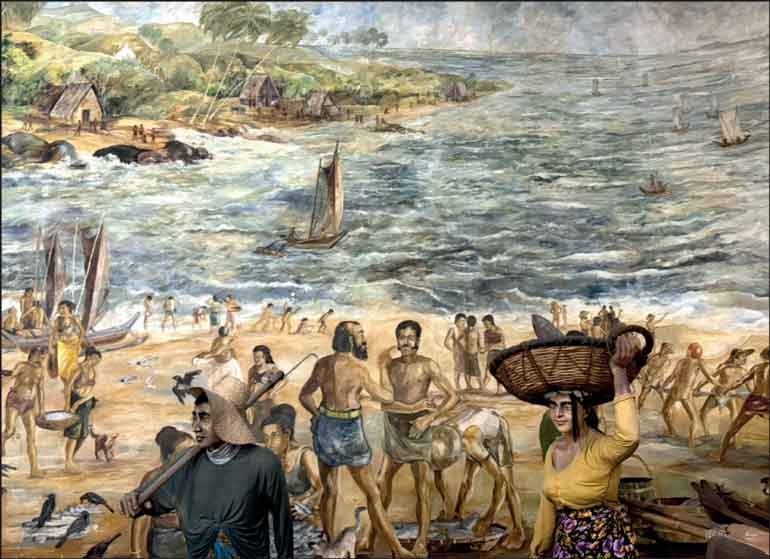
Mural at Colombo Port Maritime Museum (Avi Kumar)
Galle Lighthouse (Avi Kumar)
 For over a century, the claim that the port of Galle was the biblical port of Tarshish—King Solomon’s legendary trade hub—has lingered in local rumours, tourist brochures, and newspapers. However, a glance into the evidence shows that this rumour is incredibly difficult to verify, no matter how romantic it sounds.
Popularised by former Colonial Secretary Sir James Emerson Tennent in 1859, this unproven theory has been repeated so often that many locals and tourists alike take it as undisputed fact. Yet the colonial myth is not supported by archaeology, linguistics, geology, or logistic evidence. The most glaring flaw is simple arithmetic. King Solomon reigned around 970-931 BCE. Sri Lanka’s first historic king, Vijaya, did not arrive until roughly 500 BCE and the sprawling markets of the Anuradhapura Kingdom emerged much later.
In 1 Kings 10:22, the Bible states that Solomon’s fleet returned once every three years bearing a specific luxury cargo: “Gold, silver, ivory, apes, and peacocks.”
Colonial European theorists in the age of empires scrambled to find an island capable of supplying this exotic inventory.
Had ancient Israelite sailors landed in Galle during Solomon’s era, they would not have stepped onto a bustling cosmopolitan dock; instead, they would have encountered hunter-gatherer communities. True, the island was not entirely isolated. Excavations by Senior Professor Raj Somadeva have uncovered human activity and Iron Age civilisations in highland cave sites dating back to 1000 BCE, predating King Vijaya. His discoveries of marine shark teeth and coastal corals deep in the interior highlands confirm that early Sri Lankans engaged in domestic barter between the coast and mainland. Yet, maintaining supply-chains with far away kingdoms is far more complex.
The island lacked the highly organised royal infrastructure, holding complexes, or networks required to capture, cage, domesticate, and export hundreds of live monkeys and wild birds. While the later Anuradhapura and Polonnaruwa kingdoms had advanced royal pleasure gardens and elephant taming techniques, they emerged centuries afterwards. Furthermore, Galle did not appear on global records until the Greek geographer Ptolemy mentioned it around 150 CE, then it gained prominence only during 16th-century conflicts with the Portuguese Empire.
Even if the local tribes of the era had somehow cornered the market on caging wild primates, logistics would fail them. Transporting hundreds of fragile, highly stressed tropical animals across the scorching, open wooden decks of an ancient merchant galley—while navigating the stagnant summer air of the Arabian and Red Seas and subsequent camel caravan routes—would result in many exotic jungle critters dying before reaching the pet markets or menageries of ancient Jerusalem.
The linguistic “proof” that 19th-century colonial theorists leaned so heavily upon—the similarity between Biblical Hebrew and South Asian words cannot be verified. They linked the Hebrew word for ape (kophim) to the Tamil and Sanskrit kapi, and the word for peacock (tukkiyim) to thogai, the Tamil word for a peacock’s tail. However, it is far more plausible that these maritime loanwords simply spread fluidly and indirectly across the ancient world from one trading group to another. In fact, there is a closer alternative: Ancient Egypt. The word kophim is similar to the Egyptian word gif (vervet monkey). Meanwhile, tukkiyim could alternatively stem from the Egyptian word tekh, referring to African sacred ibis.
Furthermore, the colonial theory is rife with zoological and semantic flaws. First, Sri Lanka lacks apes; it only has monkeys. Second, in modern Israeli Hebrew, the word tuki (derived from tukkiyim) means “parrot”
not peacock. The classical Hebrew spoken during King Solomon’s era went extinct as a spoken language for centuries. By the time Jesus was born 900 years later, it was a dying language and it wasn’t Jesus’s first language. When Hebrew was recently revived by European Jewish scholars, the exact meanings and context of many ancient words had already been lost. So, trying to match words for animals across languages is probably not the most accurate way to map ancient sea routes.
Scholars also ponder if “ships of Tarshish” was ever a geographic destination at all, but rather a term for a class of large, ocean-faring ships.
The biblical text also mentions ivory. While Mediterranean islands like Cyprus had prehistoric dwarf elephants and Crete had dwarf mammoths - both were extinct by Solomon’s time. You cannot carve mineralised stone fossils like fresh ivory. Interestingly, the large hole in these fossilised skulls where the trunk should be later inspired legends of the one-eyed Cyclops (but that’s another story). Instead of sailing to Asia, Near Eastern kings had access to thriving wild populations of now-extinct Syrian and North African elephants.
In the Book of Ezekiel, Tarshish is described as a metal hub, trading in iron, silver, tin, and lead. Sri Lanka completely lacks major deposits of these metals (except iron). Why would King Solomon send a fleet across the globe to import metals from an island that would, centuries later, have to import those very same materials just to forge its own coins and bronze statues? Ancient Sri Lanka, by contrast, built a reputation on luxury commodities: blue sapphires, gems, pearls, and high-quality cinnamon.
And the Bible verse also points us entirely in the opposite direction. When the Prophet Jonah boarded a ship at Jaffa to flee the wrath of God, he headed west across the Mediterranean toward Tarshish—possibly aiming for the Phoenician mining colonies in Europe. This also corresponds with other hypothetical locations—such as Tartessos in Spain or Carthage in North Africa—also being debated.
How, then, did Sri Lankan cinnamon end up in ancient Israeli sites like Tel Dor and in Egyptian mummies? It seems more likely that trade happened via overland and maritime middlemen rather than direct shipping. Phoenician merchants fiercely protected their supply chains. To prevent competitors from discovering their sources and to artificially inflate prices, they invented far-fetched myths to superstitious and gullible customers. They told the buyers tall tales, claiming that the exotic items were harvested from dragon-guarded valleys or taken from giant phoenix nests. They swore they had to navigate phantom currents infested with bloodthirsty mermaids who lured crews down into watery graves. The truth is that the location of the exotic merchandise remained a heavily guarded corporate secret, shrouded in secrecy among a vast network of middlemen.
Furthermore, in Solomon’s Empire, ancient Israelites and Jews were not the majority; they were a ruling minority over Canaanites, Hittites, Jebusites, and other groups. Solomon married many wives from these groups to consolidate political power. The Israelite tribe of Dan and the Phoenicians were the communities that dominated marine trade. Therefore, even if Solomon the Wise’s subjects made a brief cameo on the tropical island, they would not necessarily have been the historical forerunners to modern Jewish communities.
Ancient Israelites are not mentioned in classical ancient Sinhala chronicles or religious texts like the Mahavamsa, Culavamsa, or Dipavamsa, and early records of Jewish presence by foreign visitors much later remains scant and no ancient synagogues or Jewish burial sites have been found. But does Sri Lanka have to inherit the myths of other civilisations to secure its prestige? When it has developed a unique destiny of its own and just as elegantly written in the history books. Other rumours such as the Thattar community or Rodiyas having Jewish origins have also been cited in recent discussions but similarly stand unproven.
The Tarshish theory is a relic of colonial-era romanticism that looks at the past through a Western lens. While historians will debate and continue to try and unravel this mystery, perhaps the past does not need to be perfectly decoded to be magnificent. The true grandeur of this mystery lies in the fact that some fragments of history may just lie hidden in the depths of the sea, lost to time and tide.




