Saturday Oct 03, 2026
Saturday Oct 03, 2026
Friday, 10 April 2026 00:20 - - {{hitsCtrl.values.hits}}
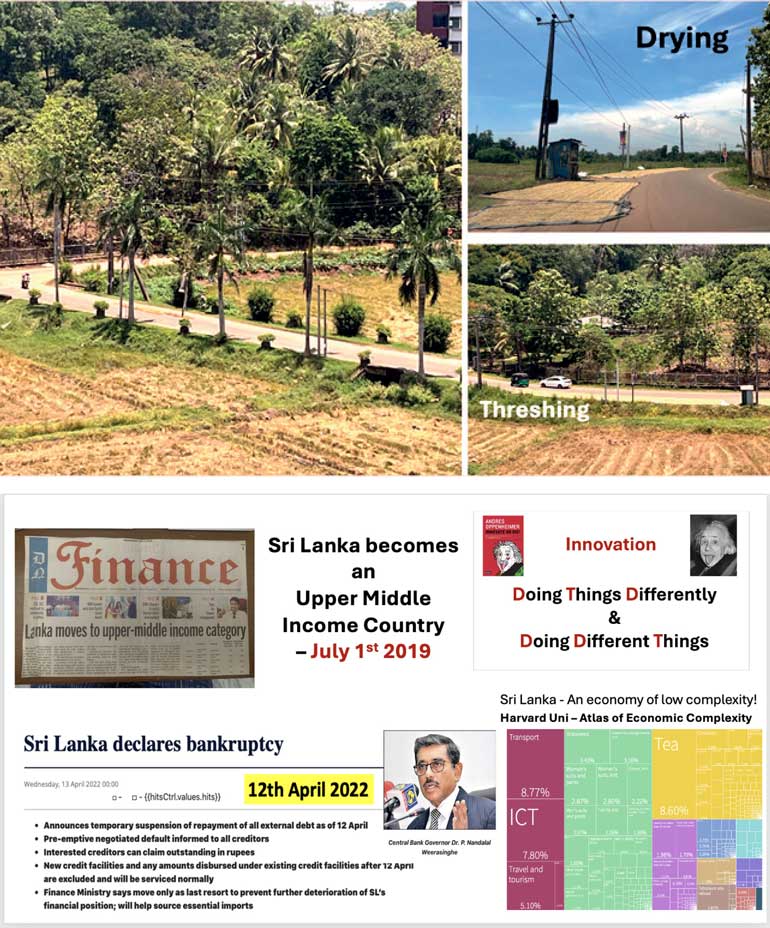
 On my way to a location adjacent to one of our foremost research institutes, I was struck by two ‘near stone age’ scenes: paddy drying along the roadside and someone inviting me to drive over the harvest for threshing, revealing how rudimentary our agricultural technology remains.
This illustrates my main concern—despite advances and repeated inquiries about paddy production and variety, our post-harvest processes have remained stagnant for decades. Meanwhile, institutions dedicated to improvement have existed for over 70 years, yet the gap between research and development and actual progress persists.
The paddy procurement system still leaves producers vulnerable to the weather. Ironically, our most advanced technology deployment is reserved for weddings and cricket matches—two events that reliably start on time in Sri Lanka, unlike vital sectors critical to the economy. This reflects a deeper issue: our national priorities seem misaligned, and our pursuit of productivity remains superficial. As global food security is threatened, reports now indicate Sri Lanka faces the worst risks among Asian countries.
Big Push theory
While we all get hit mercilessly with issue after issue, I note the topic on which the 2025 Nobel Prize in Economics was awarded– Innovation. Three recipients, Joel Mokyr, Philippe Aghion, and Peter Howitt, were rewarded for their work on technology and creative destruction for national economic growth.
It must be noted that this is not the first time this topic has been rewarded. In 1987, Robert Solow received the Nobel Prize for his work demonstrating that the US economy had advanced through technological innovation. In 2017, Paul Romer was recognised for his studies of endogenous factors in innovation. Romer showed that economic growth is not just about capital accumulation but is generated internally by people and firms seeking new ideas. He was essentially showing that companies do not innovate, but people do!
Although not awarded a Nobel Prize, Joseph Schumpeter first articulated the concept of creative destruction for economic growth in the 1920s. He was really discussing the disruptive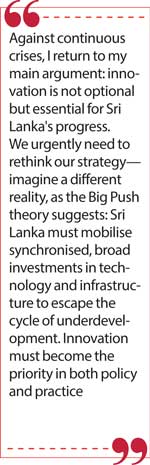 potential of technology in creating a different growth trajectory.
The reality is that the current situation and the basis of Sri Lanka's economy cannot be accepted, and we must recognise that tinkering with some financial ratios will not do us any good. It must be understood that the bedrock of income on which the Sri Lankan economy survives is remittances from the Middle East. Our national economic model should not be like that of a manpower agency. Imagining an alternative reality is the first step in the innovation journey, an imperative for Sri Lanka.
The Big Push theory in Economics is out there if one cares to learn from. The Big Push theory argues that underdeveloped countries require massive, synchronised, and comprehensive investment across multiple industries and infrastructure to break the cycle of poverty.
Against continuous crises, I return to my main argument: innovation is not optional but essential for Sri Lanka's progress. The Nobel Prize in Economics repeatedly highlights innovation as the foundation of economic growth. We urgently need to rethink our strategy—imagine a different reality, as the Big Push theory suggests: Sri Lanka must mobilise synchronised, broad investments in technology and infrastructure to escape the cycle of underdevelopment. Innovation must become the priority in both policy and practice.
It is worth recalling the oft-quoted comment of Albert Einstein: "Insanity is doing the same thing over and over again and expecting different results." That was the line that crossed my mind when I supported the request to drive over the produce.
As I teach food engineering myself, these views and reports hurt. I have my own ‘Big’ question: why are we doing what we are doing, knowing that this behavior is not going to take us anywhere to a meaningful destination? With research institutes, not just one but a few (especially one dedicated entirely to Postharvest Technology Research), in place, my view is that the researcher is not being heard or mobilised. Within one’s four walls, we may shout out, and our peers may dutifully listen and nod their heads in agreement, but walk out, and we know that someone who makes the decision is oblivious to what we are crying out loud!
I hope the comment on weddings and cricket matches using state-of-the-art technology is taken for digestion. I am serious about my statement. The investments in these are made with a complete understanding that this is the way these events should be conducted and managed. The event orchestration is meticulously planned, and the countdown is well managed. All necessary supply chains – costs immaterial – exist, and promotional events are held annually in convention centres. The event locations are excellently curated, and you see the investments – massive halls to light towers with the right flux levels– made expeditiously. As you pass towns, the event hall stands out! These services are well catered to, but they are consumption events. We are consuming at the expense of our nation!
Innovation: A mindset
Sri Lanka lags in investments that would enhance national resilience. My central point is that a creative destruction mindset—doing things differently and embracing innovation—must take centre stage. Instead, we often fall back on job numbers as the most desired metric in an investment project, or on outdated thinking. To escape stagnation, we need to shift from maintaining old processes to adopting innovative strategies. This change in mindset is critical for progress and long-term sustainability.
 Innovation must be embraced nationally, with society functioning as an innovation ecosystem. Creativity should drive growth, supported by structures that connect ideas, institutions, and industry.
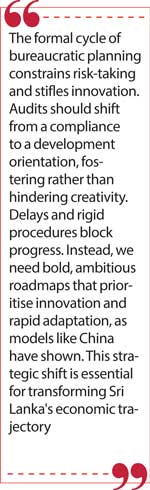
The formal cycle of bureaucratic planning constrains risk-taking and stifles innovation. Audits should shift from a compliance to a development orientation, fostering rather than hindering creativity. Delays and rigid procedures block progress. Instead, we need bold, ambitious roadmaps that prioritise innovation and rapid adaptation, as models like China have shown. This strategic shift is essential for transforming Sri Lanka's economic trajectory.
President Obama’s reminder about innovation as the engine of economic growth is a lesson Sri Lanka must heed. Our future depends on breaking from outdated models and implementing the bold, innovative strategies outlined by leading economists. Politicians and economists must support institutions and individuals in pursuing creative solutions, not just in maintaining political or bureaucratic processes.
My key question remains: will Sri Lanka plan and execute the Big Push for innovation, or remain stuck in inertia?
(The author is Professor of Chemical and Process Engineering at the University of Moratuwa and the Founding Chief Innovation Officer of the National Innovation Agency)



