Tuesday Sep 15, 2026
Tuesday Sep 15, 2026
Friday, 31 July 2026 00:22 - - {{hitsCtrl.values.hits}}
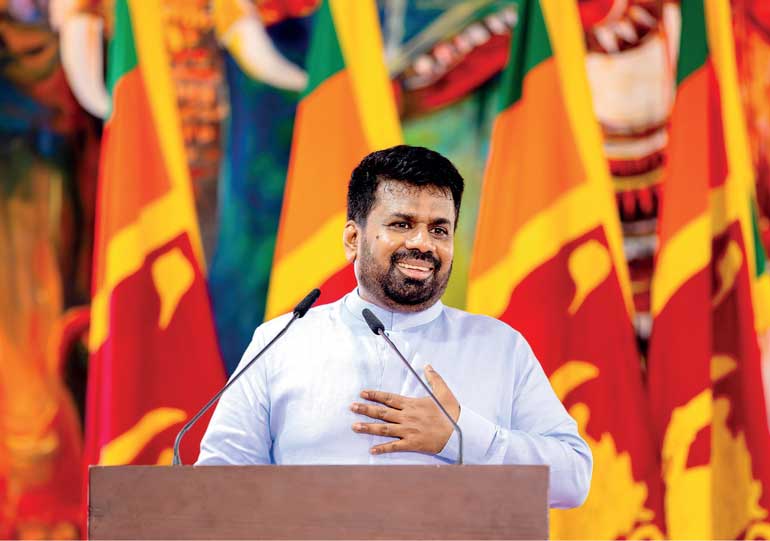
President Anura Kumara Dissanayake
 A transformative foreign-exchange idea can come from anywhere. Yet after decades of inadequate FX pathways that contributed to dependence on international sovereign bonds, Sri Lanka still lacks a national mechanism to receive, evaluate and activate the strongest proposals. Future debt commitments make new inflows increasingly vital
Sri Lanka has achieved something important. After the economic collapse, foreign-exchange conditions have stabilised, reserves have improved, and confidence has begun to return. Dedicated public officials, private-sector leaders, workers, overseas Sri Lankans and citizens who endured painful adjustments all contributed to this recovery. That progress deserves recognition.
But stability and resilience are not the same.
Stability means that the immediate pressure has eased. Resilience means that the country has built sufficient, diversified and dependable foreign-exchange earning capacity to withstand the next shock, meet its future obligations and finance rising prosperity without repeatedly returning to external borrowing.
That distinction matters because Sri Lanka’s present external stability came from a combination of debt-service relief, compressed imports, recovered remittances and tourism, official financing, stronger macroeconomic management and modest export improvement. It did not come from an extraordinary, reform-driven expansion in earnings from goods and services exports. These measures created breathing space. The national question is how we use it.
Stability, but not yet transformation
The World Bank has observed that Sri Lanka recorded a current-account surplus in 2023 for the first time since 1977. The Central Bank reported another surplus in 2025, while gross official reserves rose to approximately $6.8 billion by year-end. These are meaningful achievements.
Yet the composition of the improvement should keep us realistic. Goods exports in 2025 were about $13.6 billion and services inflows about $7.1 billion. In 2019, before the pandemic and the crisis, goods exports were about $11.9 billion and services receipts about $7.5 billion. Despite changes in statistical coverage, the broad picture is clear: Sri Lanka has recovered, but it has not experienced the scale of export transformation that would make the external sector permanently secure.
The vulnerability remains visible. In the first four months of 2026, the merchandise trade deficit widened substantially, with higher fuel imports among the pressures. One shock can quickly consume hard-earned gains.
This is not an argument against the traditional pillars of exports, tourism, remittances, foreign investment and productivity reform. Each remains important. It is an argument that, after nearly five decades of recurrent current-account pressure, those familiar pathways, operating at the scale and speed Sri Lanka has so far achieved, have not been sufficient to meet the country’s total foreign-exchange demand.
What decades of deficits are telling us
A current-account deficit is not automatically a sign of failure. A developing country may import machinery, technology and productive capacity, financing them with long-term investment that later generates exports and income. Under the right conditions, a deficit can accompany genuine development.
The danger arises when deficits persist without creating enough new foreign-exchange earning capacity to service the liabilities accumulated to finance them.
For years, Sri Lanka bridged part of its external gap through borrowing. International sovereign bonds offered quick access to large volumes of foreign currency. They relieved immediate pressure, but they also created concentrated repayment obligations in dollars. Borrowing can buy time; it cannot substitute indefinitely for the capacity to earn.
Fiscal weaknesses were also central to the crisis, and a credible solution cannot ignore them. But even perfect fiscal discipline would not remove the need for a stronger external-earning base. Sri Lanka’s challenge is therefore twofold: manage what it spends and expand what it earns from the world.
The debt restructuring has extended maturities and provided valuable relief. It also means that heavier payments lie ahead as grace periods end and amortisation rises after 2028. The country therefore has a limited window in which to convert present stability into lasting capacity.
The most dangerous response would be to treat this breathing space as proof that the structural problem has been solved.
The missing pathway
Sri Lanka may not be short of transformative ideas. It is short of a national system capable of turning the best of them into tangible results.
An idea capable of creating significant new net foreign-exchange inflows may arise far beyond the institutions normally expected to produce economic policy. Who proposes an idea should not matter. What matters is whether it is supported by evidence, practical to implement and capable of creating real value for the country.
At present, Sri Lanka has institutions to promote investment, exports, tourism, technology and enterprise. They carry out important work, often under difficult conditions. There are also forums, committees, consultations and sector-specific channels. What appears to be missing is one visible, nationally authorised and cross-sector pathway through which a serious FX-generating proposal can be:
received, screened, evaluated, coordinated, decided upon, facilitated, activated, measured and promptly scaled where successful.
Without that pathway, proposals depend too heavily on personal access, chance introductions or the exceptional interest of an already overburdened official. An idea may be forwarded from one institution to another, discussed without an accountable next step, or delayed until the opportunity passes. The country cannot know how many valuable possibilities have disappeared in this manner, because what is never properly received is never recorded.
If a nationally valuable proposal can progress only when one extremely busy chairman, secretary or director personally finds time to read it, the problem is not the commitment of that individual. It is the absence of a dependable process to carry the proposal forward.
Dedicated officials are not the problem
Sri Lanka is fortunate to have many capable public officers who work tirelessly, frequently under severe resource constraints and relentless daily pressure. They must manage urgent files, existing programmes, ministerial requirements, investor issues, international commitments and the constant consequences of earlier weaknesses. Much of their work is invisible.
It is neither fair nor effective to add a national search for new FX pathways to this workload and hope that a few exceptional individuals will somehow carry it.
This task should not depend on individuals. It should be built into a well-structured, transparent mechanism capable of examining every proposal it receives and identifying those suitable for implementation.
Governments change. So do chairmen, secretaries and directors. But the nation’s ability to listen, evaluate and activate good ideas should not disappear with them. A permanent mechanism would support officials by bringing discipline to the flow of proposals, separating credible opportunities from vague suggestions, assigning responsibility, coordinating agencies and making progress visible.
Its purpose would not be to bypass public institutions, but to help them work together around a measurable national outcome.
Not another suggestion box
The proposed mechanism should not become a website into which ideas are submitted and forgotten, or another committee that measures activity through meetings held, papers circulated or proposals “under consideration”.
It is not intended as a grant programme, public-relations exercise, general complaints channel or route for favouritism. Environmental, legal, financial and national-security safeguards would continue to apply.
Its purpose would be specific: to identify and activate credible initiatives that can generate additional, measurable net foreign-exchange inflows for Sri Lanka.
The central measure would be net foreign currency contribution (NFCC): the gross foreign currency expected to enter Sri Lanka, less the direct foreign-exchange outflows needed to establish and operate the activity. A proposal that reports large dollar revenue while requiring equally large dollar expenditure does not strengthen the country in the same way as one that retains substantial net value locally.
Forecasts and verified results are not the same. Success should be counted when a transaction is activated and foreign exchange is actually earned, not when a proposal is launched or announced.
Other considerations would also matter: evidence of overseas demand; an identifiable implementing party; a credible funding route; time to the first FX receipt; jobs and skills created; local value retained; public cost; scalability; and the precise government barrier, coordination failure or regulatory uncertainty preventing activation.
This would focus attention on proposals that need a practical state response, rather than ideas whose only request is that government finance the entire venture.
From proposal to national result
The detailed design can follow in a formal project proposal. The first national decision is whether Sri Lanka wishes to create this capability at all. Once that decision is taken, the structure, safeguards and operating procedures can be developed around the required outcome: turning credible proposals into measurable new foreign exchange.
Such a mechanism would not guarantee the acceptance of every proposal. It would ensure that serious proposals receive a fair, timely and accountable decision, with a clear answer rather than indefinite silence.
The President and Cabinet could determine its most suitable institutional home. What matters is that it has sufficient national authority to bring the relevant institutions together and clear accountability for results.
Others have institutionalised listening
Sri Lanka would not be experimenting with an unknown principle. Since 2000, Singapore’s Pro-Enterprise Panel has received over 2,000 suggestions and helped produce over 1,100 changes to rules and regulations. Its process includes a preliminary assessment within one month. Singapore also provides a route for testing new ideas under controlled regulatory conditions. In the United Kingdom, the Financial Conduct Authority’s Regulatory Sandbox gives eligible innovators a dedicated case manager and allows solutions to be tested within a controlled framework.
These are not exact templates for Sri Lanka, and neither is designed specifically as a national FX mechanism. They show a simple truth: effective states do not merely hope that valuable ideas will find the right official. They create a clear path from proposal to decision, and from experiment to adoption.
Many new paths, not one miracle
No single proposal will repair Sri Lanka’s external economy. Nor should the country wait for one spectacular project to solve everything.
Resilience is more likely to come from activating many additional pathways: some large, some modest, some immediate and some that mature over time. A disciplined mechanism would create a portfolio. A few proposals may produce limited results, while the strongest could open entirely new sources of earnings. Lessons from each attempt would improve the next.
This approach also changes the national conversation. Instead of asking only how to borrow, conserve or allocate scarce foreign exchange, Sri Lanka would continuously ask: what credible new value can we offer the world, what prevents us from doing so, and how quickly can that obstacle be responsibly removed?
The impact would extend beyond the balance of payments. A country that can recognise and activate good ideas encourages entrepreneurship, attracts capable Sri Lankans overseas, gives investors’ confidence in public institutions, creates productive employment and restores belief that initiative can lead to results. It signals that the nation values practical intelligence wherever it is found.
Over time, such a system would strengthen the state itself. Its immediate output may be additional FX. Its wider value would be a government that learns faster, coordinates better and converts opportunity into national value.
The opportunity before the President
Mr. President, Sri Lanka’s next economic breakthrough may already exist in the mind of an entrepreneur, professional, investor, researcher, public officer or Sri Lankan living overseas.
It may not require a large allocation of public money. It may be waiting only for a decision, a regulatory clarification or cooperation between institutions. Yet whether it progresses can still depend more on access and timing than on its value to the country.
That is the gap this article asks you to close.
A Presidential decision to initiate this mechanism would make the search for credible new FX earnings a continuing national responsibility, rather than an occasional effort without clear ownership. It would also provide a way forward for valuable proposals that do not fit neatly within the responsibility of one institution.
Sri Lanka now has a period of relative stability in which to act. It will not last indefinitely. What the country builds during this period will help determine whether future obligations are met through stronger national earnings or renewed dependence on borrowing.
This could become a lasting contribution of your Presidency: a country that no longer leaves its strongest ideas to chance, but has the ability to recognise them and turn them into economic value.
The opportunity is clear. Create the national pathway that can turn Sri Lanka’s strongest ideas into new foreign-exchange earnings and lasting economic resilience.
(The author is a Chartered Engineer, entrepreneur, industrialist and exporter. He is the Founder and Chairman of the KIK Group of Companies. He has more than three decades of experience in export-oriented engineering and manufacturing. He writes from practical experience on enterprise development and strengthening Sri Lanka’s foreign-exchange resilience. The views expressed are his own. He could be reached via email [email protected])




