Thursday Oct 15, 2026
Thursday Oct 15, 2026
Thursday, 23 July 2026 00:40 - - {{hitsCtrl.values.hits}}
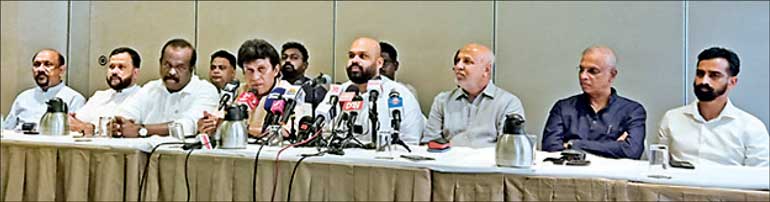
New platform of six parliamentary parties representing the Tamil-speaking people
 The Minority Six should stick to two of their three demands—hold PC elections swiftly and expedite the processing of return of lands. An all-parties campaign, national and international, demanding Provincial Council elections within a transparent, compressed yet reasonable time-frame, could be legitimately initiated by the parliamentary minority caucus
 The CPA’s latest poll made headlines. The headline-getter was the contrast between President AKD’s approval rating and that of Opposition Leader Sajith Premadasa. “…The survey found that 75.5% of respondents are satisfied with President Dissanayake’s performance, compared to 29.4% for Opposition Leader Premadasa”.
The proof of the pudding is in the eating. If AKD was even remotely as popular as the CPA figures claim, it just does not figure why the ruling JVP-NPP fails to:
 Win any multi-purpose cooperative society elections, and has instead experienced a continuing chain-reaction of defeats at the hands of a combined Opposition led by the SJB, the latest being in Naula and Karuwalagaswewa. The SJB’s numbers alone are larger than the JVP-NPP’s.
Go for several Chief Ministerships by taking the swiftest path to Provincial Council elections this one time, instead of indefinite filibustering and postponement. Dr Nalinda Jayatissa’s recent clarification on the subject retains an open-ended timeline.
Minority bloc
Six parliamentary parties representing the Tamil and Muslim people have constituted themselves into a single political platform. I call it a minority bloc or caucus.
In a revival of an old term, it is billed an in-gathering of the Tamil and Muslim parties, collectively representing the ‘Tamil-speaking people’. It consists of the Ilankai Tamil Arasu Kachchi (ITAK), Sri Lanka Muslim Congress (SLMC), Tamil Progressive Alliance, All Ceylon Makkal Congress (ACMC), Democratic Tamil National Alliance (DTNA), and the Ceylon Workers’ Congress (CWC). The leading personalities of the new bloc are M.A. Sumanthiran, Jeevan Thondaman, Rauff Hakeem, Mano Ganeshan, Selvam Adaikalanathan, and Rishard Bathiudeen.
Coverage in the mass media and social media have focused on a supposed split in the Opposition where several parties belonging to Sajith Premadasa’s Samagi Jana Sandhanaya are members of the new minority bloc. This is a grey area, because nothing prevents the six-party bloc acting as a caucus on minority issues while remaining with and within the Samagi Jana Sandhanaya, or returning to it at a national election. But it could also mark an exit from the SJS.
Social media shows a paranoid alert about a convergence of minorities and a near-hysterical call for majority unity to counter it.
As a student of politics, I see nothing amiss in the formation of a minority caucus in the legislature. The USA has long had a respected Congressional Black Caucus.
Tamil Nadu factor
Gajendran Ponnambalam and his party are not members of the new bloc. In fact, the timing of its emergence seems to make it something of a counter to the splash that Ponnambalam made in Tamil Nadu when he met the youthful new Chief Minister.
On his trip to Chennai, Ponnambalam called for political parties in Tamil Nadu and Sri Lanka to form a joint forum which will commit itself to Federalism for the Tamil people of Sri Lanka.
Whether this will happen some way down the road one doesn’t know. But the opening for him to raise such a slogan across the water, comes with the political vacuum at the provincial level in Sri Lanka, with the extended deep-freeze of Provincial Councils by the Anura Dissanayake administration.
If we had elected Provincial Councils up and running, that would have been Sri Lanka’s answer to this new demand. The Government and our able High Commissioner would only have needed to point to the PC system which emanates from the Indo-Sri Lanka Accord. Now, we have nothing to say in our defence; no political shield to raise. The situation is wide open for radical Tamil nationalists like Gajan Ponnambalam to overtly solicit Tamil Nadu political interference in our politics.
While Ponnambalam beckons Tamil Nadu political interference—and he may not be the only one, as it might prove politically contagious among Tamil politicians—the SJB’s Dr. Harsha de Silva has resumed his public crusade to hook up Sri Lanka’s economy with that of Tamil Nadu. Such entanglement would only give Chennai a greater handle over Sri Lanka, and it would be hopelessly naive to imagine that Tamil Nadu’s pan-Tamil nationalism and competitive electoral compulsions will not drive its economic behaviour in the direction of the assertion of control over the neighbour.
Why would any patriotic Sri Lankan politician, Govt or Opposition, wish to confer Tamil Nadu with a potential handle over Sri Lankan affairs—economic, ethnic and geopolitical?
Logically, this means that the SJB trusts the JVP-NPP to produce a Constitution that is more progressive, advanced and enlightened than that which JR Jayewardene, Ranasinghe Premadasa and the UNP introduced (1978), and modified through the 13th Amendment (1987). Is it only me, or isn’t it surreal to see the SJB expecting—trusting— AKD, Tilvin and the JVP to produce a better Constitution than JR, Premadasa and the UNP?
PC elections vs. new Constitution
As for the minority caucus (or ‘Minority Six-Pack’), my critique is not its formation, but the content of its agenda. Firstly, it has a glaring gap. Secondly, it is headed in two contradictory directions.
Its joint communique says:
” “…any new Constitution should provide the maximum possible devolution of powers within a framework that ensures justice, equality, and meaningful power-sharing”.
“…The representatives…expressed hope that a common approach on these issues would contribute to reconciliation, democratic governance, and the protection of the rights of all communities in Sri Lanka…”
A country’s Constitutional framework—and certainly that of Sri Lanka and any country of the global South—must have as founding objectives, the safeguarding of National Independence, unity, territorial integrity and ensuring the sovereignty of the people. However, the minority platform does not have any such overarching national/State goals. It reduces the aims of the Constitutional framework to justice, equality and meaningful power-sharing, with no commitment to the unity, territorial integrity and sovereignty of Sri Lanka as a single country. “Reconciliation, democratic governance, and the protection of the rights of all communities” are valid and valuable but the absence of an overarching commitment to Sri Lanka as a State, a country, not simply a (geographic) place, is a dangerous political Freudian slip.
The minority platform wants the Provincial Council election expeditiously held. It also wants Constitutional reform or a new Constitution. “…They have identified three immediate priorities: Constitutional reform with meaningful power-sharing; the conduct of PC elections without further delay; and the resolution of land issues affecting Tamil, Muslim, and Malaiyaha Tamil communities….” (https://www.ft.lk/news/Tamil-parties-urge-President-to-fulfil-pledges-bring-new-Constitution-hold-PC-polls-and-grant-land-rights/56-794632)
The last time the Tamil and Muslim parties sought a new Constitution making for greater power sharing than in the existing Constitution (i.e., the 13th Amendment) was 2015-2019. The upshot is that they are now lobbying plaintively for the holding of Provincial Council elections which they had enjoyed even in wartime but find jammed-up indefinitely by the ‘more meaningful’ amendments they helped introduce. The new, non-unitary Constitution project also helped elect Gotabaya Rajapaksa President.
The time before that, when they held out for a new Constitution during the tenure of President Chandrika Bandaranaike Kumaratunga, the upshot was that her ‘quasi-federal’ political packages were blocked and the backlash secured Mahinda Rajapaksa the candidacy and the presidency.
The Tamil parties forgot the truism that ‘a bird in the hand is worth two in the bush’. The bird in the hand is/was the 13th Amendment. Looking for a bigger bird, the Tamil and Muslim parties seem to have lost the one they held in their hand—the system of elected Provincial Councils (1987). Now they want a bigger bird while also wanting the old one back!
There isn’t a shred of evidence that a new or reformed Constitution would make for greater power sharing with the provinces than the existing 13th Amendment.
The Minority Bloc plus outlier Gajan Ponnambalam fail to recognise the obvious: the 13th Amendment which they want replaced—qualitatively superseded—was the product of a set of forces, factors and circumstances which no longer exist and have been supplanted by forces, factors and circumstances which have moved decisively in the opposite direction.
Black July’83, the LTTE and other armed organisations, the Eelam war, Indira’s India, a pro-devolution left and a ruling UNP that had agreed to devolution in principle, all made for the 13th Amendment enabling devolution to elected provincial administrations within a unitary State —but not beyond.
None of those factors exist anymore. Some exist in reverse. India’s priorities vis-a-vis Sri Lanka have changed. The Eelam war was lost by the secessionists and won by the State. Prabhakaran is dead, the Tigers decimated, the non-LTTE Eelam movement extinguished. The ruling JVP is not ambivalent about devolution as was the UNP, or pro-devolution as was the left led by Vijaya Kumaratunga, but was bitterly hostile to it and remains opposed to provincial devolution as a concept.
The only new card for the Minority Caucus to play is the young Tamil Nadu Chief Minister, but what MGR couldn’t do in wartime with Prabhakaran in play, it is impossible for Thalapathy Vijay to achieve in post-Prabhakaran peacetime.
It would be a commendable feat to retrieve the 13th Amendment, but to expect a new Constitution or a reform to go beyond the 13th Amendment and the unitary State in terms of power-sharing is wildly irrational.
If there is a new system of devolution, it will surely have a smaller unit and/or lesser degree of power-sharing, not a greater one. If it comes to a vote at a referendum, greater devolution will be shot down, as will a new Constitution if it entails greater devolution with or without the executive Presidency. After a defeat, it may be zero-devolution or small-unit devolution that survives. Why should the minority caucus take that risk?
The Minority Six should stick to two of their three demands—hold PC elections swiftly and expedite the processing of return of lands. An all-parties campaign, national and international, demanding Provincial Council elections within a transparent, compressed yet reasonable time-frame, could be legitimately initiated by the parliamentary minority caucus.
SJB’s ‘New Constitution’ illogic
Sri Lankan politics lacks rational thinking. We already have a Constitution which makes for power-sharing (the 13th Amendment) though the latter needs to be unfrozen and reactivated. In any walk of life, when one asks for something new, one must do so either when the old no longer exists and there’s an absence to be filled, or there’s certainty that the new which one will get in exchange for the old, is better than the old which exists.
What gives the minority bloc or the SJB the slightest notion that the new Constitution they are urging the JVP-NPP to introduce, will be better, especially in respect of power-sharing, than the current Constitution?
One can understand the Opposition making a case for a new Constitution, presenting its own ideas, and pledging implementation at an election campaign, when seeking office. That is what JR Jayewardene did in his 1977 election manifesto, having first surfaced the idea in 1966.
But that is not what the SJB and minority bloc are doing. They are lobbying the incumbent President and Cabinet to bring in a new Constitution.
Logically, this means that the SJB trusts the JVP-NPP to produce a Constitution that is more progressive, advanced and enlightened than that which JR Jayewardene, Ranasinghe Premadasa and the UNP introduced (1978), and modified through the 13th Amendment (1987).
Is it only me, or isn’t it surreal to see the SJB expecting—trusting—AKD, Tilvin and the JVP to produce a better Constitution than JR, Premadasa and the UNP?
Isn’t it surreal to see the six-party minority platform expecting—trusting—the JVP which tortured and killed pro-autonomy leftists well before the Indian intervention (university student leader Daya Pathirana) and have never apologised for it, to be architects of a better Constitutional arrangement for greater power-sharing than JR, the UNP and the Government of India produced in 1987?
What of the Opposition’s well-founded fears and warnings that the JVP-NPP is driving towards an authoritarian if not totalitarian system, and that there are many signs of that in the JVP’s politicisation of the power-structures and programs as well as in its public discourse?
The Opposition simply cannot have it both ways. If the JVP-NPP is creeping towards some form of dictatorship, why ask them for a new Constitution which they will only use to further their project of control? A new Constitution would also remove the entrenched, mandatory timeline for the holding of a presidential and parliamentary election. A new Constitution was used as a portal once before (1972) to extend the Government’s term of office. Why run that risk with the JVP-NPP which is ideologically predisposed towards totalitarianism?
Is it that the two Opposition formations —the new minority bloc and the SJB—think that a new Constitution or constitutional reform under the AKD administration is desirable and feasible because the Opposition will produce, articulate and push for enlightened proposals? It is obvious that the Opposition doesn’t have the numbers—the SJB has under 50 and the new Minority Six-Pack has around 20—so how on earth are they going to push through enlightened reform?
The JVP-NPP hardly allows Sajith Premadasa and the Opposition to speak in Parliament, so what makes the Opposition think this Government will magically metamorphose into a benign, enlightened entity which adopts the SJB and the Tamil-speaking bloc’s ‘advanced’ constitutional proposals?
The JVP-NPP doesn’t need the numbers; they have their own. A new Constitution would reflect the JVP’s and its NPP fellow-travellers’ ideas, ideology and political interests, and entrench a monopoly of power. What kind of Opposition can’t figure that out?
The Opposition simply cannot have it both ways. If the JVP-NPP is creeping towards some form of dictatorship, why ask them for a new Constitution which they will only use to further their project of control? A new Constitution would also remove the entrenched, mandatory timeline for the holding of a presidential and parliamentary election. A new Constitution was used as a portal once before (1972) to extend the Government’s term of office. Why run that risk with the JVP-NPP which is ideologically predisposed towards totalitarianism?
Socioeconomic majoritarianism
The Tamil-speaking parties’ platform could be completely flouting the advice given by Lord Soulbury to C. Suntharalingam in 1964. Expressing regret that he didn’t build-in more safeguards for the Tamil minority into the Constitution, he recommended a strategy of mainstream affiliation and participation. His example was the Northern Ireland Protestants’ cooperation with the UK Conservatives in Westminster. (The Catholics leaned towards UK Labour). Lord Soulbury explicitly recommended that the Tamil parties work with the UNP. The UNP space being occupied by its successor the SJB, the delinking/distancing by the minority bloc from Sajith’s SJB implies a rejection of Soulbury’s strategic counsel.
On the other hand, the distancing of the minority bloc from the SJB may be a blessing in disguise. The TNA/ITAK’s lobbying for a new non-unitary/quasi-federal Constitution in place of optimising the 13th Amendment—the result of the Indo-Sri Lankan Accord—did enormous damage to the administrations of Chandrika Bandaranaike Kumaratunga and Maithripala Sirisena, while supporting Ranil Wickremesinghe’s UNP “like a rope supports a hanging man” (as Lenin’s sardonic line goes).
Without the minority parties, Sajith/ SJB can no longer count axiomatically on the minority vote. The SJB is liberated from the liability of bearing the tattoo of ‘minoritarianism’ that eroded Ranil Wickremesinghe’s UNP for decades.
This means that the SJB will have to compete for Sinhala votes with Anura Dissanayake’s JVP-NPP, Namal Rajapaksa’s SLPP and Dilith Jayaweera’s Sarvajana Balaya on a level playing field.
This does NOT mean that the SJB has to resort to ethnoreligious/ethno-lingual nationalism. What it does mean is that the SJB has to revert to the Ranasinghe Premadasa strategy of socioeconomic majoritarianism, rather than ethnoreligious majoritarianism.
Premadasa’s primary base was the “nathi-bari”, the “have-nots” whom he sought to turn into “athi-haki”, “haves”, by levelling upwards.
Wrapped around this socioeconomic majoritarian core was a thick periphery of ethnic, religious, linguistic, cultural minorities.
President Premadasa’s strategy was the alliance of the socioeconomic majority of the majority, with the majority of the minorities, in a patriotic, populist, pluralist bloc.




