Monday Oct 12, 2026
Monday Oct 12, 2026
Monday, 27 April 2026 00:30 - - {{hitsCtrl.values.hits}}
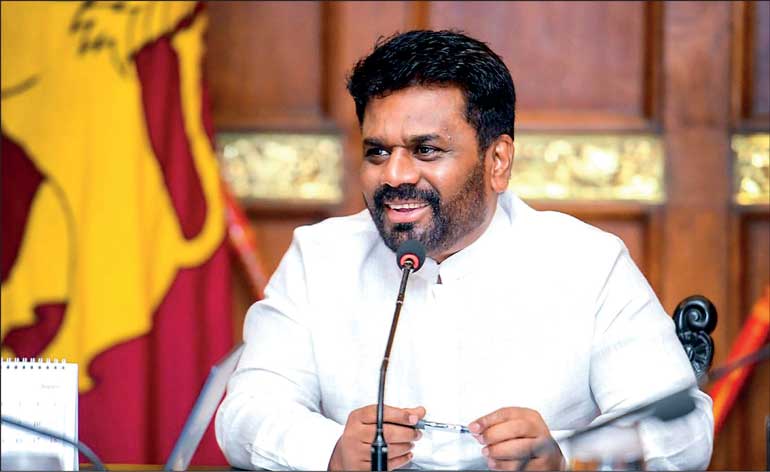
President and Finance Minister Anura Kumara Dissanayake’s Government is not single-mindedly focused on driving the economy forward, while the bureaucracy lacks the capacity to deal with the crises caused by the Middle East war

Boosting morale by promising opportunities
It has been fashionable for notable figures and political leaders to arouse positive sentiments among people deeply entrenched in crises, urging them not to lose faith but to use crises as opportunities to make a new start as a nation.
The 2nd Century CE Roman Emperor, Marcus Aurelius, put this nicely into a workable guide by advising that ‘the impediment to action advances action; what stands in the way becomes the way’[1]. In a speech in 1959, US President John F. Kennedy is reported to have said that crisis represents both danger and opportunity though his critics had later pointed out that Kennedy’s wisdom had come from a mistranslation of the Chinese characters used for writing the word ‘crisis’[2]. When the Central Bank of Sri Lanka was partly destroyed by an LTTE bomb in 1996, the then Governor, the late A. S. Jayawardena, boosted the dimmed morale of the workforce by suggesting that the reemergence of the bank will be like the mythical bird Phoenix rising from the ashes as portrayed in a famous Greek story[3].
However, economists have outdone these political leaders by observing the cause and effect of a destructive crisis and labelling it as an instance of creative destruction. The 19th Century French economist and statesman, Frederic Bastiat saw the advantage of broken windows because people could replace them with more modern ones, on one side, and keep industry going by creating a new demand for windows, on the other[4]. The Austrian American economist Joseph Schumpeter observed that capitalist societies advance by destroying the existing methods and introducing new methods which are akin to creative destruction[5]. Hence, crises are not disasters about which people should continue to lament and wail. They carry the prospect of harnessing benefits by converting crises into opportunities.
Sri Lanka’s bleak future
Crises are either man-made or God-made. Whatever the source, they put people into inexplicable destitution and untold suffering. In the case of Sri Lanka, the country was recovering slowly from the man-made economic crisis of 2022-3 when it was hit by a God-made crisis called Ditwah.
 With enormous difficulties and international support, the country had implemented some rescue methods, though from the point of critics, they were not optimal ones.
Then, it was hit by a man-made crisis in the form of a prolonged war between USA and Israel, on one side, and Iran, on the other. The war has disrupted the global supply chain derailing Sri Lanka from its natural growth path, elevated the energy, LP gas, and fertiliser prices to historically high levels causing inflation, on one side, and depleting foreign exchange reserves putting pressure on the exchange rate to fall, on the other, and partially killed the country’s three short term saviours – remittances, tourism income and exports – making recovery a distant goal.
The Central Bank has, while releasing the Annual Economic Review for the Year 2025, flagged these issues as follows: The ‘persistently elevated global uncertainties, including geopolitical tensions, trade disruptions, and climate-related risks, pose continued challenges to the economic outlook, which remains contingent on the duration and magnitude of the ongoing war in the Middle East and its potential spillovers to global energy markets, trade flows, and financial conditions. Inflation, which has remained low thus far, is expected to return to target sooner than previously anticipated, reflecting the impact of the war in the Middle East’[6]. Thus, according to the Central Bank, with these external crises prolonging, the prospects for 2026 and beyond are not that palatable.
Opportunities created by conscious action
Therefore, there is no choice for Sri Lanka but to convert the current crisis into an opportunity for growth, prosperity, and wealth. However, opportunities do not arise automatically in response to wishful thinking. They are consciously created by people who recognise the need for change and act decisively. A crisis may present openings for improvement and change, but it is human action, focused and strategically directed, that will transform these openings into tangible benefits.
For this purpose, governments, businesses, and citizens should assess the situation, adapt, and implement strategies to harness potential advantages. The US based private thinktank, the Brookings Institution, has presented a research paper in which step by step procedure has been presented how a crisis could be converted to an opportunity [7].
Five recommended actions
According to this paper, it is necessary to see, think, and respond to a crisis in new ways as the necessary groundwork when a policymaker is planning to turn it into an opportunity. In this case, the application of traditional responses could provide temporary relief by lessening the pain embedded in the crisis, but it is not the way to resolve the underlying problem resolutely. The approach recommended in this case involves five steps.
 Define crisis
The first step is to define the crisis appropriately in terms of its severity. If the term crisis is casually applied to any problem faced, then all become crises, and policymakers are prevented from adopting measures to convert them into opportunities. This is a disastrous mentality that should be avoided because such a broad approach will burn out the policymaker, delay implementation, or ruin the resolution path. A crisis like the Ditwah cyclone can easily be defined and its costs reckoned.
This was done by the World Bank Group by making a global rapid post-disaster damage estimation, known as GRADE in late 2025[8].
However, crises like the current Middle East war involve a series of events that change from day to day. Their costs accrue gradually, preventing the making of a clear-cut definition. A quick response team can handle crises falling into the first category. However, those occurring over a period will require policymakers to wait patiently to enumerate all the events and costs. While the first category can be converted into opportunities easily, the second category lacks that ease.
This is a serious issue relating to the conversion of the current Middle East war into an opportunity. As a result, when one opportunity is identified for pursuit, its importance is soon lost due to changes in subsequent events.
Understand the severity
Step two requires policymakers to understand the nature and the process of the crisis as it begins to unfold. A crisis can be a linear, dynamic one with a particular trajectory or a reinforcing vicious circle that needs to be broken into separate segments for application. The result of the first category can be identified easily, and the opportunities it would present can also be marked out. However, the second category does not allow such easy identification, and the uncertainty involved makes it difficult for policymakers to list the possible opportunities.
The Middle East war today is an example of such a reinforcing vicious circle. As a result, the changing goalposts in the crisis stand in the way of formulating strategies to identify the available opportunities.
Reframe the problem
Step three involves reframing the problem by looking at the issue through a different lens. Using the example of a camera, reframing could include widening the aperture of the lens to see more of the problem. Alternatively, it could also include bringing in lessons from other domains, such as converting a previous crisis into an opportunity within the country or drawing on such experiences in other countries. In the case of the Ditwah cyclone in Sri Lanka, it has provided a wider aperture to closely examine the engineering sustainability of the washed-out railway tracks in the country. If they had not met the required engineering norms, the cyclone would provide an opportunity to rebuild the railway tracks with modern engineering skills.
Admit mistakes
Step four is the recognition of the fallibility of the human beings involved. In sandbox experiments, users are permitted to make mistakes, and those mistakes are tolerated by superiors. Likewise, if innovative and creative solutions are to be encouraged, it is necessary to recognise that the best outcomes come from many trials and errors. People engaged in finding opportunities in a crisis will propose creative solutions if they are not penalised for their mistakes.
Leadership matters
Step five relates to the quality of leadership. Leaders need to be able to rise above the management of a crisis and shape the perception of the event internally as well as externally. This requires getting enough people within an organisation to accept the creation of new opportunities. A prerequisite for this is building trust and confidence in the capability and vision of the leaders. When distrust prevails, a crisis can emerge within a crisis rather than an opportunity to harness benefits.
Creating opportunities, a human issue
The above analysis signifies that turning a crisis into an opportunity is a human problem. A machine, or even the best computer in the world, cannot substitute for human skills, talents, or innovative ideas. From identifying the nature of the crisis to searching for the opportunities it may offer, the process should be directed by human beings through human action, though they can be supported by machines to do a better job. In this case, humans are the masters, and machines are simply servants.
Since governments are key players in turning crises into opportunities, those masters come from political leadership and the supporting bureaucracy. It is therefore necessary that those concerned be properly trained to pursue a single focus, equipped with both global and local knowledge, and flexible enough to admit errors and adopt corrective measures.
Need for united action
In this context, I observe two issues. One is that the political leadership is not single-mindedly focussed to drive the economy forward. In the present Government led by President Anura Kumara Dissanayake, the diverse views expressed by its leaders in public forums are a testimony to this. The other is that the bureaucracy is not properly trained and geared to addressing a national issue like this. I have written about how different Government agencies have thwarted a genuine attempt by an Indian investor to setup a mini hydroelectricity project in Ginigathhena though moving into sustainable energy has been a declared goal of the Government [9].
Woeful experiences of an Indian investor
The circumstances of the case are as follows: it involves an Indian investor who has set up a well-functioning mini hydroelectricity project under the approval of the Board of Investment and the Ceylon Electricity Board. Instead of taking profits back to India, which he is permitted to do, he had reinvested the proceeds in Sri Lanka, an activity classified as foreign direct investment for statistical purposes. He had already set up a 100-room hotel in the Eastern Province to cater to growing tourist demand. In the current case, he has planned to reinvest the retained profits, amounting to Rs. 400 million, in a new mini-hydro project.
Multiple approvals
The Land Reform Commission, which had owned the land, had leased it to the Indian investor for 30 years, and the land had been handed over to the company in 2023. The investor had paid five years’ lease rental in advance to the Land Reform Commission. Earlier, the Central Environmental Authority had granted approval for the project after completing due process in 2018. That due process had involved conducting consultations with 17 State stakeholders, including the Forest Department. After that, all the necessary approvals from other Government authorities had also been obtained.
A formal agreement had been signed with the Mahaweli Authority, which has power over the use of river water and the associated lands. Then, the Sustainable Energy Authority had declared the entire area, including the project land, as a dedicated renewable energy development zone. A power purchase agreement was also signed with the Ceylon Electricity Board in 2023.
Following these approvals, the investor had signed contracts with overseas suppliers of machinery, engaged local consultants and civil works contractors, and commenced construction work on the land concerned. In addition, as directed by the Divisional Secretary of the area, approval from the Urban Development Authority, Nuwara Eliya, had also been obtained in November 2025. The National Building Research Organisation had also granted its approval after assessing the geological, hydrological, and environmental risks involved.
As it is, the investor had obtained the clearance of all the Government agencies involved not by visiting a single office, as recommended by the Japanese Ambassador, but by going from one office to another, which did not have any coordinated work, at severe cost to the investor. The investor had proceeded with the work with confidence. However, an initial objection made by three local citizens to the police, claiming that the project had affected their lives, led the courts to issue an injunction to halt the commencement of work.
After a lengthy court inquiry, in which the approving Government agencies had been summoned and heard, the court dismissed the case and permitted the project to proceed in June 2024.
Final spanner
According to the local agent of the investor, when everything was moving smoothly, the Forest Department put a spanner in the works by claiming that the land earmarked for the project had been identified as far back as 1992 as a forest reserve. Since the Forest Department has discretionary powers, other Government agencies cannot overlook its objections, even though they may not align with the current development goals of the nation.
With this type of mentality held by some branches of the bureaucracy, it is unlikely that Sri Lanka could move forward with a planned program to turn crises into opportunities.
(The writer, a former Deputy Governor of the Central Bank of Sri Lanka, can be reached at [email protected])
1 Meditations, Book V, Verse 20.
2 https://www.brookings.edu/articles/sometimes-the-world-needs-a-crisis-turning-challenges-into-opportunities/
3 https://www.ft.lk/columns/Unsung-Central-Bank-heroes-who-braved-the-1996-LTTE-attack-Time-to-appreciate-their-heroism/4-787399
4 https://fee.org/articles/the-broken-window/
5 Schumpeter, Joseph, 1942, Capitalism, Socialism, and Democracy, 1994 Printing by Routledge, London, pp 82-83
6 https://www.cbsl.gov.lk/en/news/cbsl-releases-aer-2025
7 https://www.brookings.edu/articles/sometimes-the-world-needs-a-crisis-turning-challenges-into-opportunities/
8 See: World Bank, 2025, Global Rapid Post-Disaster Damage Estimation (GRADE) Cyclone Ditwah 2025 Sri Lanka, Washington DC
9 https://www.ft.lk/columns/Sri-Lanka-s-FDI-woes-A-one-stop-shop-is-the-most-urgent-priority/4-789593




