Wednesday Oct 21, 2026
Wednesday Oct 21, 2026
Monday, 6 April 2026 00:00 - - {{hitsCtrl.values.hits}}
 I have been recently mostly writing about the ongoing war and the possible impacts to Sri Lanka, and more specifically to Sri Lanka tourism. But amidst all this doom and gloom global events, there was a recent local news report regarding a leopard attacking and killing a monk. So for a change, even though this may also be a rather macabre story, I thought I would share some of my thoughts about this.
At the outset let me state that I am not an expert on leopards. However I have had conversations with leopard experts, and due to my own experiences with wildlife and elephants, (which I do know something about) and I will delve into this subject regardless.
The reported incident
Firstly the incident, as I have been able to gather from reports.
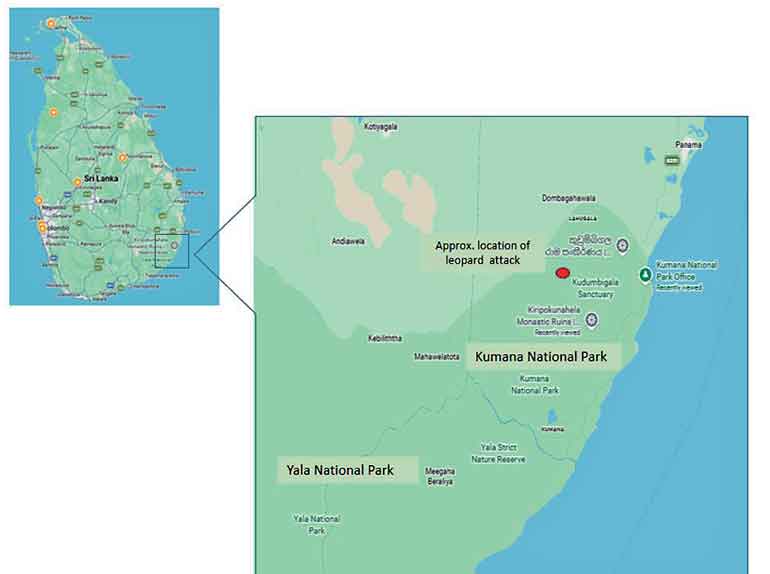
The Bambaragasthalawa Aranya Senasanaya (generally a Sanskrit term meaning forest monasteries used for meditation) is situated in the northern end of the in the Kumana National park (one of Sri Lanka’s popular national wildlife parks in the south east of the island). It is supposed to be dating back to the 9th century.
A 43-year-old Czech monk who had been meditating there, as was his usual practice, had been attacked by a leopard and killed on 25 March 2026.
This is most unusual, as generally leopards are not known to attack humans. However there have been isolated records of attacks in the past.
Historical information about leopard attacks
In 2019 there were a series of attacks reported around the Kumana National park. In one incident it resulted in the death of a labourer working on a park road and a safari jeep driver who went to the scene of the first attack with wildlife officers, was reported to have also been injured.
Historically, two notorious “man-eaters” have been recorded in Sri Lanka, both operating in the eastern region.
Now a “man-eater” is usually the term used for a wild animal, most often sharks, lions, tigers and leopards that have grown used to preying on humans. Normally no wild animal really preys on humans by instinct. However they could develop this trait, almost certainly after an initial, often chance, encounter where they discover humans are easy prey. A significant number of man-eaters are older, sick, or injured making them unable to catch fast, wild prey. Humans are slower, weaker, and easier to hunt.
The ‘man-eating leopard is the Man eater of Punanai: This is arguably the most famous and well-documented case in Sri Lanka’s history. The leopard was active in the early 1920s in the village of Punanai, on the east coast of Sri Lanka. According to reports it reportedly killed and devoured at least 18 to 20 people over a six-month period. It was eventually shot and killed in 1924 by Captain Shelton Agar, a British planter and hunter. The stuffed specimen is on display at the National Museum of Sri Lanka in Colombo. The leopard features in one of the books of Michael Ondaatje: The Man-eater of Punanai , a Journey of Discovery to the Jungles of Old Ceylon (1992).
In 1936, a different man-eater terrorised the small east coast village of Komari, north of Punanai, killing at least two people before it was shot.
More lately in the 1950s, an elusive leopard attacked pilgrims traveling to Kataragama in southern Sri Lanka, claiming several lives in the Pottana area before the attacks mysteriously ceased.
In another recorded incident in 1821 near Galle, a leopard killed five people before being destroyed. A post-mortem revealed human remains in its stomach
So there have been a few sporadic leopard attacks on humans in Sri Lanka remain rare.
Leopards and humans
Leopards are exceptionally elusive and adaptable big cats, capable of coexisting with humans in both low and high-density populated areas. Their ability to thrive close to humans is driven by their secretive nature, nocturnal habits, and opportunistic diet. While they generally avoid human interaction, they are known to survive in human-dominated landscapes by utilising fragmented forests and agricultural land. In India leopards are known to share space with local communities in Jawai, and even in the outskirts of Mumbai, India.
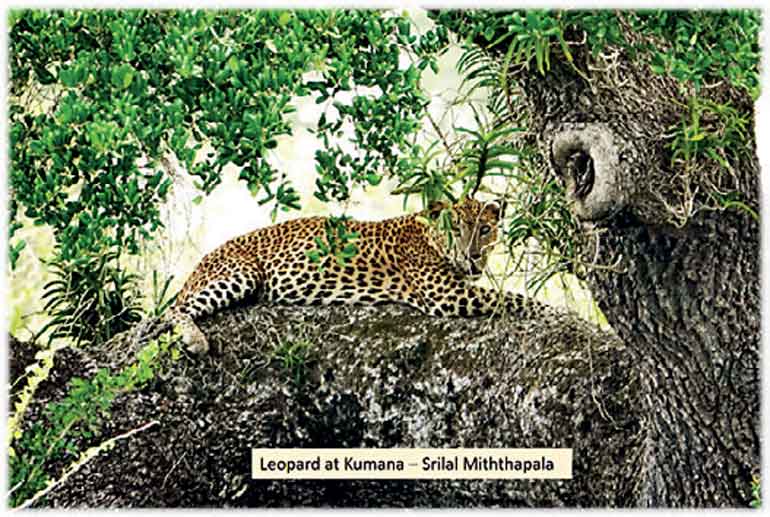
Leopard attacks on humans are rare. While they typically avoid humans, they can become aggressive when surprised or cornered and may retaliate. More often habitat loss, reduced prey availability, and human encroachment into their territory force leopards into human settlements to hunt domestic animals and livestock, and sometimes lead to altercation with humans.
Monasteries and wildlife parks in Sri Lanka
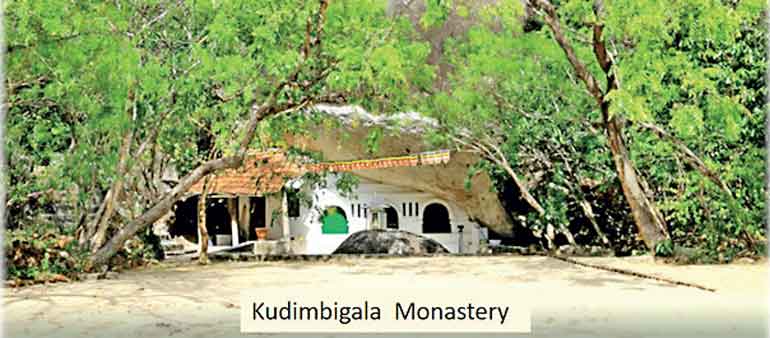
It is a well-known fact that there are many ancient monasteries that lie within the boundaries of several Sri Lankan National parks. In Kumana itself, in addition to this monastery where the attack took place, there is the Kudumbigala monastery and several other ancient religious sites. Sithulpawwa Rajamaha Viharaya, a 2nd-century BC monastery, featuring many caves and ancient paintings is situated inside the Yala National park, while Wilpattu National park holds archaeological ruins, including shrines like Pallekandal Church.
Most of these monasteries and hermitages often pre-date the parks themselves, designed to blend into the landscape with minimalist, nature-centred architecture like stone walkways and cave dwellings. They were built to facilitate solitary meditation and ascetic practices, a tradition dating back to the 3rd century BC.
With the introduction of formal wildlife protection laws, such as the Fauna and Flora Protection Ordinance No. 2 of 1937, these areas were later designated as protected reserves under the Department of Wildlife Conservation (DWC). As a result, several of these ancient religious sites now fall within protected wildlife zones.)
However in several instances the new protected area boundaries included these ancient religious sites as well. In the early days after legislation, the sharing of the wildlife habitat with the limited and sparse activity at these sites did not pose any threat. However today, with rapid habitat loss and environmental degradation, increased visitor influx, poaching and illegal encroachment into wildlife parks, the equilibrium has changed. Movement and habitat use of wild animals has changed considerably, resulting in human -wildlife confrontations in and around these monasteries, with occasional serious consequences when it involves large mammals such as elephants, leopards and bears.
An analysis of the attack on the monk
Why did the leopard attack the monk?
As stated earlier leopards generally do not attack humans. I agree with Nayanaka Ranwella, the Secretary of the Wildlife Conservation Forum, where he has postulated that the monk may have been crouching or sitting in a hunched position perhaps while meditating, which may have given the leopard the impression that it was some sort of small creature and not a human.
Why did the leopard leave after attacking?
Possibly during the attack the monk may have struggled and the leopard may have realised that this was a bigger prey and retreated. According to reports, in spite of serious neck wounds where the leopard had attacked and bitten, the monk had crawled towards his rock cave and collapsed and died there. The leopard had then returned at night and devoured the flesh.
Who is to be blamed for this incident?
The monastery has been used by several monks for mediating. This area is reported to have been an area where several leopards and bears frequent. According to Nayanaka Ranwella the monks had been warned about this and advised not to use this area for mediation. Unfortunately this advice was not heeded.
There have been a few comments that the leopard was to blame. Certainly not. This is their territory, safeguarded for them by legislation. It is we who are the trespassers who go into the parks. The leopard was just doing what he usually does. Unfortunately he mistook the human for some other easy prey.
Perhaps the DWC should have been more proactive and taken steps to prevent the monks from using this area. They are the custodians of the parks and it is their duty to protect the flora and fauna and also humans who venture into the park. That is why when visiting a park one has to take a permit, (not a ticket) and be accompanied by a tracker (ranger) who is responsible for the visitor’s safety.
Conclusion
This tragic incident underscores the precarious and sometimes violent nature of human-wildlife interaction in Sri Lanka. It is also a stark reminder that the delicate balance between humans and nature is increasingly under strain.
As pressures on wildlife habitats grow, such encounters may well become more frequent, unless we recognise, respect, and adapt to the realities of sharing space with the wild.
References
https://www.wnpssl.org/pdf/articles/11leopards.pdf
https://india.mongabay.com/2025/02/leopards-are-adapting-to-central-indias-urban-jungle/