Monday Oct 12, 2026
Monday Oct 12, 2026
Thursday, 30 April 2026 00:40 - - {{hitsCtrl.values.hits}}
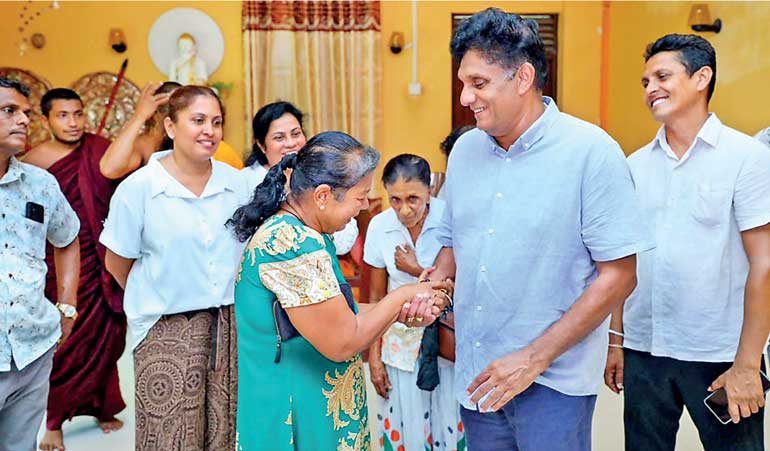
Sajith Premadasa is the clear frontrunner in the Opposition’s Presidential candidacy stakes
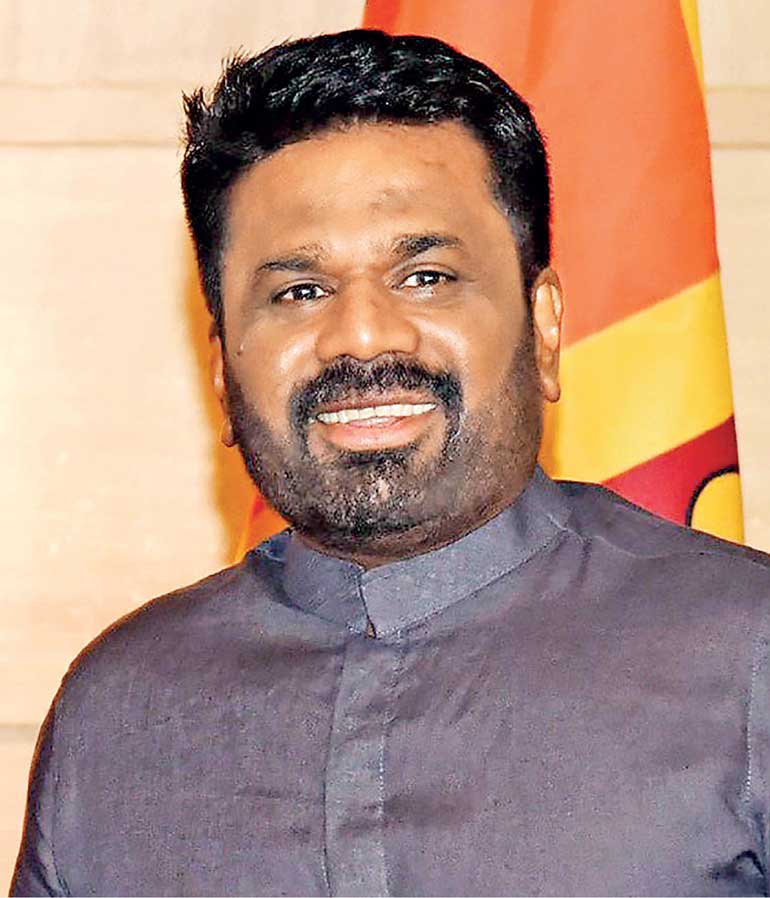
President Dissanayake: The man occupying the room at the top
 Perhaps it is best that Namal and the SLPP took a ‘timeout’ this year because they haven’t sorted themselves out. If the SLPP hasn’t identified and renounced its errors and blunders of its last Government (Gotabaya), denounced and distanced itself from the perpetrators, and corrected its policy, voters cannot be sure that those will not be repeated
 May Day 2026 holds up a mirror before the country’s politico-electoral reality. Contrary to mirages of multipolarity, the political contest reveals itself as strategically bi-polar: Sajith Premadasa vs. Anura Dissanayake; SJB vs. JVP-NPP. The country’s essential choice of leadership in 2029 is discernible.
It is a pity that the SLPP isn’t celebrating May Day. While 1 May is indeed a Poya (full moon) Day, it isn’t Vesak. Observances of sil are usually completed in the morning. If the late TB Illangaratne is to be commemorated by the SLPP on 1 May it means the party has not foresworn all public events on the day—only the May Day mobilisation.
‘Apeykama’
Perhaps it is best that Namal and the SLPP took a ‘timeout’ this year because they haven’t sorted themselves out.
If the SLPP hasn’t identified and renounced its errors and blunders of its last Government (Gotabaya), denounced and distanced itself from the perpetrators, and corrected its policy, voters cannot be sure that those will not be repeated.
For instance, the SLPP is still unclear, silent or truculently defensive as to why:
 The excessively high taxes imposed by Mangala Samaraweera and the Yahapalanaya UNP were replaced by the Gotabaya Rajapaksa administration not with a sensible middle path but by an extreme slash of taxes which caused the state a colossal loss of revenue.
He took the wildly irrational step of overnight island-wide conversion of agriculture to organic fertiliser through an outright ban of chemical fertiliser, weedicides and pesticides though his manifesto had called for a 10-year transition, and persisted in the policy despite farmers’ protests in the South itself.
Bondholders were paid-off instead of renegotiating/restructuring the debt early enough, including playing the China card of a ‘rollover’, when it was arithmetically obvious that what was left in our foreign exchange reserves was insufficient to pay for the import of essentials including fuel, and would cause great suffering to the citizens. (Reckless decision to repay sovereign bondholders | Daily FT)
Ratios of chemical components in the gas cylinders were changed, causing lethal explosions. Victims were blamed for careless maintenance of their cookers/kitchens.
The cremation of Muslim dead wasn’t discontinued when it was clear that no other country was following that extreme policy and the global scientific community didn’t uphold the hypothesis of pollution of ground water through burial of Covid victims.
The ongoing investigations into the Easter massacre were disrupted by arbitrary transfers, the proceedings of Commissions obstructively intervened in at crucial moments by opaque security authorities, and the full reports of inquiries not released.
There were anti-Government demonstrations even in the Rajapaksa home base which had to be blocked by Police barricades, while there wasn’t a single counter-demonstration by the ‘anti-imperialist’ patriotic masses even in the South, against the allegedly Western-sponsored Aragalaya.
The new buzzword from SLPP circles, “Apeykama” (“Ourness” or “Us-ness”) is a slippery term which evokes insularity and encourages involution. It can be dangerously exclusionary, divisive and lead to insider/outsider zero-sum polarisation in a multiethnic, multireligious, multilingual, multicultural, pluralistic society.
Who decides who “api” and “apey” (we/us/ours) are?
What constitutes “Apeykama”? What social, political and economic content does it contain?
Who decides on who and what passes the “Apeykama” test; possesses the quality of “Apeykama”?
What room does it leave for, and what value does it accord, irreducible personal individuality?
Why not simply call it “Laankikakama” or “Laankikathvaya/Laankikabava” (Lankanness)?
Pre-eminent Opposition
The UNP, a faction of which improbably wants Ranil Wickremesinghe to be the common Presidential candidate instead of honorably retiring, with Sajith Premadasa who holds vastly larger political real-estate playing second fiddle, is holding its May Day indoors at the party headquarters.
The radical Left FLSP’s May Day will have significance as a sign of its growth as the left alternative—including to the JVP.
The inability of the non-SJB miscellaneous Opposition to pull its constituent organisations (SLPP, UNP et al) together for a May Day mobilisation, exposes a basic political flimsiness as a bloc. Either these parties and personalities have to accept the leadership of Sajith/SJB, or Namal/SLPP, or Dilith Jayaweera (as transit lounge).
Within the Opposition, only Sajith and the SJB seem to have a credible option of going it alone as a mass party—though remaining single isn’t a status I’d recommend because the SJB doesn’t represent enough votes to win convincingly. However, all other parties including Namal’s SLPP require a supportive coalition much more than the SJB does.
SJB’s clarity deficit
The real question is whether, from this May Day onwards the SJB will overcome its core confusions.
The first issue that requires clarity is the strategic importance of May Day 2026 in relation to election year 2029. In 1973, Sri Lanka was hit by a combination of a national economic crisis and the global oil price hike, just as it is today. The UNP had just 17 Opposition MPs unlike today. However, it is in 1973 that the UNP and the leadership of JR Jayewardene with deputy leader Ranasinghe Premadasa as V-8 engine, gear-shifted and went on the offensive inside and outside Parliament. It maintained the mode of a permanent, escalatory, strategic political offensive until 1977. Do Sajith and the SJB, placed in the same propitious setting of a combined internal and external economic crisis and socially insensitive Government with a 2/3rds majority, have what it takes to do the same, commencing May Day 2026?
The new buzzword from SLPP circles, “Apeykama” (“Ourness” or “Us-ness”) is a slippery term which evokes insularity and encourages involution. It can be dangerously exclusionary, divisive and lead to insider/ outsider zero-sum polarisation in a multiethnic, multireligious, multilingual, multicultural, pluralistic society
The second challenge is to clear confusion of argument and critique of AKD and the Government. Since its inception the SJB has not known how, where and what to aim at. Various personalities aim in different directions at diverse targets.
While AKD-JVP-NPP are correctly accused of having “signalled left and turned right” as the old phrase goes, the SJB is muddled as to which was the greater wrong: “signalling left” or “turning right”?
The SJB must abandon the over-simplification that AKD and the JVP-NPP came to power in 2024 merely by “lying”. They did lie, but in the specific sense that they promised one thing and cold-bloodedly did the opposite. AKD-NPP’s stand in 2022-2024 wasn’t a lie because they promised things that could never be done. Anura beat Sajith and the JVP-NPP beat the SJB in 2024 not by presenting a fairy tale that could never be implemented, but by taking a centre-left stand that was closer the people’s sentiments than the technocratic-managerial platform and perspective of the SJB in 2023-2024.
What was wrong was not what AKD and the JVP-NPP said in 2024. What they said was more correct than what the SJB did – though I endorsed Sajith over Anura in 2024, just as I supported Sajith over Gotabaya in 2019, because I was sure then as I am today that he would make a better President than his rivals. Unlike his father in 1988, in both elections Sajith ran with a ball-and-chain around his ankle—in 2019 the party platform drafted by Mangala Samaraweera and Eran Wickremaratne, and in 2024, the neo-Ranilist ‘Blueprint’ of Dr.Harsha de Silva supported by Eran Wickremaratne.
Anura beat Sajith and the JVP-NPP beat the SJB in 2024 not by presenting a fairy tale that could never be implemented, but by taking a centre-left stand that was closer the people’s sentiments than the technocratic-managerial platform and perspective of the SJB in 2023-2024
The SJB must strive to win the vote that swung to the NPP by recognising the fact that the NPP manifesto of 2024 was more in the ballpark of the people’s legitimate aspirations than Harsha’s Blueprint was. Anura and the JVP-NPP must be indicted not for what they promised, but for not doing what they promised. They didn’t even try to fulfil their promises when they had more than a fair chance to do so in 2024 and again, post-Ditwah.
What was necessary in 2024 was a shift to the centre from Ranil’s neoliberal adjustment and savage austerity policies of 2022-2024. Though Sajith himself promised (then as now) to renegotiate the IMF package, the SJB Economic Troika positioned itself as endorsing Ranil’s policies and the SJB as having the best “team” to manage and continue Ranil’s policies—implicitly, even under Ranil. The SJB troika’s only criticism of Ranil was that he was keeping company with the SLPP.
Far from shifting to the centre, Anura and his administration self-confessedly stuck to ‘the Ranil road’ and proceeded along it—turning further to the right than any previous Government.
Anura could easily have secured the available advice and support of Joe Stiglitz, Thomas Picketty, Martin Guzman, Jayati Ghosh et al and renegotiated better packages with both IMF and private creditors. He could have done so in in 2024, invoking the 2022 Aragalaya and pointing out that President Wickremesinghe had no popular mandate to agree in principle to the terms he did. He could have pushed for a fairer deal once again after the Ditwah cyclone, with the support of these world-renowned economists. But he didn’t. Instead, AKD preferred Duminda Hulangamuwa to Joe Stiglitz, signed on the dotted line with the IMF and accepted one of the world’s lowest ‘haircuts’ from the private creditors. None in the JVP-NPP dissented. Why? Was anyone on the take or were the party coffers the beneficiary?
The SJB cannot logically argue that the JVP-NPP is implementing the correct (rightist) policies now, having earlier Opposed them when the UNP proposed them in 2001-4 and 2015-19. This excuses and applauds Anura’s betrayal and ‘down-blends’ the critique to the managerial factor rather than the policy factor—as in “the JVP cannot implement the correct right-wing policies they have belatedly arrived at; it takes the SJB to do so”. If this is the line, then logically the SJB is not ‘The Alternative’ as it advertises in its May Day 2026 poster—merely a better managerial ‘Substitute’.
The SJB must expose to the nation that Anura either lied to the people from the beginning even when he was promising progressive reforms, or that he has betrayed everything he promised the people after winning the elections although he had the international sympathy necessary to push for policies that were macroeconomically more capacious and fairer by the citizenry.
The SJB must clearly indict Anura not for lying about things he couldn’t or shouldn’t do economically/financially—because if that’s the charge, then surely it is good he isn’t doing them! The SJB must indict Anura for coldly, needlessly betraying his promises to the people and the mandate he received from them.
On May Day, the SJB must clarify whether its role is to steer the country on a different, better, more humane and socially responsive path, as represented by Sajith Premadasa’s policy paradigm, or whether it exists mainly to secure Dr. Harsha de Silva the post of Finance Minister. It must disclose whether it is better than AKD and the JVP-NPP because it has the best technocratic-managerial team or because it has the best leader with the best ideas for the country.
Sajith’s 27 April invitation to UNP members and supporters to join the SJB May Day unambiguously uses the keywords ‘progressive’, ‘Social Democracy’, ‘social market economy’ and ‘Middle Path’. (https://www.facebook.com/share/v/1B2c5tjzwG/?mibextid=wwXIfr)
Will the SJB elite take its cue from the leader?
Far from shifting to the centre, Anura and his administration self-confessedly stuck to ‘the Ranil road’ and proceeded along it—turning further to the right than any previous Government. Anura could easily have secured the available advice and support of Joe Stiglitz, Thomas Picketty, Martin Guzman, Jayati Ghosh et al and renegotiated better packages with both IMF and private creditors. He could have done so in in 2024, invoking the 2022 Aragalaya and pointing out that President Wickremesinghe had no popular mandate to agree in principle to the terms he did
Foreign puppet’s existential sins
The JVP-NPP’s sins aren’t only ‘sins of omission’, i.e., the correct things they haven’t done, which they should have. The JVP-NPP under AKD has also committed ‘sins of commission’, i.e., the wrongs they have actively done.
The Anura Dissanayake-led JVP-NPP Government’s only unforgivable faults aren’t economic and social, i.e., not trying to negotiate a better deal with the IMF and the creditors when there was every possibility to do so, and causing by that omission, avoidable economic hardship and social retrogression.
The AKD-JVP-NPP ruling bloc’s more unforgiveable sins are those of ‘commission’: the strategic and existential crimes committed against Sri Lanka. These have very long-term implications and cannot be easily rectified.
When societies are debating the complexities of mass immigration from the standpoint of collective national identity, Anura has by all accounts not raised any objection to the decision to grant OCI certificates, i.e., Indian citizenship to Sri Lankan Tamil citizens of 6th generation Indian origins, stretching the earlier 4th generation cut-off. Does the OCI (Indian citizen status) encompass the natural increase of the ones granted it, and if so how far down the line? Shouldn’t the Sri Lankan Government insist on a ceiling as far as the numbers go—as Madam Bandaranaike did during the Sirima-Shastri Pact?
Even if this unilateral move of ‘demographic patronage’ or ‘acquisition’ is one-time-only, over time the 6th generation of Indian origin will automatically become the 66th generation, and the 666th generation, etc. Our future will see an expanding, Hanuman-sized Indian footprint or shareholding, rooted in British colonial occupation.
Ranasinghe Premadasa corrected DS Senanayake’s injustice of depriving the hill-country Tamil people of recent Indian origin of their citizenship and voting rights, by presenting in Parliament the legislation which re-enfranchised them. Premadasa would never have envisaged that India would violate the spirit of that restitutive act by granting Indian citizenship in huge numbers, thereby making more problematic the protracted project for national integration. Modi’s move clearly reverses and negates the advice given to the Ceylon Indian Congress and the hill-country Tamil people by the iconic Jawaharlal Nehru on his visit to Ceylon, that they should not look to India but fully integrate themselves into Ceylon.
Anura has agreed to grant the bulk of the Trincomalee oil tank farm to India—as previous presidents did not.
The JVP-NPP leader has also asked India to ‘develop’ the whole Trincomalee area, and link it up all the way across with Mannar. Which sane person would ask their neighbour who owns a vast extent of land, to ‘develop’ the immediately adjacent portion of one’s own small property inhabited by those who speak the same language and adhere to the same religion as dwellers of the most proximate portion of the neighbour’s colossal property, separated only by a narrow stream?
When countries seek energy self-reliance by shifting massively to non-fossil fuel sources such as solar and wind-power, Anura has agreed to an oil pipeline from Trincomalee to Tamil Nadu, which would make us energy-dependent on that state with all its hostility to us and piratical trawler incursions into our waters.
What any leader of Lanka has to do and indeed has sought to for millennia, is to protect and defend this island, its distinctive character and destiny, and pass it on as the heritage of generations to come. Anura has been the only exception—certainly the only one since Independence. Future history will record that no leader and ruling party did as much long-term damage and left as negative a legacy of historical harm to the fundamental fabric and destiny of this island-state, as did President Anura Dissanayake and the JVP-NPP.
Apart from the Frontline Socialist Party—and that too only sporadically—no one has raised any objection to the JVP-NPP’s sacrifice of this island to the octopus-like multiple grips of the Indian project.
The SJB’s Dr. Harsha de Silva has long preached the virtues of economic and infrastructural integration with Tamil Nadu, advocated by Ranil Wickremesinghe and Milinda Moragoda for a quarter-century.
On this May Day, will Sajith and the SJB show themselves faithful to Ranasinghe Premadasa’s fierce patriotic commitment to national independence and sovereignty?




