Tuesday Nov 17, 2026
Tuesday Nov 17, 2026
Tuesday, 17 November 2026 05:10 - - {{hitsCtrl.values.hits}}
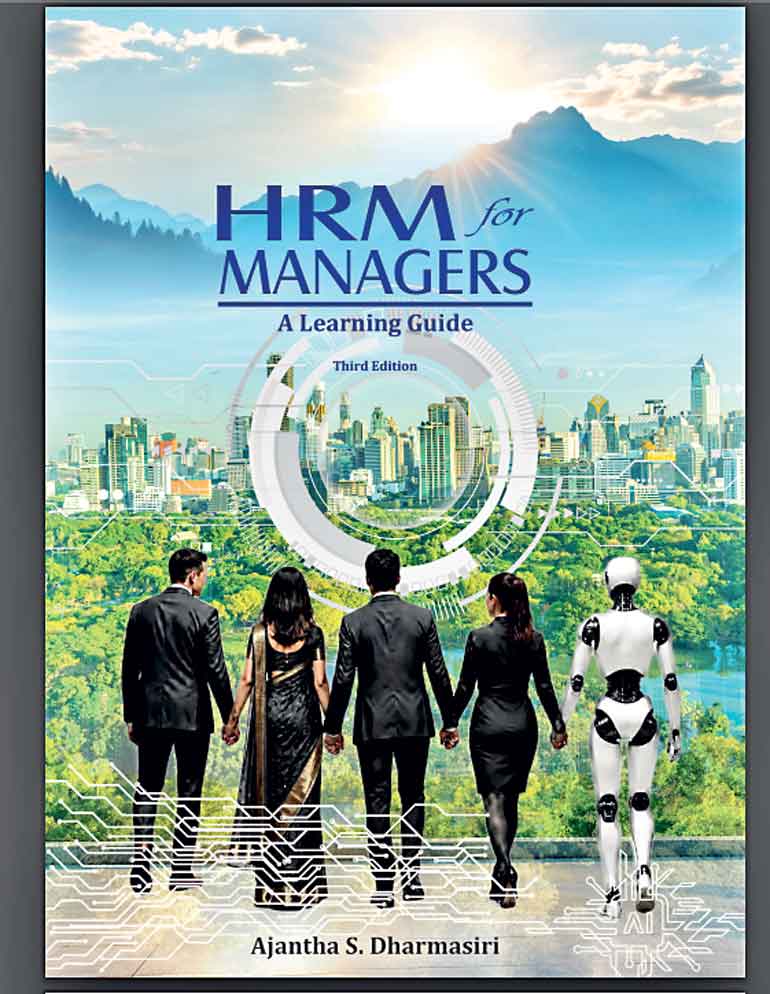
 People drive business is becoming an old adage. There is technology to assist immensely. It is how humans and humanoids work in harmony in harnessing sustained results. I am delighted to present my 12th book, titled “HRM for Managers: A Learning Guide – Third Edition”, as a publication of the Postgraduate Institute of Management (PIM). It is a renewed, revamped, and restructured version with future-proof enterprises in mind. Today’s column is about its contents with Sri Lankan managers in mind.
Overview
“Great vision without great people is irrelevant” So said Jim Collins, the author of “Good to Great.” I attempted to highlight the much-needed collaborative value creation. My book features the way to be future-proof in becoming competent and confident of managing “humans and humanoids.”
In a typical corporate setting, managing people might also be viewed as “managing personnel,” “managing human resources,” “managing human talent,” “managing human capital” or “managing humans.” In my view, all point to the same set of challenges relating to the resource that is alive, vibrant and “most precious” to any organisation.
Having left a multinational career in HRM, over two decades ago, knowledge sharing as a teacher and a trainer has been a pivotal part of my professional life. Researching, supervising, coaching, consulting, and leading have been the other vital roles that I needed to play in my multi-dimensional career. Developing an authentic way of deliberating human resources in celebrating their versatility has been a dream come true for me. Now, I often take a holistic view as a Board Director having future in mind.
Contents in a nutshell
“HRM for Managers : A Learning Guide” is consisting of 12 chapters, apart from a prologue and an epilogue. With an overview of HRM, the book introduces it as a “Eco-system of ten Gs.” These Gs are illustrated in one chapter each as GOAL (Strategic aspects), GET (Acquiring talent), GROW (Developing talent) , GIVE (Rewarding talent), GLUE (Engaging talent), GLOW (Managing performance), and GUARD (Controls for conformance). Whilst these seven Gs consisting of a widely-acclaimed corporate framework of HRM, the remaining three Gs offer insights beyond the realm of an institute extending it to cover an industry. They are namely, GRAPPLE ( competitive collaboration), GRIP ( handling political, economic, social, and other gearing factors) and GRATIFY ( dealing with stakeholders).
It can also be viewed as a journey of discovering an HRM ecosystem. From GOAL, the strategic intent that sets the direction of the entire HRM enterprise, and ended with GRATIFY, the broadest, most outward-looking, and most socially ambitious of the ten Gs. In between, we have covered the full life cycle of managing people: getting them in, growing their capabilities, giving them appropriate rewards, binding them through engagement, helping them glow through performance, guarding them through policy and law, grappling with the disruptions of the modern world, and gripping the data that makes our people decisions smarter.
In a tech-savvy world with AI dominance, research has found out that the biggest barrier to a digital transformation is not technical or legal. Rather, it relates to a combination of prevailing managerial and employee attitudes, practices, and traditions around what constitutes best practice. Most acknowledged best practices were established decades ago using the technology then available to address problems or challenges that for the most part no longer exist. Actions that once were considered best practice are increasingly becoming unnecessary or obsolete. Yet it is the perpetuation of these traditional practices that thwart significant breakthroughs toward new and more meaningful ways to work. This is the context where HR has to be reimagined for future.
Organisations must shift from managing strictly human resources to coordinating a blended ecosystem of human workers, digital agents, and physical humanoids. As we observe around the globe, the shift to hybrid human–AI teams, including agents, is happening faster than managers can keep pace with. The challenge is to ensure that one’s responsibilities do not diminish as AI agents become a part of one’s team. A future-focused manager’s business acumen, oversight, and sense of accountability are crucial to the success of a hybrid workforce.
Relevance to Sri Lanka
“If you pick the right people and give them the opportunity to spread their wings, and put compensation as a carrier behind it, you almost don’t have to manage them.” So said Jack Welch, the one-time most-admired CEO. I see a mixed scene in the Sri Lankan organisations in this respect. Perhaps, an awareness on the HRM eco-system comprising of ten Gs and an adherence to the required priorities could be of help.
As the book illustrates, the seven G framework representing HRM in a corporate setting and the broader, ten G aspects from an eco-system perspective, offer a profound and practical approach in attracting, developing, and engaging people. Irrespective of one’s functional specialty, mastering the art and science of managing people is of high importance. That is why we identified every manager as a people manager.
Each chapter of the book consists of a case for discussion, with a specific question on the applicability of the lessons learnt to Sri Lankan organisations. It invites the reader to appreciate the best practices and making them, their “next practices.”
Way forward
“HRM for Managers: A Learning Guide” is not meant to be a comprehensive textbook. It is a companion for managers in guiding them to learn HRM in a practical manner. It is intended to assist private sector executives and public sector administrators alike, in inviting them to “be brilliant on basics.”
My invitation is not just to read it, but to recognise the key contents, reflect on the main challenges, relate the basic concepts learnt to the current issues faced by one’s workplace, and reinforce the way one professionally applies the key lessons, in playing a people manager role in one’s workplace. In essence, knowing should lead to doing and that in turn will deliver results.
(The author, a Senior Professor in Management, and an Independent Non-Executive Director, can be reached at [email protected], [email protected] or www.ajanthadharmasiri.info.)




