Monday Oct 12, 2026
Monday Oct 12, 2026
Monday, 6 July 2026 03:25 - - {{hitsCtrl.values.hits}}
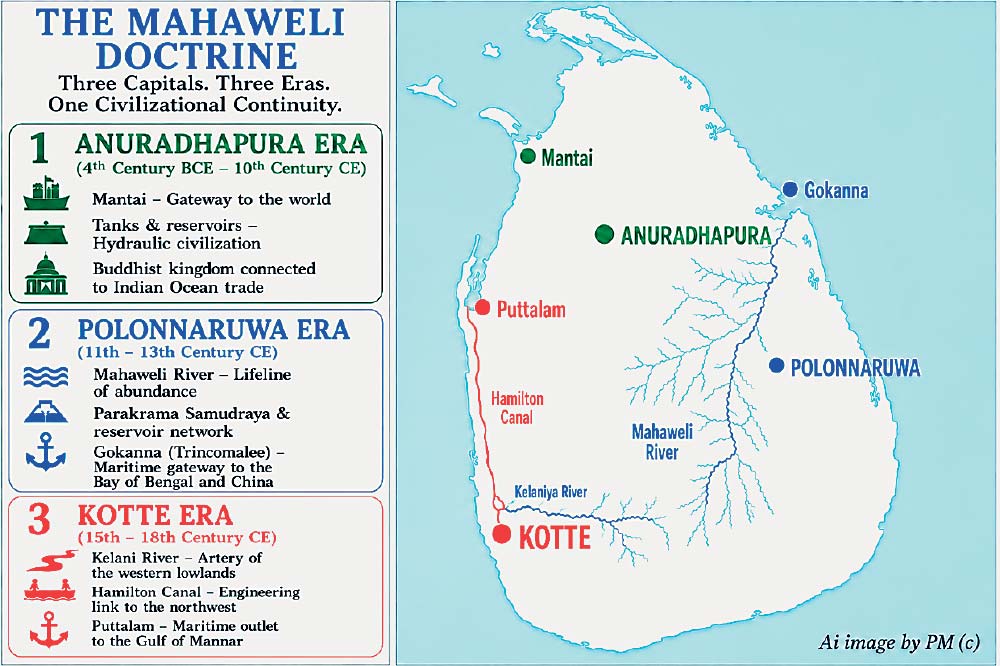
 Sri Lanka’s destiny has always been shaped by water. With 103 river basins and an intricate network of reservoirs, canals, and waterways, the island transformed its landscape into one of the world’s most sophisticated hydraulic civilisations
 If King Parakramabahu I were alive today, he might ask: Has Sri Lanka forgotten the foreign policy that once made the island prosperous, secure, and connected to the wider world?
The great king understood that water, commerce, and diplomacy were inseparable. The hydraulic civilisation he built in Polonnaruwa, now a UNESCO World Heritage Site, not only fed a unified nation but also generated agricultural surpluses that flowed through the Mahaweli River system to Gokanna—present-day Trincomalee—for trade across Asia. Historical accounts suggest that Sri Lanka exported rice to China and maintained naval forces to protect commercial shipping from piracy. Long before modern theories of economic development emerged, Parakramabahu practiced what might be called “Trade for Peace,” a phrase I later used in one of my books to describe the commercial diplomacy that helped shape the founding of the United States 250 years ago.
I write this essay from Washington, D.C., a few blocks from the White House and overlooking the Potomac River. Like the Mahaweli in Sri Lanka, the Potomac helped shape the American nation’s commercial destiny. President George Washington championed river and canal navigation, laying the foundation for what later became the Chesapeake and Ohio Canal system, which connected the young republic to its interior. President Thomas Jefferson expanded the United States through the Louisiana Purchase and dispatched the Lewis and Clark Expedition along the Missouri and Columbia Rivers toward the Pacific Ocean, seeking new commercial opportunities and trade links with Asia.
The lesson from both Polonnaruwa and early America is remarkably similar: rivers are not merely waterways. They are instruments of national development, commercial connectivity, and strategic statecraft. When linked to visionary leadership, they become the foundations of prosperity, security, and peaceful engagement with the wider world.
From Potomac to Polonnaruwa
During the past four decades, I have had the privilege of traveling, working, and teaching in more than 150 countries. Along the way, I have studied the river civilisations of the Potomac, Mississippi, Missouri, and Columbia Rivers in the United States; the Yangtze River and Grand Canal in China; and many other waterways across Africa, Asia, Europe, and Latin America.
I have researched and lectured at universities including Columbia, Harvard, Minnesota, and Yale in the United States, as well as Guangzhou, Nanjing, Peking, Shandong, Tongji, Tsinghua, and Wuhan universities in China. These experiences have taught me humility. They reminded me how small any individual is in the larger sweep of history while broadening my understanding of development, diplomacy, and governance.
Yet the lessons that have shaped my thinking most profoundly did not begin in Washington, Beijing, Brussels, or Warsaw. They began in the rice fields of Polonnaruwa.
Growing up on a three-acre farm with water buffaloes in Sri Lanka’s ancient heartland, I learned lessons that no classroom could fully teach. The canals, reservoirs, paddy fields, temples, churches, and villages around me formed a living ecosystem in which water became rice, rice became prosperity, prosperity sustained communities, and communities developed their own identities and character.
Only later did I come to appreciate that the same principles that enabled ancient Sri Lanka to flourish also offer valuable lessons for its foreign policy in the twenty-first century. To understand why, one must first appreciate the central role that water has played in shaping the island’s civilisation, economy, and national identity.
For more than two millennia, Sri Lanka’s rivers, reservoirs, ports, and trading networks connected the island not only to itself but also to the wider world. The story of that achievement begins in the ancient kingdoms of Anuradhapura and Polonnaruwa, where hydraulic engineering, commercial enterprise, and diplomacy worked together to create one of the most remarkable civilisations in Asia.
Power of water
Sri Lanka’s destiny has always been shaped by water. With 103 river basins and an intricate network of reservoirs, canals, and waterways, the island transformed its landscape into one of the world’s most sophisticated hydraulic civilisations.
For centuries, settlements, agriculture, commerce, and governance were organised around watersheds rather than arbitrary political boundaries. The great kingdoms of Anuradhapura and Polonnaruwa emerged not from administrative convenience but from natural ecological systems that linked mountains, forests, rivers, reservoirs, villages, and ports into a coherent whole. Our ancestors understood a simple but profound truth: prosperity depended on the health of the entire watershed.
Water was more than a resource. It was the foundation of economic production, social organisation, political authority, and cultural identity. The reservoirs of Anuradhapura and Polonnaruwa did not merely irrigate fields; they connected communities, supported trade, strengthened State institutions, and sustained one of Asia’s most enduring civilisations.
Only later did European colonial powers divide the island into administrative districts designed primarily for imperial governance and resource extraction. While those boundaries served colonial purposes, they often obscured the deeper civilisational logic through which Sri Lanka had organised itself for more than a millennium.
Today, as Sri Lanka seeks to realise the national renaissance envisioned by the current administration, there is value in rediscovering this older wisdom. Ancient rulers recognised that successful governance required connecting local communities to broader systems of production, commerce, and exchange. Their achievements were not merely engineering marvels; they were integrated systems of governance that linked villages to markets, markets to ports, and ports to the wider world.
This perspective offers an important lesson for contemporary policymakers. National development cannot be separated from economic connectivity, just as foreign policy cannot be separated from the foundations of domestic prosperity. The same waterways that nourished Sri Lanka’s ancient kingdoms also connected them to regional trade networks stretching across the Indian Ocean.
The Mahaweli River offers a powerful metaphor. Like the river itself, Sri Lanka’s foreign policy should not divide but connect; not isolate but unite. It should link villages to global markets, local enterprise to international opportunity, and ancient wisdom to modern statecraft
Anuradhapura: Water, trade, and openness
For more than a millennium, Anuradhapura demonstrated how water, commerce, and culture could work together to create prosperity. It was not merely a political capital. It was the centre of a hydraulic, commercial, and intellectual civilisation that connected Sri Lanka to the wider world.
The ancient port of Mantai served as the island’s principal gateway to Indian, Persian, Arab, and Chinese trading, intellectual, and spiritual networks. Merchants, monks, scholars, and travelers moved through its harbor, bringing not only goods but also ideas, technologies, and religious traditions. Among them were Persian Christian merchants associated with the Church of the East, who established communities on the island and left behind enduring evidence of their presence, including the celebrated Anuradhapura Cross, now incorporated into the symbolism of the Catholic Bishops’ Conference of Sri Lanka.
The island’s openness also attracted Buddhist pilgrims from abroad. In the early fifth century, the revered Chinese monk Faxian spent two years in Anuradhapura studying Buddhist texts. He recorded the flourishing monastic communities at Abhayagiri and Mahavihara and described a society in which intellectual exchange accompanied commercial exchange.
Two centuries later, the renowned Chinese monk Xuanzang never reached Sri Lanka because of political instability on the island. Nevertheless, through conversations with Sri Lankan monks and merchants he encountered in India, he developed such admiration for the island’s civilisation that he described it as a remarkable “Buddhist Kingdom of the Lion,” distinguished by learning, prosperity, and moral order.
Yet none of this openness would have been possible without the hydraulic foundations of Anuradhapura. The reservoirs, canals, and waterways of the kingdom transformed water into rice and rice into prosperity. Agricultural surpluses sustained urban life, supported religious institutions, financed commerce, and enabled international trade. Economic strength made cultural and spiritual exchange possible.
The lesson is as relevant today as it was then. Prosperity emerged not from isolation but from openness to the wider world.
For that reason, I have often described Sri Lanka as the “Grand Central Station” of commerce, culture, and spirituality in the Indian Ocean. Anuradhapura’s success lay not simply in its reservoirs or monuments, but in its ability to connect local prosperity with global engagement. It is a lesson that remains highly relevant as Sri Lanka seeks its own National Renaissance in the twenty-first century.
Polonnaruwa: Mahaweli River to the world
The second great capital, Polonnaruwa, expanded and refined the vision of Anuradhapura.
Under King Parakramabahu I, the Mahaweli River became the backbone of a sophisticated system linking the island’s hydraulic civilisation to Gokanna, at the entrance to the magnificent natural harbor of Trincomalee. Through the Parakrama Samudraya and an interconnected network of waterways, agricultural production moved toward the eastern seaboard, connecting Sri Lanka to wider Asian markets.
Historical evidence points to commercial relations with China and other Asian powers. The kingdom maintained naval forces to protect maritime trade from piracy while pursuing commercial diplomacy alongside agricultural development. According to some historical accounts, King Parakramabahu employed Chinese soldiers to serve in these maritime security efforts. The later emergence of the name China Bay reflects the long history of connections between Trincomalee and the wider Asian world.
The Mahaweli was therefore far more than a river. It was a commercial, diplomatic, and strategic artery. Like the bloodstream of a living organism, it connected distant regions into a single functioning system. Water from the central highlands nourished farms; farms generated surplus production; and surplus production supported commerce, diplomacy, culture, and statecraft.
The lesson remains relevant today. Foreign policy is most effective when it connects local communities to international opportunities and transforms domestic strengths into external influence.
Kotte and Hamilton Canal
This tradition did not end with Anuradhapura or Polonnaruwa. During the Kingdom of Kotte, King Parakramabahu VI strengthened connections between inland waterways and the Kelani River basin, linking Negombo, Halawatha (Chilaw), Puttalam (ancient Uppuththalam), and other coastal communities. These waterways enabled local producers to participate in maritime commerce across the Indian Ocean.
Centuries later, the Dutch and British formalised parts of this older network through the construction of the Hamilton Canal. Running along the western coast, the canal connected Colombo with Negombo, Chilaw, and Puttalam while facilitating the movement of cinnamon, cardamom, and other commodities.
The canal illustrated a principle that Sri Lanka’s rulers had long understood: prosperity depends on connecting local entrepreneurs to regional and global commerce.
From Mahaweli to Potomac and Yangtze
My travels have repeatedly reinforced this lesson. The United States became a continental power in part because its leaders recognised the strategic importance of rivers and canals. The Potomac, Ohio, Mississippi, Missouri, and Columbia Rivers—together with extensive canal systems—helped integrate vast territories into a single national economy and connected the American interior to global commerce.
China offers a similar example. One of the world’s great civilisations emerged along the Yangtze River and the Grand Canal. Stretching from Hangzhou in the south to Beijing in the north, the canal linked agricultural production with political authority, facilitating the movement of grain, goods, and people across Imperial China. Even today, these waterways continue to influence China’s economic development and strategic thinking, complementing the country’s modern coastal growth from the Pearl River Delta—anchored by Hong Kong, Macau, and Shenzhen—to the political centre in Beijing.
Interestingly, just as the Mahaweli River connected the hydraulic civilisation of Polonnaruwa to Gokanna on Sri Lanka’s eastern coast, the Yangtze River and Grand Canal linked China’s agricultural heartland to Tianjin on the Hai River and onward to Beijing, integrating commerce, governance, and national development.
Great powers understand that geography alone is not destiny. Geography creates opportunities, but only infrastructure, commerce, and effective governance can transform those opportunities into national strength. Sri Lanka’s ancient rulers understood the same principle centuries ago.
Foreign policy as Mahaweli River
As the global order gradually evolves toward a more multipolar structure, Sri Lanka faces both opportunities and risks. The country can no longer depend excessively on any single external partner. Instead, it must cultivate constructive relations with the United States, China, India, Europe, Japan, ASEAN countries, the Middle East, and Africa. This is not traditional nonalignment. It is a pragmatic strategy of multi-alignment.
Yet external engagement alone is insufficient. Foreign policy must begin at home. Ancient Sri Lanka’s hydraulic civilisation offers a valuable model—one rooted in the island’s own history and natural endowments rather than relying exclusively on contemporary examples such as Singapore or Dubai. The Mahaweli River was not managed solely from the royal centre. It connected villages, farmers, traders, religious institutions, and ports into a single system of mutual dependence.
Modern foreign policy should operate in much the same way. Agriculture, tourism, education, technology, entrepreneurship, environmental stewardship, and cultural exchange should become integral components of a national diplomatic strategy. Farmers, fishermen, artisans, entrepreneurs, universities, and local governments should all participate in connecting Sri Lanka to global opportunities.
One innovative approach would be to utilise the existing network of Grama Niladhari officers, working through district and provincial administrations, to align local development priorities with national economic and foreign policy objectives. Just as every canal contributed to the strength of the Mahaweli system, every village can contribute to Sri Lanka’s international engagement.
Sri Lanka’s entrepreneurial culture should also be encouraged to follow the same outward-looking path. Entrepreneurs from agricultural communities such as Polonnaruwa have expanded from rice milling into hospitality, tourism, transportation, and aviation. Their entrepreneurial experience demonstrates how local initiative can generate national opportunity when connected to broader markets.
Yet economic success alone is not enough. Every national renaissance requires sources of inspiration that shape how people see themselves and their place in the world.
Today, as Sri Lanka seeks to realise the national renaissance envisioned by the current administration, there is value in rediscovering this older wisdom. Ancient rulers recognised that successful governance required connecting local communities to broader systems of production, commerce, and exchange. Their achievements were not merely engineering marvels; they were integrated systems of governance that linked villages to markets, markets to ports, and ports to the wider world. This perspective offers an important lesson for contemporary policymakers. National development cannot be separated from economic connectivity, just as foreign policy cannot be separated from the foundations of domestic prosperity
Gal Vihara: Source of inspiration
My birthplace in the ancient heartland of Polonnaruwa is known throughout the world for the magnificent Gal Vihara.
The renowned American Trappist monk Reverend Thomas Merton of the Abbey of Gethsemani in Kentucky introduced the ancient Buddhist capital to many Christian readers through his celebrated The Asian Journal. Reflecting on his visit to Gal Vihara in December 1968, the Catholic mystic described encountering the great Buddha statues as a moment of extraordinary “inner clearness” and “aesthetic illumination.” He wrote that he had finally seen what he had been “obscurely looking for,” suggesting not a conversion to Buddhism but a profound spiritual insight that transcended conventional religious boundaries.
As someone born Catholic and shaped by Buddhist practice, I often visited Gal Vihara during my youth. Yet the inspiration I found there was not only spiritual. It was also civic and entrepreneurial, encouraging me to look beyond the horizons of my childhood among water buffaloes and rice fields.
The ancient builders of Sri Lanka understood that civilisations flourish when entrepreneurship, governance, commerce, culture, and nature work together. They recognised that prosperity emerges from connection rather than isolation. The same reservoirs that sustained agriculture also supported trade, learning, religious life, and social harmony. Their achievements remind us that national greatness rarely emerges from a single policy or institution. It arises when diverse elements of society are connected by a shared purpose.
Today, Sri Lanka stands at a pivotal moment. The question is not whether the world is changing. It clearly is. The question is whether Sri Lanka will draw upon its own civilisational wisdom to navigate that change.
The Mahaweli River offers a powerful metaphor. Like the river itself, Sri Lanka’s foreign policy should not divide but connect; not isolate but unite. It should link villages to global markets, local enterprise to international opportunity, and ancient wisdom to modern statecraft.
The current Government’s vision of a national renaissance presents an opportunity to reconnect Sri Lanka’s future with the enduring wisdom of its past. By doing so, the country can reclaim its historic role as the Grand Central Station of the Indian Ocean—not as a memory of what once was, but as a model for what it can become.
(The author is a distinguished visiting Professor of Transatlantic Relations at the University of Warsaw in Poland. He has served as an American diplomat and a military professor at NATO and the U.S. Pacific Command. A native of Polonnaruwa and recipient of a UNESCO Award during his school years, he served as a sergeant in the Sri Lanka Police Cadet Corps and was recognised as the best commander of the Sri Lanka Army Cadet Corps while studying at Palugasdamana Maha Vidyalaya. A former American Field Service (AFS) exchange student at Perham High School in Minnesota, he is also an alumnus of the University of Sri Jayewardenepura, the University of Minnesota, and Harvard University. Before becoming a naturalised U.S. citizen, he was appointed by the Government of Sri Lanka as the nation’s first Youth Ambassador to the United Nations in New York. During his service at the U.S. Department of State, he was chairman of the interagency policy working group on science and technology in the Bill Clinton administration, and Secretariat Director of the Bureau of Educational and Cultural Affairs in the George W. Bush administration. Later, he served as a U.S. National Commissioner for UNESCO during the Barack Obama administration. With the endorsement of the U.S. Congress, the Biden White House appointed him as Presidential Adviser to the National Security Education Board at the U.S. Department of Defense. He lives between Kraków, Poland, and Washington, D.C., in the United States)




