Saturday Oct 17, 2026
Saturday Oct 17, 2026
Saturday, 17 October 2026 00:00 - - {{hitsCtrl.values.hits}}
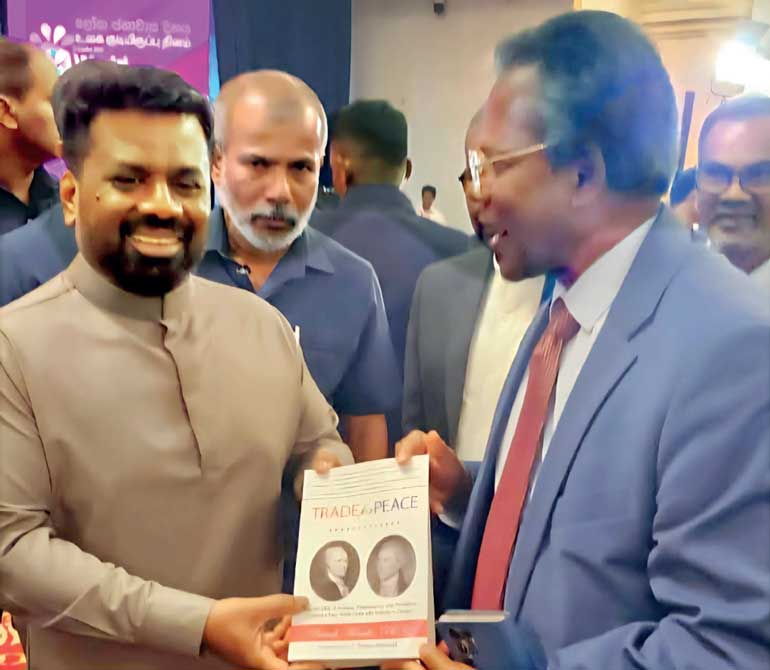
President Anura Kumara Dissanayake (left) with the author
In an age of fragmented interdependence, Sri Lanka does not need merely to stand between great powers. It must learn to flow among them—like the Mahaweli—drawing strength from many tributaries, converting external relationships into domestic capacity, and remaining unmistakably Sri Lankan in its destination
 When I introduced the “Mahaweli Doctrine” in the Daily FT in July, I argued that Sri Lanka’s foreign policy should behave like its greatest river: not divide but connect; not isolate but unite; and link villages to global markets, local enterprise to international opportunity, and ancient wisdom to modern statecraft.
That proposition has become even more urgent, especially following the Washington summit between President Donald Trump and President Xi Jinping. The international system is not simply moving from American unipolarity to Chinese primacy, nor is it dividing neatly into two rival blocs. Instead, the world is entering what I call an “age of fragmented interdependence.”
Put simply, countries — including island nations like Sri Lanka — may depend on the United States for security, finance, technology, or education while depending on China for manufacturing, trade, infrastructure, and supply chains. The same country may deepen strategic relations with India, attract investment from the Gulf, trade with Europe, work with Japan on development, and seek markets in ASEAN and across the Global South.
For Sri Lanka, this is not merely a description of the world. It should become a framework for statecraft in pursuit of “economic freedom” — moving beyond a historical dependence on the World Bank, the IMF, and other external lenders toward greater national economic capacity and resilience.
The Mahaweli Doctrine must therefore evolve from nonalignment to multi-alignment, and from multi-alignment toward strategic connectivity with sovereign guardrails. The objective is neither equidistance nor opportunistic balancing. It is to connect different external partners to different national needs while preventing any single relationship from becoming a source of strategic dependence.
President Anura Kumara Dissanayake has described “economic freedom” as the unfinished business of Sri Lanka’s independence. That insight deserves to be placed at the center of foreign policy. A country that cannot finance essential imports, withstand an energy shock, protect critical infrastructure, create productive employment, or negotiate from a position of fiscal strength cannot exercise complete strategic autonomy.
Economic freedom, therefore, is not separate from national security. It is one of its foundations.
From Plymouth and Jamestown to Polonnaruwa
As a former American diplomat and professor, my reflections and writings on Sino-American relations have repeatedly taken me back to the historical origins of the United States. The American experience contained two powerful impulses almost from its beginning.
Jamestown in Virginia, founded in 1607 as a commercial venture, represented enterprise and the search for material prosperity. Plymouth in Massachusetts, founded in 1620 by the Pilgrims, represented another aspiration: religious community and freedom of conscience.
Neither story should be romanticised, and both unfolded within a larger colonial history that brought devastating consequences for Indigenous peoples. Yet, as historical archetypes, they illuminate an enduring American tension between material ambition and moral purpose—a tension that ultimately helped generate extraordinary innovation and economic dynamism.
More than a century later, Adam Smith gave intellectual expression to a similar duality. ‘The Wealth of Nations,’ published in 1776, explained the productive power of specialisation, exchange, and commerce. But Smith had already written ‘The Theory of Moral Sentiments’ in 1759, examining sympathy, conscience, justice, and the moral foundations of human society.
Markets require trust. Wealth requires purpose. The same tension appeared in the American founding. Alexander Hamilton understood that political independence without public credit, productive capacity, commerce, and finance would leave the new republic vulnerable. Thomas Jefferson represented a republican suspicion of concentrated economic and political power.
America needed something from both: Hamiltonian capacity and Jeffersonian restraint—or, as I described it in my book ‘Trade for Peace,’ Hamiltonian means to Jeffersonian ends.
Sri Lanka has its own, much older vocabulary for this relationship. King Parakramabahu I understood that water sustained agriculture; agriculture created surplus; surplus enabled commerce; commerce connected ports and markets; commercial networks required security; and security ultimately required diplomacy. Long before Hamilton or Smith, ancient Sri Lanka demonstrated that productive capacity, international commerce, and strategic power could reinforce one another.
The genius of Sri Lanka’s hydraulic civilisation was not simply that it built reservoirs. It built systems—transforming water into agricultural abundance, agricultural abundance into commercial capacity, and commercial capacity into wider regional influence in Asia.
America and China: Two portfolios of power in fragmented interdependence
The contemporary Sino-American competition should not be reduced to the proposition that America possesses military power while China possesses economic power. The United States remains an extraordinary military, economic, technological, financial, diplomatic, and educational power. China is simultaneously an industrial, commercial, technological, and diplomatic power with rapidly expanding military capabilities.
What differs is the composition and geographical expression of their power. The United States has, for example, an unparalleled network of alliances and security partnerships, together with deep capital markets, leading universities and technology companies, and the continuing centrality of the dollar. China has developed another enormous network: manufacturing supply chains, ports, infrastructure, industrial capacity, trade relationships, and development finance.
The 2026 meetings between Presidents Donald Trump and Xi Jinping illustrate this changing relationship. The Council on Foreign Relations observed after the May Beijing summit that both governments embraced the language of “strategic stability” while attaching different meanings to it. Washington emphasised transactions and economic deliverables; Beijing gave the term broader political content involving the management of competition and respect for what it regards as its core interests.
In September, the Washington summit produced tariff reductions covering $ 30 billion in non-sensitive goods in each direction, an artificial-intelligence dialogue, a trade mechanism, and an extension of the economic truce. Yet the deeper strategic rivalry remains.
Other observers portray this changing relationship as part of Asia’s wider re-emergence and point to a Chinese perception of being strategically constrained by American alliances and deployments extending from Japan through the Philippines. That is a perspective, not an uncontested fact. Washington and its Asian allies, in turn, view Chinese military modernisation, pressure around Taiwan, and maritime behavior as sources of insecurity.
This reciprocal perception is important for Sri Lanka. Great powers increasingly interpret economics through security—and security through economics. Semiconductors, artificial intelligence, rare earths, ports, energy networks, data, shipping routes, and supply chains now belong to both domains. That is fragmented interdependence.
Sri Lanka must not become somebody else’s strategic geography
For centuries, Sri Lanka’s location attracted merchants, monks, travellers, missionaries, imperial powers, and navies. Geography, however, is not automatically an asset. It becomes an asset only when national strategy converts location into prosperity while protecting sovereignty. Otherwise, geography becomes a liability.
The Portuguese, Dutch, and British did not come because Sri Lanka was irrelevant. They came precisely because the island was valuable to the commercial and strategic networks of their times. Contemporary policymakers should remember that lesson.
Sri Lanka should welcome Indian investment and connectivity without becoming merely an extension of Indian strategic geography. It should welcome Chinese investment without becoming an extension of Chinese strategic geography. It should deepen relations with the United States without becoming an instrument of American strategic competition. And it should cultivate Japan, Europe, ASEAN, the Middle East, Africa, and other partners without allowing excessive dependence on any single relationship to diminish its freedom of action.
This is not equidistance. Geography makes some relationships different from others, and India’s proximity gives it a unique significance. Nor is this passive neutrality. It is strategic autonomy through diversified interdependence.
The relevant question is not, “Which great power should Sri Lanka choose?” It is, “How can each relationship strengthen Sri Lanka while no relationship controls Sri Lanka?”
Mahatma Gandhi offered a remarkably appropriate metaphor for the predicament of smaller nations in an interconnected world: “I want the cultures of all lands to be blown about my house as freely as possible. But I refuse to be blown off my feet by any.”
For Sri Lanka, this should become an organising principle of fragmented interdependence: open the windows in every direction, but remain firmly rooted in our own house—built upon the foundations of the Mahaweli civilisation.
Different tributaries, one national river
The Mahaweli provides the appropriate metaphor. A river does not ask whether useful water originated in one tributary or another. Different streams enter the system, but they ultimately serve a larger national ecology. Foreign policy can operate similarly:
The objective should not be to calculate which external power receives what percentage of Sri Lanka. It should be to determine which combination of relationships best advances the national interest. In other words, every tributary should flow into the same Sri Lankan reservoir.
Five sovereign guardrails
Fragmented interdependence requires discipline. Diversification without strategy can simply create multiple dependencies. The Mahaweli Doctrine should therefore be supported by five sovereign guardrails.
First, no single external partner should acquire indispensable leverage over critical national systems. Ports, energy, telecommunications, data, transport, water, and other strategic infrastructure require transparent governance, resilience, and appropriate diversification.
Second, foreign investment should be judged primarily by national productivity rather than geopolitical identity. The central question should not be whether capital is American, Chinese, Indian, Japanese, European, or Arab. Policymakers should ask whether an investment creates productive employment, transfers technology and skills, strengthens Sri Lankan enterprises, generates exports or foreign exchange, and leaves behind durable national capacity.
Third, Sri Lanka should avoid unnecessary exclusivity in strategic commitments. A small island situated along major sea lanes derives influence from being useful and trusted by many partners rather than subordinate to one.
Fourth, economic diplomacy must reach beyond Colombo. This was central to the original Mahaweli Doctrine. Foreign policy should connect Polonnaruwa’s farmers, Jaffna’s entrepreneurs, Trincomalee’s harbor, Rajarata’s universities, Hambantota’s logistics, Colombo’s financial institutions, and enterprises in every province to global opportunity. The Grama Niladhari and district networks could help identify exportable products, investment needs, tourism assets, and skills that Sri Lankan missions and embassies abroad can connect to international markets.
Fifth, Sri Lanka must build sufficient domestic capacity to say both “yes” and “no.” Strategic autonomy is impossible without fiscal space, reserves, energy resilience, food security, institutional competence, human capital, and technological capability.
At the end of the day, sovereignty is not merely a flag. Sovereignty is national capacity—and human resource development through education is central to building that capacity.
From stabilisation to transformation
This is particularly relevant to the administration of President Dissanayake. Sri Lanka has already learned the severe consequences of the interaction between external vulnerability and domestic weakness.
There has been significant progress since the crisis. In September, the International Monetary Fund reported that gross official reserves had risen to $6.9 billion by the end of August 2026, that banks remained well capitalised and profitable, and that debt restructuring was largely completed. Earlier IMF reporting noted that public debt had declined from 125.8 percent of GDP in 2022 to 101.1 percent in 2025.
But the same IMF assessment warned that risks remain tilted to the downside because of global trade uncertainty, energy and geopolitical shocks, climate conditions, and continuing domestic vulnerabilities. Its formulation is especially relevant: Sri Lanka now needs to move from “stabilisation to transformation.”
That transformation should become the economic dimension of the Mahaweli Doctrine. Stabilisation prevents collapse. Transformation creates capacity.
The next stage must therefore emphasise export diversification, productive investment, human capital, digital capability, energy resilience, competitive enterprises, effective institutions, and adequate external buffers. President Dissanayake’s concept of economic freedom can supply the political purpose: macroeconomic indicators matter, but they become meaningful when they enlarge the real choices available to citizens and the strategic choices available to the State.
Here again, the reservoir provides a useful analogy. A reservoir is valuable not merely because water enters it. Water must be stored, managed, distributed, and transformed into productive activity.
Foreign capital should be treated in much the same way. Sri Lanka should not celebrate investment merely because money arrives. Policymakers should ask: Where does it flow? What does it produce? Whom does it employ? What knowledge does it transfer? What foreign exchange does it generate? What environmental costs does it impose? And what national capability remains after the investor receives a legitimate return?
That is the difference between attracting capital and achieving development.
From nonalignment, through multi-alignment, to strategic connectivity
Sri Lanka has a distinguished tradition in the Non-Aligned Movement, and the Dissanayake administration continues to describe its foreign policy as non-aligned. That principle remains valuable. But classical nonalignment emerged in a different international system.
Today, the challenge is not simply to remain outside military blocs. It is to participate simultaneously in overlapping economic, technological, financial, security, and diplomatic networks without surrendering national autonomy.
The progression should therefore be understood as: Nonalignment → Multi-alignment → Strategic Connectivity. Here, nonalignment protects independence of judgment; multi-alignment diversifies partnerships; strategic connectivity converts those partnerships into national capability.
This final step is crucial. Diplomacy should be measured not by the number of high-level visits, memoranda, or photographs, but by whether those relationships increase Sri Lanka’s productive capacity and resilience. A foreign-policy meeting should ultimately connect to a factory, university, port, farm, technology transfer, export contract, tourism flow, research partnership, or skilled job somewhere on the island.
Grand Central Station of the Indian Ocean
I have previously described Sri Lanka as a potential “Grand Central Station” of commerce, culture, and spirituality in the Indian Ocean.
A great station does not choose only one train. Its importance derives from the number of destinations it connects. Colombo, Hambantota, Trincomalee, Jaffna, Galle, and Sri Lanka’s emerging economic corridors should therefore not become geopolitical trophies conceptually belonging to one external power or another. They should become Sri Lankan nodes connecting South Asia, Southeast Asia, East Asia, the Middle East, Africa, Europe, and the Americas.
The same principle should extend beyond ports. Sri Lanka can become a meeting place for finance, logistics, higher education, digital services, maritime activity, tourism, culture, and interfaith exchange.
This would transform the island from an object of great-power competition into a platform for international cooperation. In a fragmented world, connectivity itself can become a form of power.
The lesson of Parakramabahu: The power of diplomacy
Nearly nine centuries ago, King Parakramabahu I did not possess the vocabulary of geoeconomics, strategic autonomy, multi-alignment, or fragmented interdependence. He understood something more elemental that national power begins with productive capacity. It requires infrastructure. Infrastructure enables commerce. Commerce requires connectivity. Connectivity requires security. And sustainable security ultimately depends upon diplomacy.
That is why the Mahaweli Doctrine is not simply a foreign policy metaphor. It is simultaneously a development doctrine and a national security doctrine.
The emerging world does not require Sri Lanka to choose Washington over Beijing, Beijing over Washington, India over China, or China over India. Nor should Sri Lanka assume that great powers will organise their policies around our interests. They will pursue their own. Our responsibility is to pursue ours.
The island should welcome many tributaries of investment, technology, knowledge, security cooperation, and commerce, but it must build institutions capable of directing those flows toward a common national purpose.
America’s historical experience teaches that wealth and values, markets and institutions, capacity and restraint must be held together. China’s rise demonstrates the strategic power of production, infrastructure, trade, and long-term economic connectivity. Sri Lanka’s own hydraulic civilisation teaches an even older lesson: resources become power only when they are intelligently connected—and, for that, capable diplomacy is indispensable.
President Dissanayake has spoken of completing Sri Lanka’s independence through economic freedom. The Mahaweli Doctrine offers one way to translate that aspiration into external strategy through diplomacy.
In an age of fragmented interdependence, Sri Lanka does not need merely to stand between great powers. It must learn to flow among them—like the Mahaweli—drawing strength from many tributaries, converting external relationships into domestic capacity, and remaining unmistakably Sri Lankan in its destination.
(The author is a former US diplomat and military professor at NATO and the US Indo-Pacific Command, has worked at the World Bank and the United Nations. The first Sri Lankan Youth Ambassador to the United Nations in New York, Prof. Mendis has established scholarships and awards at the University of Sri Jayewardenepura, Rajarata University of Sri Lanka, the University of Minnesota, and Harvard University. He is a Distinguished Visiting Professor of Transatlantic Relations at the University of Warsaw and resides in Poland and Washington, D.C., United States)




