Tuesday Oct 20, 2026
Tuesday Oct 20, 2026
Monday, 31 August 2026 00:24 - - {{hitsCtrl.values.hits}}
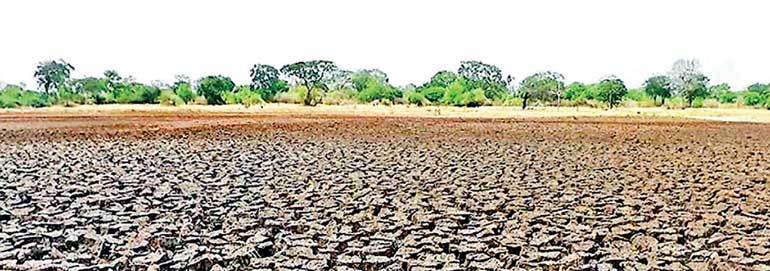
Farmers could begin land preparation and planting following the first significant rainfall. But if the subsequent rainfall fails, the reservoirs may not contain sufficient water to sustain the crops through their critical growth stages. This could result in widespread crop losses after farmers have already invested heavily in land preparation, seed, fertiliser, labour and other inputs
Delaying Maha cultivation until November or December should not be seen as a failure to cultivate. It should be viewed as a prudent water-management strategy – effectively an insurance policy against an uncertain climate year

In water management, a timely warning can be worth far more than a post-disaster response. Sri Lanka is now facing a situation where decisions taken in the coming weeks could determine whether farmers have adequate water to complete the 2026/27 Maha season.
The Irrigation Department has already urged farmers and the public to use irrigation and drinking water carefully as the country faces a heightened risk of drought and rising temperatures associated with the expected El Niño pattern. With reservoir storage falling rapidly, the timing of Maha cultivation deserves careful reconsideration.
Strong El Niño threat
The Pacific Ocean is currently exceptionally warm. According to NOAA, the Niño 3.4 region has recorded a very high positive sea-surface temperature anomaly, while subsurface waters are also significantly warmer than average. The International Research Institute (IRI) has indicated the possibility of a very strong El Niño developing during October-December 2026. Sri Lanka’s Department of Meteorology has also indicated that El Niño conditions could continue into the first quarter of 2027.
El Niño does not automatically mean drought in every part of Sri Lanka. Its influence interacts with other climate systems, including the Indian Ocean Dipole (IOD). A positive IOD can sometimes enhance rainfall over Sri Lanka and partly offset the drying influence of El Niño. However, it would be risky to plan the Maha season on the assumption that such rainfall will occur.
The important point is that this is not a normal year. There is considerable uncertainty over the behaviour of both the Second Inter-Monsoon (SIM) and Northeast Monsoon (NEM).
Reservoirs under Irrigation Department already under pressure
The situation is particularly worrying because reservoir storage has fallen substantially from the levels seen at the end of 2025. Most of the reservoirs that were overflowing in December 2025 are have fallen to about 40% of full capacity level.
According to reports published on 26 August, storage in 74 major reservoirs managed by the Irrigation Department stood at about 1,182,385 acre-feet, or 1,465 million cubic metres, equivalent to only about 35% of their combined gross capacity of 3,114,407 acre-feet (3,843 million cubic metres). Reservoirs in the Ampara District had particularly low storage, at around 22%, while Senanayake Samudraya was reported to have only about 18%.
The Irrigation Department operates or oversees around 340 irrigation schemes covering approximately 306,000 hectares, representing a major share of Sri Lanka’s irrigated agriculture.
At the end of July, the Department reported that only around 40% of the capacity of the major reservoirs remained. This represents a sharp decline from early June, when storage was around 63%.
This rapid depletion should be treated as a serious warning.
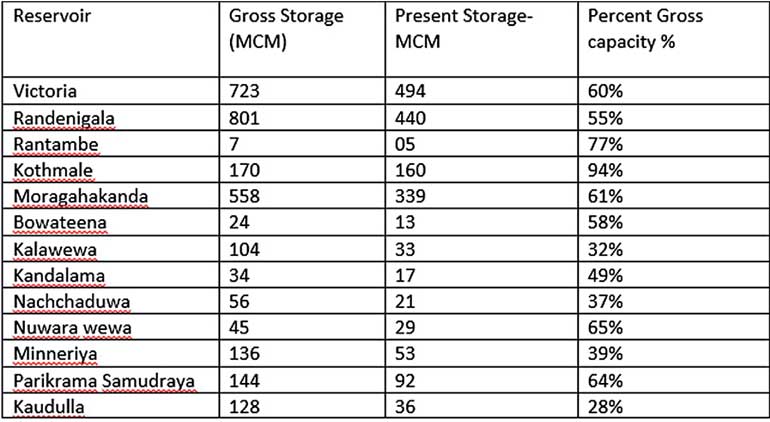
Status of Water Storage as of 14 August 2026 in Mahaweli Reservoirs
Source: Water Management Secretariat, Mahaweli Authority (14 August 2026)
Mahaweli reservoirs also show declining storage
The Mahaweli system is equally important, as its reservoirs support both irrigation and hydropower generation.
At the end of the 2025/26 Maha season, several major Mahaweli reservoirs still had substantial storage. However, by August, the situation had changed considerably.
As of 14 August 2026, Victoria contained about 494 million cubic metres, equivalent to around 60% of its gross capacity, while Randenigala stood at 55%. Moragahakanda had 61%, Kotmale 94% and Rantambe 77%.
More worrying for the North Central Province is the declining storage in downstream reservoirs such as Kalawewa, which had only 33 million cubic metres, or 32% of capacity. Nachchaduwa was at 37%, Minneriya 39% and Kaudulla only 28%.
These reservoirs cannot be considered as isolated water bodies. Water released through upstream regulating reservoirs such as Kotmale, Victoria and Randenigala in the Mahaweli system has to serve several downstream reservoirs and irrigation systems. Therefore, the apparent availability of water in a few upstream reservoirs does not mean that the same quantity is readily available for the entire cultivation area, particularly when many downstream reservoirs are already at relatively low storage levels.
Schemes under Department of Agrarian Development
Minor village irrigation systems, comprising schemes with command areas of less than 80 hectares, are managed by the Department of Agrarian Development. The command area of these minor tanks across the island extends over roughly 185,000 hectares.
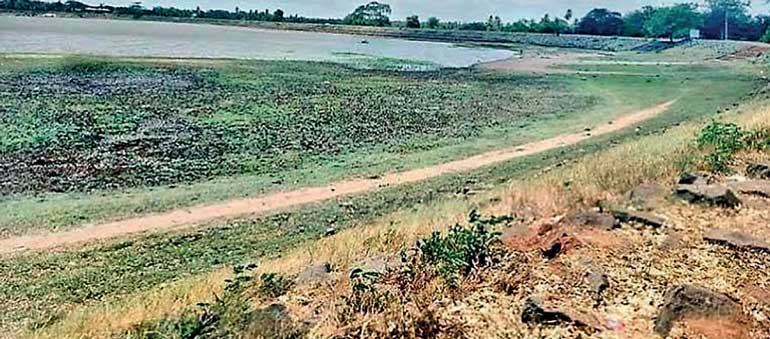
Due to the prolonged drought, many of these tanks now have little or no water, creating tremendous hardships for rural communities. Domestic and agricultural wells located close to the minor reservoirs provide water for highland cultivation and drinking purposes. Villagers also depend heavily on these tanks for bathing, livestock and other domestic needs.
The declining water levels in these small tanks are therefore not merely an agricultural concern. They are directly affecting the day-to-day lives and livelihoods of rural communities.
Should Maha cultivation begin in October?
The Government has already taken steps to prepare for the expected El Niño conditions. At a high-level meeting on 11 June, attended by officials of the Irrigation Department and Mahaweli Authority, water-management plans were discussed, and it was indicated that the 2026 Maha season could commence about one and a half months earlier than usual. The Department of Agriculture has also indicated that Maha cultivation would commence in early October, with the expectation of substantial rainfall in November.
These are welcome measures. However, an important question now arises: should Maha cultivation be started in October based largely on the expectation of substantial rainfall in November?
In my view, this could carry considerable risk.
Farmers could begin land preparation and planting following the first significant rainfall. But if the subsequent rainfall fails, the reservoirs may not contain sufficient water to sustain the crops through their critical growth stages. This could result in widespread crop losses after farmers have already invested heavily in land preparation, seed, fertiliser, labour and other inputs.
No meteorological agency can guarantee that the Southwest Monsoon (SWM) and Northeast Monsoon (NEM) will deliver normal rainfall this year. Therefore, cultivation decisions should not be based solely on the expectation of heavy rainfall in November.
Given the declining storage levels in many reservoirs, a more cautious and flexible approach to the timing of Maha cultivation may be necessary. The Government should closely monitor rainfall, reservoir storage and short-term weather forecasts before making final decisions on the extent and timing of cultivation.
Waiting could be form of crop insurance
My recommendation, based on long experience in irrigation water management, is to delay the main Maha cultivation program until November or, preferably, early December, depending on rainfall and reservoir storage.
Waiting until December would provide valuable additional information. By then, the authorities will have a much clearer picture of:
If storage remains inadequate, cultivation can be restricted to areas where water availability is reasonably assured. If storage improves sufficiently, farmers could be encouraged to cultivate shorter-duration rice varieties.
A December planting does not necessarily threaten the following Yala season. With appropriate short-aged varieties, harvesting could be completed by around March, allowing Yala cultivation to commence as early as April 2027 where water availability permits.
Do not gamble on expected rainfall
The temptation in agriculture is always to respond to the first rainfall. But rainfall at the beginning of the Maha season does not guarantee rainfall throughout the crop cycle.
Starting cultivation over large areas simply because substantial November rainfall is expected could create a dangerous situation. If the expected rainfall does not materialise, farmers will face the consequences while the authorities will have limited water to rescue already-established crops.
The current reservoir situation therefore calls for water-first, rainfall-second planning.
Sri Lanka has experienced years when reservoirs were overflowing and water was abundant. The present situation is very different. With strong El Niño conditions possible, rapidly declining reservoir storage and uncertainty over the coming monsoon, caution is essential.
Delaying Maha cultivation until November or December should not be seen as a failure to cultivate. It should be viewed as a prudent water-management strategy – effectively an insurance policy against an uncertain climate year.
The objective should not simply be to start Maha cultivation early. It should be to ensure that farmers who start cultivation have a reasonable assurance that sufficient water will be available to take their crops to harvest.
(The author holds a B.Sc. in Agricultural Engineering from Tokyo University and an M.Sc. in Soil and Water Management from the University of Wageningen. He is a specialist in watershed management and soil conservation, and a former Director of the Natural Resources Management Centre, Department of Agriculture, Sri Lanka. He has also worked with FAO in Sri Lanka and Bangladesh)




