Wednesday Oct 21, 2026
Wednesday Oct 21, 2026
Wednesday, 2 September 2026 00:22 - - {{hitsCtrl.values.hits}}
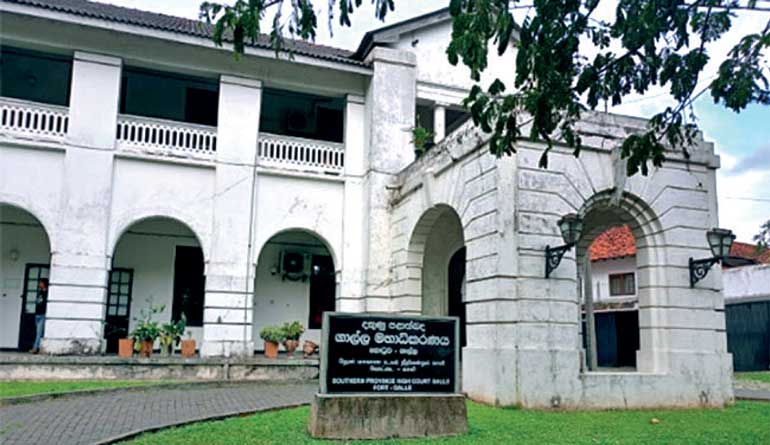
 Although the new Courts Complex in Galle was not quite complete, the then President Ranil Wickremesinghe was anxious to make a profound discourse on how our legal structure was shaped from the time the Dutch introduced ‘Roman Dutch Law’ to our land.
At the official inauguration of the Rs. 1.6 billion court complexes in Beligaha, Galle on July 19, 2024, President Ranil Wickremesinghe drew on rich historical context to connect our littoral province’s judicial evolution with the origins of Sri Lanka’s modern legal framework.
In his address, he detailed how Galle served as a foundational pillar for the island’s administrative justice system, tracing its roots back to the legal frameworks introduced during the Dutch colonial era.
He highlighted the Batavian Statutes and the establishment of the Landraad (Land Board), a system that granted native interlocutors access to land ownership and elevated their social status under Dutch and, subsequently, British rule.
Ranil W is the great grandson of Helena Wijewardene who restored the Kelaniya temple. He is also the great grandson of Wewege Arnolis Dep, a leading Arrack rentier in Colonial Ceylon whose fortune daughter Helena spent on renovating the Kelaniya Temple. The paradox of such dichotomies is comfortably foundational to our belief system.
So, it is for elite classes whose prejudices and distrusts make them immune to genuine aspirations of ordinary people. Father of the 1956 revolution S.W.R.D. Bandaranayake wore the national dress for mass mobilisation and a three-piece suit with bow tie to receive a medal from the Kennel Club for his pet Greyhound Billy Micawber.
New era
But today is a different time. It is a different country. What is unfolding is the end of an era and the dawn of a new. I will not be around to see its full extent. But it is an inexorable process. It will have its hiccups. But it will move on. Deng Xiaoping comes to mind. There is great disorder in the heavens. Times are propitious!
In his homily on the Law, Ranil Wickremesinghe seamlessly linked this regional judicial history to his own elite lineage, illustrating how his ancestors have been intricately woven into the fabric of Sri Lanka’s legal, political, and State administrative systems for generations.
To Wickremesinghe and his contemporary class, the law has often functioned as an exclusive preserve of the manor born.
The “peaceful transfer of power” from the British Empire to the native Ceylonese elite in 1948 was largely realised because the Westernised, English-educated bourgeoisie successfully captured and institutionalised the colony’s legal architecture.
Rather than executing a militant revolution or a Gandhian Swaraj Movement, this gentry used their mastery of colonial jurisprudence as leverage to position themselves as the sole legitimate heirs to the departing British administration.
For the entrenched political class and the legal scholars who act as their jurisprudential guardians, systemic structural adjustments—such as the 22nd Amendment—are frequently framed as disruptions to order, rather than what critics view as a necessary prelude to the de-elitisation, and genuine democratisation of the law.
By drawing a direct historical line from the Dutch Landraad (Land Board) and the Batavian Statutes to his own ancestral lineage, Wickremesinghe inadvertently laid bare the foundational myth of Sri Lankan legal architecture.
To the Westernised, English-educated bourgeoisie that captured the State during the ‘peaceful transfer of power’ in 1948, the law was never an instrument of radical egalitarianism.
It was a sophisticated preserve—a tool utilised by native interlocutors to institutionalise colonial privilege and position themselves as the sole legitimate heirs to the departing British Empire.
For generations, this jurisprudential Brahmin class has guarded the gates of administrative and Constitutional Law, treating the State structure as an inheritance rather than a public trust.
Justice as fairness
Within this historical context, the enactment and implementation of the 22nd Amendment represents much more than a routine package of legislative adjustments.
Viewed through the philosophical framework of John Rawls’s Justice as Fairness in his seminal work – A Theory of Justice, the amendment signifies an epochal transition: a deliberate shattering of dynastic legal hegemony and a structural leap toward ‘Justice as Fairness.’
John Rawls posited that a genuinely just society must be designed from behind a ‘veil of ignorance,’ wherein no individual knows their class, social status, or ancestral lineage.
Under this veil, rational actors inevitably choose two fundamental principles: absolute equality in basic liberties, and the arrangement of social and economic inequalities to the maximum benefit of the least advantaged class of our citizens who now bear the brunt of the savagery of El Nino.
The historical Ceylonese (now Sri Lankan) legal framework, anchored in the legacy of the Landraad, was the structural antithesis of this ideal.
No fear. The Maha Nayakas will endorse BASL. Monastic Landlordism that H.L. Seneviratne Social Anthropologist unravelled in his “Work of Kings” is what made the prelates worried. Renunciation is foundational in Buddhism. Monastic Landlordism is the raison d’être of present-day’s institutional Sangha order.
Our systems were designed precisely by those who knew their status, tailored explicitly to safeguard elite networks and insulate the executive machinery from accountability.
The 22nd Amendment fundamentally disrupts this oligarchical paradigm by institutionalising Rawlsian fairness within the machinery of governance.
Step in right direction
The 22nd Amendment is a step in the right direction.
It reconstitutes the State not as a playground for dynastic networks, but as a neutral arbiter bound by public collective reasons.
This transition addresses the core of the Rawlsian Difference Principle. In a society where the legal and executive architectures are weaponised by a ‘Crony Class of Oligarchs,’ the least advantaged are systematically disenfranchised, facing a legal system they can neither afford nor influence.
De-elitising the law—democratising its institutions is not a challenge to Judicial Independence. The 22nd Amendment is only a tentative step to level the foundational playing field.
It transforms the administration of law from the clutches of a Professional bourgeoisie into a collective shield serving the public interest.
To the jurisprudential Brahmins and their institutional mouthpieces, such structural re-orderings are frequently described as disruptions to stability or departures from established tradition.
Yet, this critique merely exposes their anxiety over losing an empire of influence.
The 22nd Amendment is not a breakdown of order; it is the genesis of a legitimate democratic order. It marks the precise moment Sri Lankan jurisprudence shifts away from the shadow of the Vereenigde Oostindische Compagnie’s Landraad towards a constitutional reality where justice is no longer defined by elite lineage, but strictly by fairness.




