Saturday Oct 03, 2026
Saturday Oct 03, 2026
Monday, 15 December 2025 00:22 - - {{hitsCtrl.values.hits}}

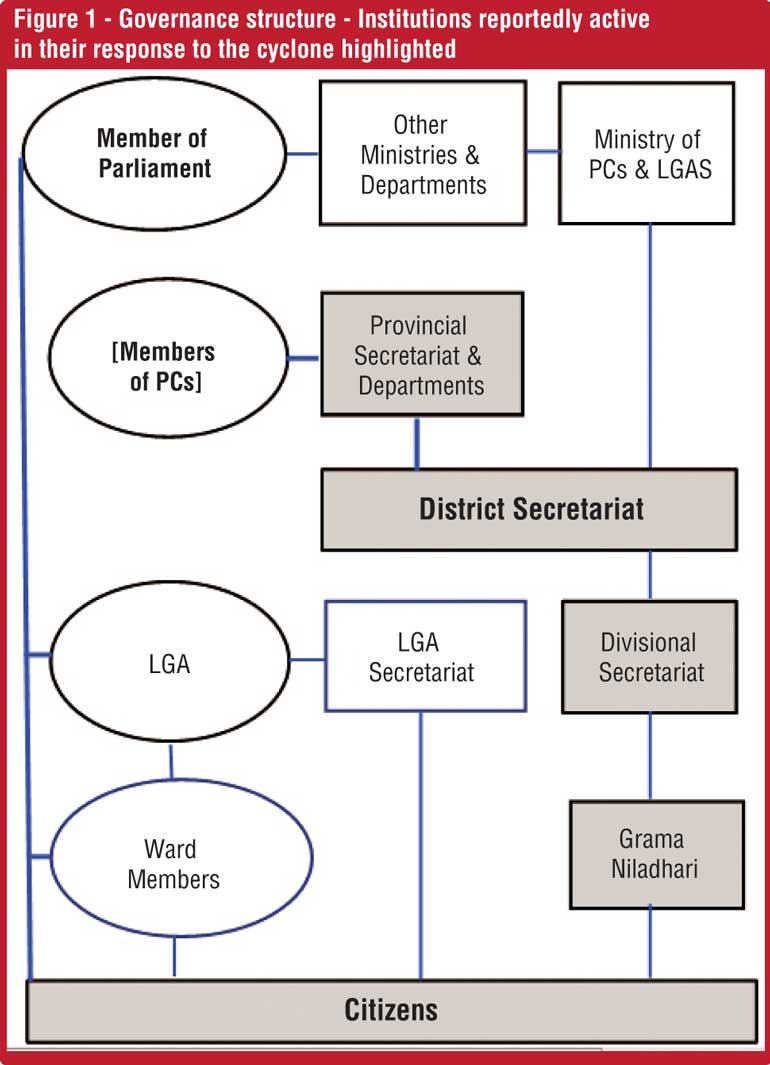
 Cyclone Ditwah wreaked havoc in 21 out of the 25 districts in Sri Lanka during the last few days in November 2025. People were mostly unprepared for the magnitude of the cyclone due to reasons that are yet to be confirmed, but public servants and the public quickly rallied in the aftermath to provide relief to those affected.
The public servants in the frontline are personnel in the Divisional Secretariat Divisions (DSDs) providing relief, beginning with shelters and cooked food for the displaced, with the Grama Niladharis working closer to the action. District Secretariats (DSs) who are at the next higher level are coordinating the work. The tri-forces and government agencies with a ground level presence are working with the District Secretaries. NGOs and citizen groups have been engaging in relief efforts with or without coordinating with the DSDs or DSs. Essentially, those who are closest to disaster are those able to act.
The Provincial Councils are not active because their elections have not been held since 2018-2019, but the Provincial Departments led by the provincial Chief Secretary are involved in operations. By all accounts, the newly elected local councils with 8000+ members, staff and equipment who needed to take care of the convenience, comfort and welfare of the people as per their mandate have not been taking the lead as they should have. There were pictures of DSD secretaries hauling bags of rice or stories of them peeling onions when the respective LGA (Local Government Authority) for the jurisdictions had the workforce and the equipment necessary. A reason could be the lack of formal connections between LGAS and other bodies (Figure 1, bottom left) and/or the inexperience of newly elected members. The complexity of our governance structure with its departments at national, provincial and local levels, often with overlapping responsibilities and political authorities in parallel, is a subject for another time. This column is about the respective roles of planners v. the doers; the national Government v. sub-national levels; and the centre v. peripheries.
The role of the Central Government was over by the time the cyclone began unleashing its fury. If the centre has not done the policy part and the warning part, it is too late for them to do anything at the time of the disaster, except to issue executive directives as per requirements from the field. What we see during disasters in Sri Lanka is on-the-spot decentralisation driven by circumstances.
Subsidiarity principle behind decentralisation
Subsidiarity is the principle in governance that decision making should be delegated to the lowest level possible, with higher authorities only stepping in to do what the lower levels cannot do. Subsidiarity essentially is the rationale for decentralisation.
How subsidiarity comes into play during the disaster was illustrated by Sunil Kannangara, a retired civil servant with an exemplary service as a District Secretary (or Government Agent as the position is popularly known) and other positions, at a webinar on the topic organized by the National Movement for Social Justice.
All that is required at the time of an emergency is for the President to instruct the tri-forces to give all assistance to the District Secretaries, and that is sufficient for them to proceed, he said. The same is for other Government departments with a presence at district or divisional level. Once the clearance from the centre is given, a District Secretary knows how best to communicate and coordinate with other Government departments.
Kannangara also pointed out the role of parliamentarians or other politicians at a time of crisis. He said a good politician would ask the District Secretary what the politician can do to clear obstacles, if any, and do the needful.
These observations on the importance of decentralisation with coordination and communication are corroborated in a report on Tsunami 2024 published after one year of relief and recovery operations.
A joint report on “Post Tsunami Recovery and Reconstruction,” published by the Government of Sri Lanka and development partners in December 2005, one year after the Tsunami, identifies the full set of post-tsunami activities as emergency response and relief: funding the recovery and reconstruction, getting people back to their homes, restoring livelihoods, addressing health, education and protection needs and upgrading national infrastructure.
The report further lists eight guiding principles, all of which are still valid. I have listed them under the themes Decentralization, Coordination, Communication and Fiscal and Monetary Management.
A “Post-Disaster Recovery Plan: Sri Lanka, Floods, And Landslides” published by UNDP in 2017 recommended the National Planning Department as the focal point nationally, and District Secretaries as the focal point sub-nationally. In the absence of political authority at the provincial level at this point, District Secretaries are positioned well to coordinate all provincial, district and local actors and institutions.
This “Decentralization, Communication and Coordination” trio of principles is well illustrated in the way the present crisis is handled in different provinces or districts. In the Uva province, the charismatic Chief Secretary for the province Anusha Gokula Fernando, seems to be leading. In some other provinces each District Secretary would be leading with the Provincial Secretary facilitating. The President is doing his job of boosting morale by going around the country, except when he gets into unnecessary micro-management in some instances. Ministers or other parliamentarians have allowed the administrators to take the lead, perhaps due to their lack of experience, but I hope that will continue to be the practice, because as Kannangara indicated, politicians best serve by asking what he/she can do, not how I can lead. In some instances, according to the circumstances, politicians may find themselves leading.
Why can’t we have subsidiarity at other times?
Our governance system is a messy one with three levels of political authority and parallel levels of bureaucracy. The present crisis shows that if the goals are clear and the responsibility is given with assurance of fullest support from the top, the lower levels of Government will organise themselves to deliver.
In the present case, the goal is relief, recovery and rebuilding. Relief and recovery seem to be going well. I am sure the rebuild process too will progress satisfactorily if the Central Government continues with the principle of subsidiarity.



