Friday Oct 23, 2026
Friday Oct 23, 2026
Friday, 23 October 2026 02:56 - - {{hitsCtrl.values.hits}}
 The true measure of a nation’s commitment to wildlife conservation is not how deeply it mourns its iconic animals after they die, but how effectively it protects them while they are still alive
 The death of Kavantissa on 16 October 2026 was a profound loss for Sri Lanka. One of the country’s most magnificent wild tuskers, he was estimated to be around 45 years old when he died, following several weeks of veterinary treatment for a reported gunshot injury. His death has prompted widespread grief, raised questions about the medical care he received and renewed calls for better protection of Sri Lanka’s remaining wild tuskers.
It has also exposed a disagreement about what conservation should mean in practice. Following Kavantissa’s death, the Director-General of Wildlife Conservation defended the Department’s holistic approach to elephant management rather than a focus on individual animals. Some elephant specialists make a similar argument: Sri Lanka must devote its limited resources to conserving the population as a whole and reducing human–elephant conflict (HEC), not to protecting a few well-known elephants.
But it does not follow that an elephant such as Kavantissa should receive no additional attention. Protecting a population and responding to the needs of an individual animal are not opposing ideas. The real question is whether a responsible wildlife authority should recognise differences in biological characteristics, exposure to danger and the likely benefit of intervention.
I believe it should. Equal concern for every elephant does not require precisely the same intervention for every elephant. That is not a sentimental argument. It is a matter of sound management.
Why the rarity of tuskers matters
Sri Lanka has an unusual feature within its wild elephant population: only a small proportion of adult males carry prominent tusks. In many other Asian elephant populations, the proportion is considerably higher, although it varies between places and over time.
A study by Fred Kurt, Günther Hartl and Ralph Tiedemann, published in Acta Theriologica in 1995, examined historical records and population genetics to investigate this difference. The researchers referred to estimates suggesting that about 93% of Sri Lanka's subadult and adult male elephants were tuskless. Their historical analysis and modelling indicated that selective capture and killing of tuskers may have played an important part in producing this pattern.
These are historical estimates, not figures from a recent elephant census. Nor has modern research fully resolved how tusk development is inherited in Asian elephants. There may be several influences on the prevalence of tusks, and we should be careful not to treat one historical explanation as the whole story.
Still, the study raises a question that deserves more attention than it has received. If human activities have helped reduce the occurrence of a natural characteristic over many generations, should we not investigate that change and take reasonable steps to prevent further avoidable losses?
Having tusks does not make a male elephant genetically superior, nor does it necessarily make him a more successful breeder. Research by Karpagam Chelliah and Raman Sukumar, published in Animal Behaviour in 2013, found that body size and musth, a periodic reproductive condition experienced by adult bulls, were generally more important than tusks in determining dominance during male encounters.
Tuskless males are essential members of the population and deserve the same fundamental protection. Indeed, emergency veterinary care should depend on the needs of the animal, not whether it happens to possess tusks or attract public attention.
But that is different from saying the rarity of tuskers has no conservation relevance. Conservation is not concerned only with preventing extinction. It also involves understanding the variation found within a population, how that variation has changed, and whether human pressures are causing it to disappear. Kavantissa stood out even among Sri Lanka's tuskers. His extraordinary stature and prominent tusks made him one of our most recognisable wild elephants. As a tusker, he also belonged to a relatively small proportion of Sri Lanka's wild male elephant population. These facts do not prove that his genes were more valuable than those of another elephant. They do give us a reason to ask whether his circumstances warranted closer assessment and preventive monitoring.
Kavantissa estimated age of around 45 has sometimes been compared with that of an elderly human being. However, such comparisons have no established scientific basis, as elephants age differently from humans. More importantly, our responsibility to protect wild elephants should not depend on their age, reproductive potential or perceived usefulness. Kavantissa's life was valuable in its own right, just as the lives of all other wild elephants are. His age should not diminish the responsibility to protect him from avoidable human-induced threats.
Protecting people and protecting elephants
No serious discussion about elephant conservation in Sri Lanka can ignore the suffering caused by human–elephant conflict. Families have lost breadwinners; farmers have watched their crops destroyed; children and older people in some villages live with the fear of an elephant encounter after dark.
A Reuters report published on 14 October 2026 stated that, since 2019, Sri Lanka has recorded annual averages of approximately 138 human deaths and 402 elephant deaths in the wider human–elephant conflict crisis. Behind every figure lies a loss that statistics alone cannot describe.
It would be wrong to ask rural communities to bear the costs of conserving elephants without providing effective protection for their lives, homes and livelihoods. Human safety must remain paramount, and reducing conflict must be a central responsibility of the State.
The National Action Plan for Human–Elephant Conflict Mitigation provides an important scientific starting point. It recognises that much of the elephants’ range is outside protected areas, where farming communities also live. Rather than trying to push all elephants into national parks, it calls for protecting settlements and cultivation through practical, locally appropriate measures.
The problem is not that the country has no scientific proposals. It is that implementation has too often failed to match the scale and urgency of the crisis.
Why, then, is better protection for vulnerable tuskers sometimes treated as a rival to HEC mitigation? The Department of Wildlife Conservation has several responsibilities. It must conserve habitats and populations, prevent illegal killing, respond to injuries and help communities live more safely alongside wildlife. These duties are connected, but they are not identical.
An elephant that frequently enters a dangerous settlement corridor may need different monitoring from one in a relatively secure part of a protected area. An injured elephant may require urgent clinical intervention. An identifiable tusker with a history of threats may justify additional preventive attention. None of this means other elephants matter less.
There is a genuine question of cost. Wildlife officers, vehicles, veterinary equipment and public funds are limited. Money spent on one animal must be justified against what that money could achieve elsewhere. Any special protection program that merely creates new titles, offices or publicity opportunities would be difficult to defend.
The answer is a modest, risk-based program working through existing field and HEC operations, rather than an expensive parallel institution. Where closer monitoring can warn communities of an approaching elephant, identify a hazardous location or allow earlier treatment of an injury, it may benefit people as well as wildlife. Those benefits must be measured, not simply asserted.
And one distinction must remain clear: preventive monitoring of a high-risk animal is not the same as giving it priority over others in emergency medical care. An unknown tuskless male suffering a serious injury should not receive poorer treatment because a famous tusker commands more public attention. Clinical decisions must be based on need, urgency, welfare and the realistic prospects of treatment.
A lesson from Kenya, not a model to copy blindly
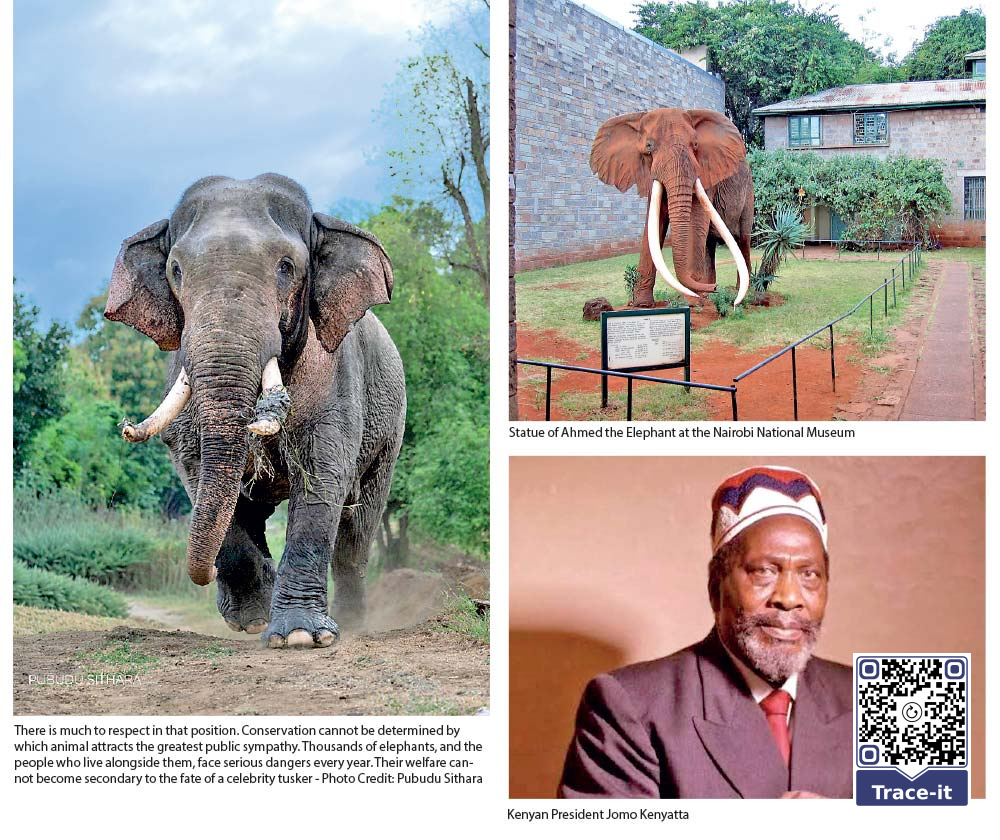
The idea that an exceptional elephant may warrant additional protection has a long history. In Kenya, Ahmed, the celebrated tusker of Marsabit, became the subject of a campaign by schoolchildren concerned about his safety.
In 1970 President Jomo Kenyatta placed him under presidential protection. Recognised as a living national monument, Ahmed was watched day and night by armed rangers until his death, reportedly from natural causes, in 1974.
The importance of this episode is not the ceremony surrounding a famous animal. Kenya acknowledged that a recognisable elephant with unusually large tusks faced a particular danger and took steps to protect him.
A more useful contemporary example is the Big Tusker Project in Kenya’s Tsavo Conservation Area. Tsavo Trust, working with the Kenya Wildlife Service, uses aerial surveillance, mobile field teams and individual identification to help protect exceptional elephants while supporting wider conservation work. The program was described by Moller, Cahill and Kimaile in a 2019 paper in the International Zoo Yearbook.
Kenya’s experience offers a useful precedent, but not a ready-made solution for Sri Lanka. Targeted protection can operate within a broader programme for habitats, wildlife and surrounding communities. However, this does not necessarily mean that the same methods would succeed in Sri Lanka or that the costs would be justified here.
The two countries face different threats. Large African tuskers are especially vulnerable to ivory poaching. Sri Lanka’s elephants face shootings, electrocutions, accidents, land-use pressures and the daily hazards of conflict with people living across elephant range.
We should therefore learn from Kenya’s principle, not copy its arrangements. We do not need armed escorts for every well-known tusker. We need to identify our own risks and decide, on evidence, when additional protection is likely to prevent harm.
Could more have been done for Kavantissa?
Kavantissa’s final weeks deserve careful, independent scrutiny. According to the account given by the Department of Wildlife Conservation and reported in The Sunday Times on 18 October, veterinary officers attended to him after receiving information about a reported shooting in September. Treatment was provided, two teams were assigned to observe his condition, and additional specialists were consulted when his health deteriorated.
Those efforts should be recognised. Wildlife veterinarians and field officers often work long hours in dangerous and difficult circumstances. It would be unfair to question their professional dedication without evidence. But the commitment of individual officers is not the same thing as the effectiveness of the institution around them. We need to examine what happened before the injury as carefully as what happened afterwards.
Was Kavantissa known to face particular risks in the areas he frequented? Had those risks been assessed? Could preventive monitoring or better coordination with communities have reduced his exposure?
Once he was injured, were the necessary diagnostic facilities, specialist advice, transport and clinical resources available at the right time? Could a different response have altered the outcome?
These are questions for an investigation, not conclusions that can responsibly be drawn from his death alone. We cannot yet say that negligence caused the loss of Kavantissa, or that better monitoring would certainly have saved him. Equally, the provision of treatment does not, by itself, settle whether the wider system was adequate.
President Anura Kumara Dissanayake has appointed an expert committee to examine the immediate and underlying causes of Kavantissa’s death, consider possible lapses in his treatment and recommend procedures for wild elephant welfare and a national conservation program. Its mandate is sufficiently broad to look beyond the final clinical episode.
The committee should seek the expertise it needs and distinguish clinical findings from shortcomings in policy, equipment or field coordination.
Its report should be published, subject to legitimate investigative restrictions, and accompanied by responsibility for implementing its recommendations.
Sri Lanka has established many committees over the years. Public confidence will depend less on the announcement of another inquiry than on what changes after its findings are delivered.
A practical way forward for Sri Lanka’s remaining tuskers
Sri Lanka should establish a scientifically designed, risk-based program for vulnerable wild elephants, with a specific component addressing the remaining wild tuskers. This would sit within the Department of Wildlife Conservation and work closely with its HEC mitigation and veterinary services, rather than competing with them.
The starting point should be reliable information. The Department, working with researchers and experienced field observers, could maintain a regularly updated register of identifiable tuskers, using photographs, observations and relevant health records. It would document broad ranges, past injuries and known threats, while keeping precise location data secure so that the exercise does not itself increase the risk of harm.
Additional monitoring should then follow clear criteria: evidence of repeated threats, exposure to conflict, an animal’s vulnerability, the feasibility of intervention and the likely benefit to wildlife and nearby communities. Fame alone should not qualify an animal for special treatment.
Technology has a role, but it is not a substitute for field judgment. GPS collars may help in selected cases, although immobilisation, collaring and continuing maintenance bring financial and animal-welfare costs. Routine observation, photographic identification, responsible community reporting and better communication between local wildlife teams may sometimes achieve more with fewer risks.
Our veterinary response also needs attention. Field officers should have dependable access to appropriate diagnostic equipment, mobile treatment facilities, specialist consultation and clear emergency protocols. These investments would improve care for all injured wild elephants, not just the most recognisable tuskers.
A pilot program could begin in a limited number of high-risk landscapes with a published budget and clear objectives.
Independent evaluation should examine whether it improves the detection of threats, shortens response times, reduces avoidable injuries or helps prevent dangerous encounters with people. The scheme should be expanded only when the evidence warrants it.
At the same time, Sri Lanka needs updated research on the proportion of tusked males, tusk inheritance and the effects of selective mortality on the population. We should not continue relying on historical estimates when contemporary scientific methods could provide a better basis for decisions.
None of this requires making elephants dependent on human attention. Wild elephants must remain wild. Interventions should be limited to what is reasonably necessary to reduce avoidable human-induced harm, without encouraging habituation, dangerous close contact or unnecessary disturbance.
Ultimately, success should be judged by fewer preventable injuries, safer communities and better conservation outcomes, not simply by the number of meetings, patrols or collars.
The legacy Kavantissa deserves
What concerns me about the debate following Kavantissa ’s death is the suggestion that caring about an individual animal is somehow at odds with scientific conservation. It need not be.
Science should help us understand why particular animals face particular risks and how we can respond without neglecting the population or the people who share its landscape.
Public grief cannot be a substitute for evidence. But scientific authority should not be used to brush aside legitimate questions from the public. When an animal as remarkable as Kavantissa dies, people are entitled to ask whether our institutions did all that could reasonably have been done and what they will do differently next time.
The Department of Wildlife Conservation exists not merely to administer land and respond to emergencies, but to protect the country’s wildlife for future generations. That requires sound science, experienced field staff, capable leadership, adequate resources and accountability for conservation outcomes.
Kavantissa was not more entitled to live than another elephant. Yet he was not indistinguishable from every other elephant either. He belonged to a relatively uncommon group, possessed extraordinary physical characteristics and had become a symbol of Sri Lanka’s natural heritage. Recognising those facts does not diminish other elephants or the communities who must be protected from conflict.
The argument should no longer be about whether one famous tusker deserved attention. It should be about whether Sri Lanka has the capacity to identify foreseeable risks early, protect people effectively and prevent avoidable losses among the elephants that remain.
We do not need another conservation program that exists only on paper. We need better implementation of HEC mitigation, stronger veterinary preparedness, practical monitoring of vulnerable animals and transparent institutional accountability. Above all, we must shift from responding to tragedies towards preventing them wherever reasonably possible.
The true measure of a nation’s commitment to wildlife conservation is not how deeply it mourns its iconic animals after they die, but how effectively it protects them while they are still alive.
(The author is a telecommunications engineer turned environmental and wildlife conservationist, citizen scientist and wildlife documentary filmmaker. His work bridges science, public policy and sustainable development, with particular emphasis on the long-term conservation of Sri Lanka’s elephants and other threatened species)




