Monday Sep 28, 2026
Monday Sep 28, 2026
Monday, 28 September 2026 04:03 - - {{hitsCtrl.values.hits}}

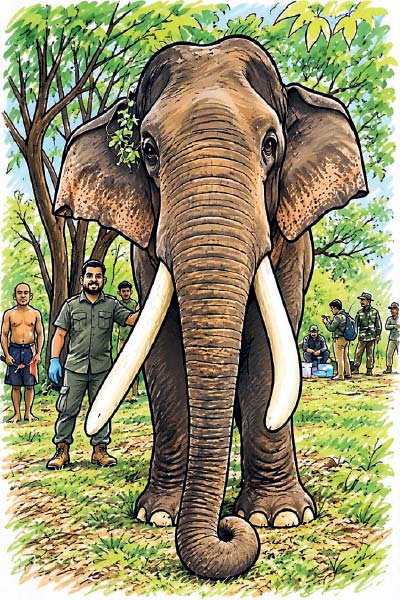
Kavanthissa is not just another elephant. He is widely recognised as Sri Lanka’s largest and tallest living wild tusker, a magnificent animal with exceptionally long tusks and one of the very few great tuskers remaining in our country.
Since 2025, I have been asking a simple question: Why can we not establish a dedicated protection team for elephants like Kavanthissa?
Today, after Kavanthissa has reportedly been shot and seriously wounded again, that question has become even more urgent. Veterinary teams may treat his injuries, but treatment is not protection. His life remains at risk.
And we must ask another very uncomfortable question:
Where is the law? Where is the deterrent?
Sri Lanka already has laws protecting elephants. The Fauna and Flora Protection Ordinance makes it an offence to shoot, kill or injure an elephant, to use electric wires to kill or injure one, or to use any device to harm an elephant.
Yet elephants continue to be shot, electrocuted, poisoned and killed using illegal methods.
Based on reported figures, more than 200 elephants have already been killed in Sri Lanka in just the first nine months of 2026. More than 200 lives lost in nine months, how many more must we lose before we act?
So what is happening to the law?
 We need arrests. We need proper investigations. We need prosecutions. And, where guilt is established, we need the law to be enforced and meaningful sentences imposed.
Without consequences, what is the deterrent?
And we are living in the 21st century.
We do not need to reinvent the wheel.
Kenya has demonstrated how individual “Super Tuskers” can receive dedicated monitoring through specialised teams, working with wildlife authorities. Ground teams, aerial surveillance, tracking and technology are used to know where these precious elephants are and to respond when they are at risk.
South Africa has adopted a similar principle for rhino conservation through Intensive Protection Zones, concentrating security resources, technology and intelligence in areas where particularly vulnerable wildlife needs greater protection.
Why can’t Sri Lanka do the same?
We could establish a small National Tusker Protection Unit under the Department of Wildlife Conservation, beginning with Kavanthissa and other identified high value tuskers.
Sri Lanka can develop its own version.
For Kavanthissa and other identified national-treasure tuskers, we could have GPS/radio monitoring, camera surveillance, drones where appropriate, night patrols, rapid-response teams and a central database tracking their movements, health and threats.
And we do not have to do this alone.
There are professionals, scientists, veterinarians, conservationists, technology experts and ordinary citizens who are willing to volunteer their knowledge, time and resources to save our elephants. Let us bring these people together with the Department of Wildlife Conservation, the Police and other relevant agencies.
This is not about giving one elephant privileges over another.
It is about recognising that when an animal is exceptionally rare, genetically significant and irreplaceable, losing that individual is a loss to the entire nation.
Kavanthissa should be the beginning.
Are we going to wait until the remaining great tuskers of Sri Lanka disappear from this earth before we recognise what we have lost?
These are our national treasures.
The Government has a responsibility to protect them. We, as citizens, have a responsibility to demand that protection.
Kavanthissa has survived once before.
Now he is wounded again.
Let us not wait for his death to recognise that he was a national treasure. Let us protect him while he is still alive.
(The author is a wildlife enthusiast)




