Monday Sep 28, 2026
Monday Sep 28, 2026
Monday, 15 June 2026 03:29 - - {{hitsCtrl.values.hits}}
 As the public, we could observe how NCPA had to force the Police to take action to arrest the monk and produce him to the court. The monk was only produced to the court on the 2nd court day, only to be released on bail. It speaks for itself that the case will proceed to deny justice unless relevant authorities, such as NCPA, are empowered to defend the child’s interests
By Women of Conscience
‘Justice delayed is justice denied’ is a well-tested dictum in Sri Lanka. Details of the cases of child abuse, particularly by clergy, Buddhist clergy in a number of instances, revealed a common trait of long, drawn-out legal procedures, only to be thwarted due to discrepancies in evidence. Accusations against Pallegama Hemarathana Thero, who allegedly procured a child for sex and raped her, also show a similar pattern.
Despite the gravity of the accusation - procuring an 11-year-old girl and raping her, the Sri Lanka Police did not take prompt action to arrest the monk and investigate the case thoroughly.
Given the enormous political power the monk wields as a prominent religious leader with a close relationship with the political establishment, neither the government nor opposition political parties in the Parliament rallied swift support to put the Police into action.
Twenty two women Parliamentarians, a historical record in women’s representation, also did not stand with the child. It was only after repeated attempts by the National Child Protection Authority (NCPA) and public outcries that the Police arrested the monk. In addition, court proceedings also reveal a number of loopholes creating favourable conditions to deny justice to the abused child. It is in this context that the Women’s Caucus in the Parliament called for a secret meeting on 5 June.
The secret meeting amidst screaming silence has aggravated public fear that justice would be denied to the child. On top of the secrecy, the news that the NCPA was reprimanded for making the Police uncomfortable, reported by the BBC Sinhala news, and later by other media, quoting sources present at the meeting, is distressing.
As the Government, the Ministry of Women and Child Affairs, the Police, and women parliamentarians failed to stand with the child, only the NCPA and web-based social and select other media stood up to ensure that due process would take its course unhindered by the influence of power and privilege. As the public, we could observe how NCPA had to force the Police to take action to arrest the monk and produce him to the court. The monk was only produced to the court on the 2nd court day, only to be released on bail. It speaks for itself that the case will proceed to deny justice unless relevant authorities, such as NCPA, are empowered to defend the child’s interests.
The press release issued by the Women’s Caucus on 8 June, while hinting that the Caucus, too, shares an interest in ensuring that the case proceeds with stronger evidence, reveals a dangerous tendency. Reference to intervention in setting new guidelines on “media reporting and judicial proceedings relating to child abuse cases” has escalated worries that the attempt is to impose a complete blackout and obstruct transparency in how investigations and court proceedings move forward.
We, as the concerned public, believe that justice is not limited to the affected girl, but also to all of us, abused children participating in their respective judicial proceedings, and people in Sri Lanka. It is important we know what happened at the court, and social media has been the only outlet for information in the case of Pallegama Hemarathana, as all mainstream media except a few observe a vow of silence, bound by their affinity to high-powered religious figures.
We, as the concerned public, believe that justice is not limited to the affected girl, but also to all of us, abused children participating in their respective judicial proceedings, and people in Sri Lanka
Following the secret meeting and BBC exposé, the statement by MP Lakmali Hemachandra, on using her parliamentary privileges and related political conversations, has further shifted the spotlight away from where it belongs: the abused child and justice. The case, which first received deafening silence from the political establishment, women MPs, and mainstream media, has now entered a Yanne Koheda, Malle Pol (neither here, nor there) moment. Amid procedural debates and privileged statements, the child's right to timely justice has been pushed to the backseat once again. Forces derailing justice are taking the upper hand.
Therefore, we as the concerned public demand answers to the following;
(The author is a group of women standing in solidarity with those abused and marginalised by racial, capitalist and patriarchal systems)
|
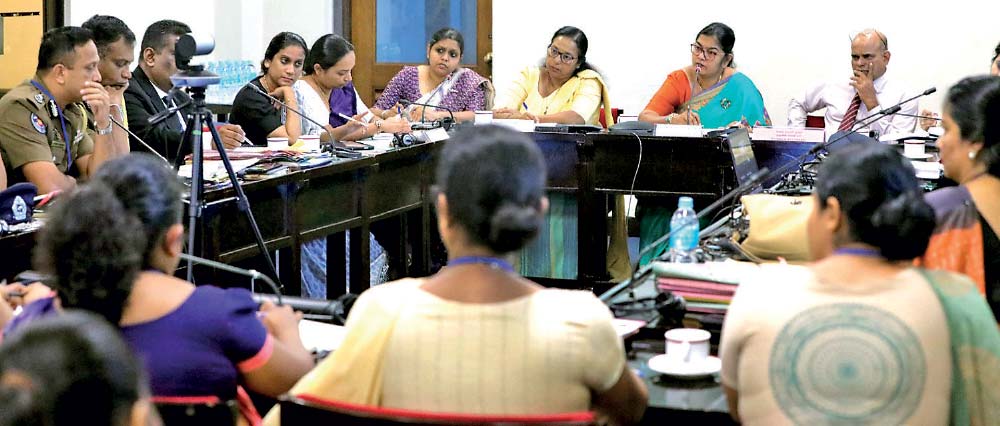
The Women Parliamentarians’ Caucus met in Parliament on 5 June to review the progress of investigations and discuss the next steps relating to the case concerning the abuse of a girl in the Anuradhapura area. The meeting was chaired by the Chairperson of the Caucus and Women and Child Affairs Minister Saroja Savithri Paulraj. Officials representing the Attorney General’s Department, the National Child Protection Authority, the Department of Probation and Child Care Services and the Sri Lanka Police were invited to attend the meeting. During the meeting, the Women Parliamentarians’ Caucus instructed the relevant authorities to ensure that all ongoing investigations related to the incident are conducted strictly in accordance with court orders. The Caucus also requested that forensic reports and other medical reports relevant to the case be obtained without delay. |