Thursday Oct 22, 2026
Thursday Oct 22, 2026
Saturday, 10 January 2026 00:10 - - {{hitsCtrl.values.hits}}
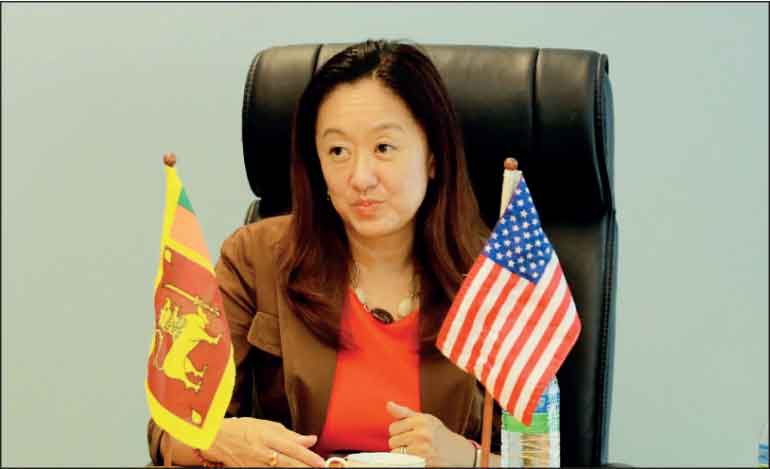
US Ambassador Julie Chung
 US Ambassador Julie Chung, whom I have engaged with since 2022, will complete her tenure in Sri Lanka in January 2026. During her time in Colombo, she became one of the country’s most recognisable and engaged diplomats.
Arriving in early 2022, she stepped into one of the most turbulent periods in Sri Lanka’s post-independence history. Foreign reserves had evaporated, inflation was spiralling, fuel and food shortages became part of daily life, and public confidence in institutions had nearly collapsed. In such moments, diplomacy often retreats into protocol, cautious statements, and distance. Ambassador Chung chose a markedly different approach—one that attracted wide attention and, at times, criticism during her tenure.
Diplomatic engagement
From the outset, she redefined what diplomatic engagement could mean during a national crisis. Rather than limiting herself to formal government-to-government interactions, she reached out broadly—to policymakers, business leaders, civil society organisations, youth groups, media professionals, and ordinary citizens grappling with daily hardship. This transformed the role of ambassador from distant observer to genuine partner at a time when Sri Lanka urgently needed reassurance, candour, and credibility. What distinguished Julie Chung was not merely her visibility, but the sincerity and consistency of her engagement. She was present, accessible, and willing to listen. At a time when Sri Lankans were anxious about their future and understandably sceptical of external actors, she communicated clearly about US support for economic stabilisation, democratic institutions, and social resilience. Her tone was collaborative rather than prescriptive—a quality that resonated deeply during a period of national hardship.
A constructive role
During the most difficult phase of the crisis, Ambassador Chung played a constructive role in supporting Sri Lanka’s engagement with international financial institutions, particularly in relation to IMF-supported reforms and the complex process of debt restructuring. While respecting Sri Lanka’s ownership of its reform agenda, she consistently underscored the importance of transparency, accountability, and long-term sustainability—principles framed not as abstract ideals, but as practical necessities for restoring stability and rebuilding public trust.
Beyond immediate crisis management, she remained focused on the future. Under her tenure, the US Embassy in Colombo intensified efforts to promote bilateral trade and investment, particularly in renewable energy, petroleum, technology, logistics, agribusiness, and services. She encouraged American companies to look beyond short-term turbulence and recognise Sri Lanka’s strategic location, skilled workforce, and long-term potential—helping shift the national conversation from survival to recovery, and from recovery to opportunity.
Security cooperation also remained a steady and carefully managed pillar of engagement. Amid growing geopolitical complexity in the Indo-Pacific, Ambassador Chung navigated Sri Lanka’s sensitivities with balance and respect. She supported cooperation in maritime security, disaster preparedness, humanitarian assistance, and professional military education, while consistently affirming Sri Lanka’s sovereignty and long-standing non-aligned foreign policy tradition.
Democracy and civil society
Equally significant was her engagement with Sri Lanka’s democratic fabric. She spoke firmly yet respectfully on democratic governance, the rule of law, media freedom, and accountability—framing these not as external lectures, but as shared values essential for social cohesion, investor confidence, and sustainable growth.
While she faced criticism at times for engaging across the political spectrum and articulating US positions openly, her transparency ultimately enhanced her credibility. Beyond political and business circles, Julie Chung maintained strong engagement with civil society. She attended their events and showed particular interest in the empowerment of women, often referring to her own childhood as an immigrant in the United States. During periods of strain between government and civil society, activists approached her with confidence that their concerns would be conveyed to the relevant authorities.
Presence
As Ambassador Julie Chung concludes her nearly four-year tenure in Sri Lanka, she leaves behind more than a completed diplomatic assignment. She leaves a model of engagement rooted in partnership, clarity, and collaboration—one that proved especially valuable during moments of national distress. In Sri Lanka’s modern diplomatic history, she will be remembered not as a passive observer of the crisis, but as a diplomat who stood with the country when it mattered most. Her tenure is a reminder that diplomacy, at its best, is measured not by protocol, but by presence, trust, outcomes, and purpose.
References :
https://www.ft.lk/news/US-Ambassador-Julie-Chung-to-depart-Sri-Lanka/56-786650
https://themorningtelegraph.com/37366/
https://www.newsfirst.lk/2023/01/01/over-240-mn-us-assistance-given-to-sl-in-2022-julie-chung#:~:text=by Mariam Gunawijayah 01-01,partnership,” the Ambassador said.




