Friday Oct 02, 2026
Friday Oct 02, 2026
Friday, 2 October 2026 00:22 - - {{hitsCtrl.values.hits}}
 “For Brutus is an honourable man;
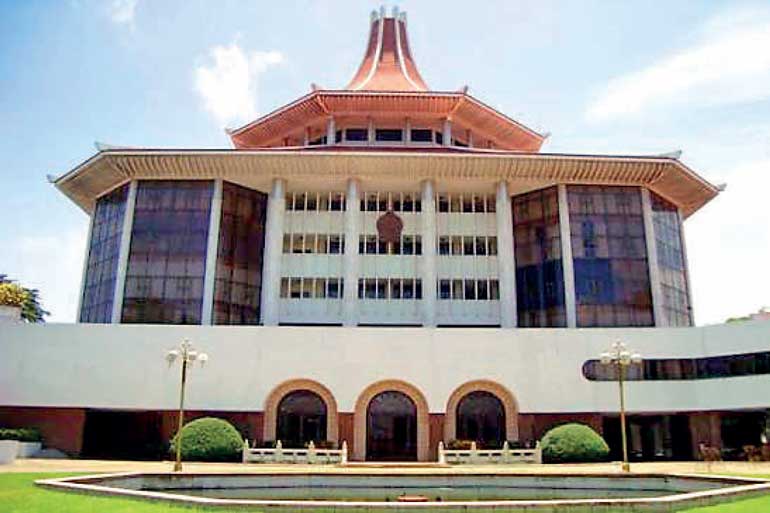
 With the hearing of the 22nd amendment to the country’s Constitution, the person and the role of the Chief Justice has come into sharp focus.
This attention should be welcome, the courts after all only exercise the judicial powers of the people, and are an institution wholly upheld with public funds. Justice is an expensive business, not only in monetary terms, on a daily basis it engages the time of many thousands across the island who have to attend court in various capacities. Greater its impact on the daily life of citizens, higher the expenses incurred by an institution, more the required scrutiny.
By any yardstick, the recent history of the office of Chief Justice of Sri Lanka cannot be said to be illustrious. We had a Chief Justice who later apologised for favouring a powerful politician in a case before him. They were long-term friends, even after retirement, this Chief Justice has shown a marked partiality to the politician’s cause. We had another Chief Justice who upon the electoral defeat of the President responsible for his judicial elevation, was virtually chased out of his office (whether he retired, was removed or unceremoniously shown the door is unclear). So scorned was he. It is commonly said that on election night the judge was with his patron, the defeated President. A tale of two judges and one president!
A judge can have other skills, a diplomat, even a good salesman perhaps. So base is our so-called elite, when political winds changed later, the man was appointed the nation’s spokesman on the international stage, confirming yet again the world’s dismissive opinion of this country!
The foreignness of the laws we practice is obvious. None of it evolved here, beginning a few centuries ago when a handful of venturesome European seafarers landed on our shores; a chance discovery and a tentative landing on a hot beach. Gradually, depending on the needs of the time, new laws and legal methods were introduced. The dress of legal practitioners; the black tie and jackets, robes and wigs to the weathered books the lawyers carry with a weighty air, are as foreign as a stethoscope around the neck of a native physician.
In the originating countries the legal system is in its evolutionary habitat; comfortable, commanding general acceptance; committed to fairness, leaning towards liberality, a symbol of a particular civilisation. Important court decisions are analysed minutely, the judge’s legal philosophy examined, his personal life subject to scrutiny; a price is paid to keep the quality high and system straight. It is commonly said that some of the best English writing is found in British judgments; men of the world, considering matters with wisdom and foresight. In a differently evolved culture, institutions like the judiciary can easily become a totem, a holy cow venerated by rote. We live in a crisis-ridden society; one way or the other, every institution is affected by the malaise. Here, for an institution to claim respect, it must threaten violence.
If we expect the courts to represent the true meaning of justice, our expectations could be too rosy, even naive. By definition, their function is narrower, further constricted by cultural personality. Democracy has more meaning when practiced by individualistic cultures, where a person’s liberty is fundamental and the individual commands parity with his counterpart. Our infamous patron/client social arrangement; the humble supplicant before the benevolent patron, distorts the essence of the system, a system which assumes equality in the encounter.
Courts do justice because it is their duty, not because a party is humbling itself before court.
Practicality tells us that justice is on a sounder footing when that economy is robust, a people with a work culture delivering high quality. Where poverty is a nation’s perpetual shadow, when failure defines its institutions, when productivity is at a low ebb, we cannot expect a shining judiciary. Examine our legal literature; it is unsettling that nearly all accepted textbooks as well as the ideas of law emanate from the originating societies. On the other hand, weakness gnaws at the pretenses of the imitating cultures, giving rise to touchiness and excessive ceremony.
Every institution is a creature of its people; it cannot march far ahead, nor will it lag far behind.
Recently we read of the passing of a former Chief Justice G.P.S. De Silva. He was in his nineties. There were several obituaries of him. One particular tribute, on a talk -show, in Sinhala, by a youngish female presenter caught my attention. In her tone there was a hint of comparison, she thought of the legal personalities of yesteryear as significantly better, more fitting the role. Their cultural personality was approximate as could be to the lawyers of the originating countries. That past is receding now; the presenter was too young to have known the long-retired judge personally; the incident she described to illustrate her admiration of the deceased judge could not have been a first-hand experience. Her presentation was not that of a lawyer, nor did her ideas or wording come from the world of the deceased personage. In her appreciation she chose to emphasise the judge’s humbleness, the point of the story, a story that had been told to her.
The Chief Justice was in the habit of doing a morning walk at the Galle Face Green. He had a walking companion who happened to work at Elephant House which had a plant nearby. Apparently, they walked together but did not talk very much, remaining somewhat unacquainted.
One morning this companion suggested to G.P.S. De Silva that they extend their walk to the company plant where he had to attend to a matter. The judge agreed to accompany the man. The companion, having given instructions to the employees there, rejoined the judge with an air of importance. He then identified himself as a senior manager at the plant and asked his not so communicative walking companion what he did for a living. He replied he was in the legal profession. Was he a Proctor? No, he worked in a court. After a lengthy process of questions on this line, he finally cajoled the judge to admit his office, he was the Chief Justice.
The female presenter saw greatness in the judge’s self-effacement. Obviously, G.P.S. De Silva was a man of few words, carrying his office lightly. Her admiration was consistent with a cultural narration which finds humbleness becoming; a personal quality necessarily subjective in assessment. Defined whichever way, it is a quality rarely seen in word or action today, only in our overall national achievements is humbleness apparent!
After all, G.P. S. De Silva was a judge, that was his life’s work. Judges reach senior positions through the passing of time and automatic promotions. Did his judgments open greater horizons or expand our potentialities? Are our rights stronger or our human dignity more assured on account of his interpretations of the law? Is there less social tension or frustration now? There is a huge backlog of million plus cases in our courts, was an attempt made to put this right? Not a word on his judicial life in the presenter’s appreciation of the judge.
That is our media, one of the most vital elements of the system.
Judge in his own cause
“Judge in his own cause” is a concept very much in the public domain now. We do not know how deep the aversion to a person judging his own cause goes in our national psyche. Bribing the umpire, or fixing the match, seems not so uncommon in the Sub-Continent. As long as you get the desired result, trespassing the sporting spirit is forgiven. Similarly, our various tender boards, both public as well as private sector, have mastered the techniques of fixing the result. In short, the decision maker has an interest in the outcome, and he ensures that outcome.
The idea is not merely a judicial concept. It is an existential issue where a party engages another assuming an even playing field, unaware that the result is already decided or “fixed”. It can happen anywhere; a tender for a contract, the selection of a beauty queen or even a sporting encounter.
In an anthology of short stories by the renowned author Somerset Maugham (1874-1965) I came across a story fascinating for its unusualness.
The narrator of the story notices a little book at a small secondhand bookstore in Seoul, South Korea. Being a gambling man, the title interests him, “The complete Poker Player” by John Blackbridge, an actuary and counselor-at -law, published in 1879. It is a bargain price. “I do not remember that for so small a price I have ever purchased better entertainment”
From the pages of the book, the narrator conjures up the personality of Blackbridge the author - a middle-aged man, clean-shaven, square jaw, sallow face, discerning eyes. At the card table, he was just, rather than merciful. The narrator quotes Blackbridge “Men hate those whom they have injured; but love those whom they have benefited, men are universally actuated by self-interest”
“The lower cards as well as the lower classes are only useful in combination or in excess, and cannot be depended upon under any other circumstances”
Blackbridge considered himself a gentleman gambler (living in a day when it had its obligations and also its privileges). Giving his counterpart a fair go was an obligation of a gentleman; fair play or equal footing were sacrosanct to that way of thinking. Blackbridge looked down on betting on a certainty, the essence of their pursuit being the uncertainty in the outcome for both parties.
Blackbridge ends his book with the line “For we must take human nature as it is”.
Judge in his own cause, is obviously a concept long in evolution, owing variegated sources, complex and nuanced.
Also in the air is the word referendum, consulting the people by a direct vote.
Here, I like to indulge in two fanciful conjectures.
Firstly, after years of observing the men involved and the systems they operate, how will our citizens react if asked whether they would prefer a final appeal to a British Court, expenses of no consequence?
Presently, we have a choice in health services. Everyone who can afford it, fly to Mt. Elizabeth Hospital in Singapore for their ailments.
Secondly, Maldives. If we were that kind of country, Maldives could have been a satellite State of Sri Lanka. To have satellite countries the primary country must be either powerful, rich or at least an exemplar in an important activity. We are not any of these. Tiny by comparison, Maldivians are said to be of Sri Lankan origins biologically, marooned fishermen perhaps. Many Maldivians are here as students. Many more live here. There are thousands of Sri Lankans working there.
How will the Maldivians vote if they were asked at a referendum to accept a final appeal to a Sri Lankan court on their legal disputes?
Will such referendums confirm the common narrative, we are a nation with sound institutions and capable men, or will such a referendum debunk completely the seventy years of myth building we have indulged in?



