Friday Oct 02, 2026
Friday Oct 02, 2026
Thursday, 18 June 2026 00:05 - - {{hitsCtrl.values.hits}}
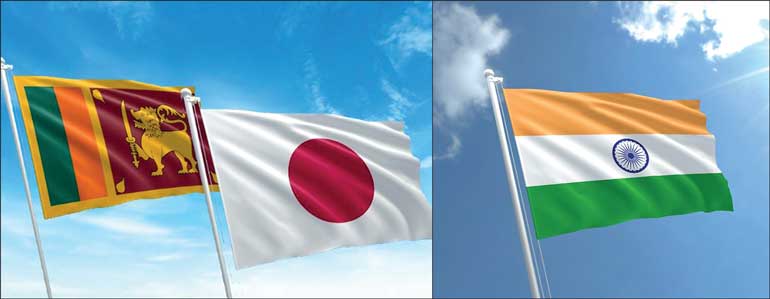
 According to reports available the Prime Minister of India Narendra Modi and the President of Sri Lanka Ranil Wickremesinghe, had a productive and outcome-oriented discussion during their interactions in New Delhi on 21 July 2023. They agreed that India’s sustained and rapid economic growth and technological advancement, coupled with the current phase of stabilisation and economic recovery, reconstruction, and development in Sri Lanka, provides a unique opportunity to forge a closer and deeper bilateral economic partnership between the two countries and enhance growth in the Indian Ocean Region. But due to uncertainty of political future of Sri Lanka it did not progress further.
The new president of Sri Lanka, Anura Kumara Dissanayake and his Government officially rejected the proposed land bridge or bridge-and-tunnel connection between India and Sri Lanka. His administration communicated to India that it is not ready for physical land connectivity due to significant economic and political disparities between the two countries.
When President Anura Kumara Dissanayake officially visited Japan from 27 to 30 September, 2025 Sri Lanka Resident Representative of Japan External Trade Organisation (JETRO), Hiroki Oi, came out with a landmark proposal to explore ways to position Sri Lanka as a strategic export-oriented corridor connecting Japan, India, and other South Asian markets.
This is a trilateral initiative aims to create seamless technology and investment flows. It focuses on manufacturing (electronics, minerals, agriculture) in Sri Lanka for export to the massive Indian market. The Key pillars include a proposal for land bridge and petroleum pipeline across the Palk Strait, maritime and power grid integration, and a Japan-backed trilateral export-oriented industrial corridor.
Japan’s experience in establishing economic corridors
Japan’s Free and Open Indo-Pacific (FOIP) initiative guides its vision for the region. First introduced in 2016, the vision is built on three main pillars. They are;
1. Rule of Law and Free Trade,
Promoting fundamental principles like freedom of navigation, upholding international maritime law, and opposing coercion.
2. Economic Prosperity,
Enhancing regional connectivity through high-quality infrastructure investments, resilient supply chains, and economic security.
3. Peace and Stability.
Committing to regional security by providing maritime law enforcement capacity-building and humanitarian assistance to vulnerable nations.
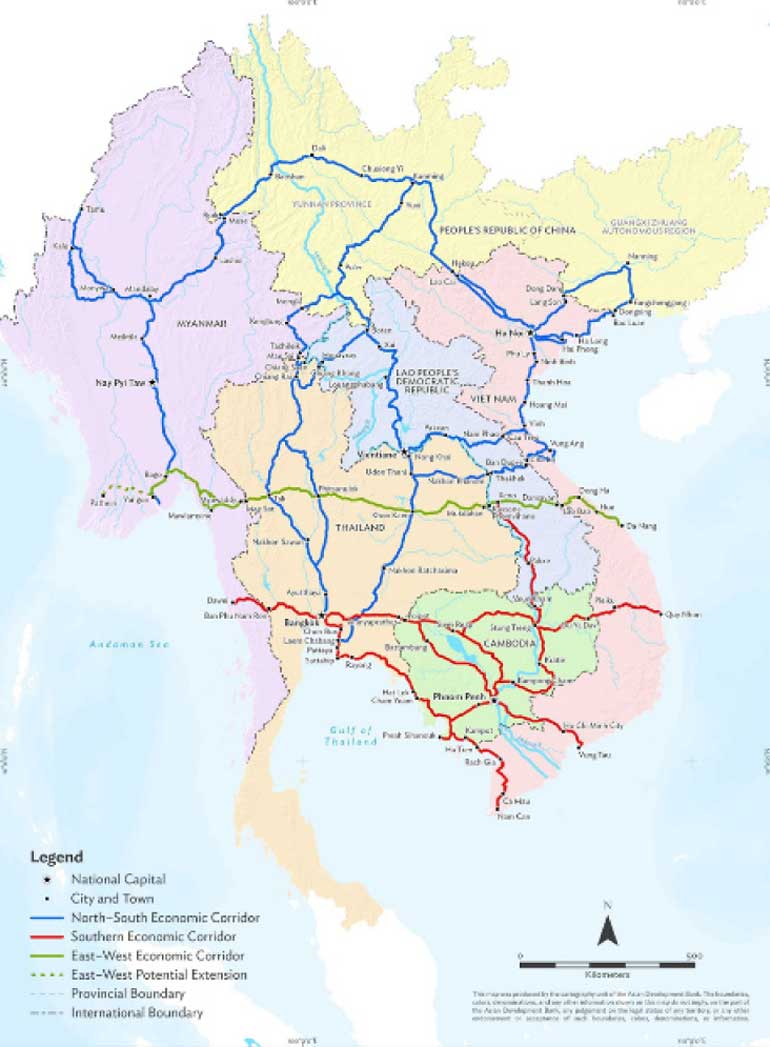
The FOIP seeks to bolster economic and security cooperation, and Japan in particular aims to ensure a rules-based international order. In addition, the Japanese Government has stated clearly that it will cooperate with any country that meets the basic principles of FOIP. One of the three pillars of FOIP is pursuit of economic prosperity by improving regional connectivity, including physical infrastructure development.
Japan's approach is different from some other countries. Japan usually focuses on long-term infrastructure, human resource development, technology transfer, and private-sector investment rather than pursuing rapid, large-scale geopolitical projects.
Sri Lankan authorities should study the Japanese experience in supporting to establish three major corridors. They are;
1. East–West Economic Corridor (EWEC) – linking the Indian Ocean and Pacific coast through Myanmar, Thailand, Laos, and Vietnam.
2. North–South Economic Corridor (NSEC) – connecting southern China with mainland Southeast Asia.
3. Southern Economic Corridor (SEC) – connecting Bangkok, Phnom Penh, Ho Chi Minh City, and nearby ports.
Japan financed major highways, bridges, ports, and customs modernisation projects along these routes. The strategic objective was not only trade but also regional stability and ASEAN integration.
In 2014 Japan and Bangladesh launched the Bay of Bengal Industrial Growth Belt (BIG-B) initiative focusing on ports, transport infrastructure, industrial zones and regional connectivity between South Asia and Southeast Asia. The main objective of this initiative was to make Bangladesh a gateway connecting the economies around the Bay of Bengal.
Not only in Southeast Asia as given above but Japan has also commenced investing heavily in two industrial corridors in India.
1) Delhi–Mumbai Industrial Corridor (DMIC) - Phase I implementation agreements were formally launched in 2014. DMIC is a mega-project stretching about 1,500 km across six Indian states. It was never intended to be completed in a single phase. Instead, it consists of multiple industrial cities, logistics hubs, freight infrastructure, and smart-city projects. Many components are operational, many are under construction, and others remain in development.
2) Chennai–Bengaluru Industrial Corridor (CBIC) - Japan, through JICA, prepared the master plan during the early 2010s for the corridor and it became part of India's national industrial corridor program around 2016. The central Government gave the approval on 30 December 2020 for key industrial nodes at Tumakuru (Karnataka) and Krishnapatnam (Andhra Pradesh). Both nodes are under active development at present.
These two mega projects are primarily within India, but Japan views them as part of broader Indo-Pacific supply-chain connectivity linking India with Southeast Asia and Japan.
Discussions between India and Sri Lanka for an economic space
While these developments are unfolding across Asia and the Pacific, Sri Lanka has advanced only a few free trade agreements, largely due to internal politics, poor leadership, and a lack of vision.
For more than two decades, policymakers, business leaders, and economic think tanks in India and Sri Lanka have discussed moving beyond a simple free-trade relationship toward a more integrated economic space. Sri Lanka's first bilateral free trade agreement was the India-Sri Lanka Free Trade Agreement (ISFTA), signed on 28 December 1998, and entering into force on 1 March 2000. It marked a historic milestone for trade liberalisation in South Asia. Despite significant criticism, India and Sri Lanka have completed their phased tariff cuts under the agreement's Tariff Liberalisation Program.
While the original ISFTA is still active, it covers only trade in goods. Both nations have frequently engaged in negotiations to upgrade this partnership into a deeper Economic and Technological Cooperation Agreement (ETCA). This expansion aims to cover services, investments, and more streamlined customs.
A proposal for a Comprehensive Economic Partnership Agreement (CEPA) between India and Sri Lanka was finalised in 2008. It is a broad, "FTA-plus" framework intended to expand the existing ISFTA to include trade in services, mutual investments, and technology transfer. However, it was never signed due to domestic political resistance and concerns from Sri Lankan industry sectors.
In recent years, policymakers and business groups have discussed transforming the two countries into a more integrated economic zone through improved port and energy connectivity, transport links, digital infrastructure, industrial investment zones, and supply chain integration with the fastest-developing region of India, South India, led by Tamil Nadu.
Why Japan supports economic corridors
Japan is keen to create stable supply chains for Japanese companies, promote regional economic growth and political stability, expand markets for Japanese investment and technology, and support its vision of a free and open Indo-Pacific. In other words, it seeks to ensure supply chain diversification, tap the vast markets developing in South Asian nations, and strengthen regional connectivity between South Asian countries and Southeast Asia to stimulate trade and job creation throughout the broader Indo-Pacific.
There is another main objective of Japan. That is counterbalancing excessive dependence on any single country in Asia. A typical example is China funding the infrastructure development projects heavily, occasionally gaining strategic assets (such as the Hambantota Port) via debt-to-equity arrangements. Japan is therefore interested in establishing a rules-based economic alternative to counter China's Belt and Road Initiative.
India-Sri Lanka Economic Corridor potential and Japanese investment strategy
A corridor could attract Indian companies to invest in manufacturing, logistics and ports, renewable energy, information technology, healthcare, and tourism. Indian firms could bring technical expertise, management practices, digital technologies, and research collaboration and improve the competitiveness of Sri Lankan industries. Similarly, Sri Lanka could attract Japanese entrepreneurs to establish feeding industries that cater to mega Indian factories.
Better connectivity may increase travel between the two countries, benefiting hotels, airlines, restaurants, and retail businesses.
Sri Lanka concerns regarding economic integration with India
While Buddhist clergy and nationalist groups in Sri Lanka fear that any integrated economic space between India and Sri Lanka could affect the island's sovereignty, Sri Lankan business leaders and industrialists worry that cheap Indian goods could easily dominate their smaller market, while penetrating the Indian market remains difficult. Sri Lankan professional associations also feel that opening the services sector would allow Indian professionals (such as IT workers, engineers, and doctors) to flood the Sri Lankan job market.
This situation stems largely from the experience with the ISFTA, which was more beneficial to India. The absence of a transparent monitoring mechanism in the ISFTA confined the benefits to a few specific products, such as scrap copper and Vanaspati exports to India.
I believe that the present NPP Government is in a better position and has the entrepreneurial and political leadership to push back against misconceptions and build consensus among the people to move forward with the JETRO proposal. The initiative aims to create an export-oriented industrial corridor by combining Japanese technology and capital with India’s massive market and Sri Lanka’s strategic geography.
The outcome would depend largely on how the corridor is designed, negotiated, and regulated. Japan could assist Sri Lanka in achieving a mutually beneficial outcome in negotiations with India, the island's largest neighbouring economy, thereby alleviating concerns about India's economic dominance.
Historical and moral ties between Japan and Sri Lanka
Japan does not have a strict legal obligation to provide developmental support to Sri Lanka, but it will not forget that Sri Lanka advocated a move to help Japan’s return to the international community at the 1951 San Francisco Peace Conference.
The majority of young Sri Lankans and Japanese are unaware of the role Sri Lanka (then Ceylon) played in accelerating Japan’s re-entry into the global community after its defeat in the Second World War. The San Francisco Peace Conference of 1951 was primarily organised and driven by the United States (USA), with significant joint preparation from the United Kingdom (UK), six years after Japan's surrender in 1945.
The conference was held at the War Memorial Opera House in San Francisco from September 4 to 8 September 1951. There were delegates from 52 nations. Their main objectives were to officially end World War II with Japan and define Japan's post-war borders, requiring Japan to formally renounce its claims over conquered territories like Korea and Taiwan.
At a time when the Allied powers were heavily debating severe post-WWII punishments and massive financial reparations, the delegate from Sri Lanka, then finance minister J.R. Jayewardene, delivered a historic defense of a free and sovereign Japan. He famously quoted the Buddhist Dhammapada: “Hatred ceases not by hatred, but by love,” and officially waived all war reparations from Sri Lanka.
This speech swayed the tone of the conference, directly accelerating Japan’s re-entry into the global community. By the seventies, Japan had become an economic powerhouse.
J.R. Jayewardene became the executive president of Sri Lanka on 4 February 1978, 26 years after the historic speech he made at the San Francisco Peace Conference. Thereafter, he launched a radical market liberalisation program that dismantled trade protections, opened the country to foreign capital, and encouraged private enterprise.
At this stage, Japan significantly increased its assistance to help develop the country. The establishment of Sri Jayewardenepura General Hospital and Rupavahini Corporation are only two examples. While the former introduced modern health care, the latter had a major impact on people’s lives, providing entertainment, news, and information.
Even today, these open economic policies of J.R. Jayewardene are continued by successive Governments with few modifications.
Following Sri Lanka's 2022 default, Japan demonstrated this commitment by co-chairing the Official Creditor Committee (OCC) and signing a major $2.5 billion debt restructuring agreement. This landmark deal allowed Japan to unfreeze and resume funding for critical, long-suspended infrastructure projects.
Conclusion
In a trilateral agreement among Japan, India, and Sri Lanka to establish an Indo-Lanka Economic Corridor, as suggested by Japan, Sri Lanka can expect Japanese assistance to ensure a level playing field in the negotiations, as well as in the policy formulation and implementation.
Although the proposal is at an embryonic stage, it’s up to the Sri Lankan Government to capitalise on the opportunity.
I wrote this article with the expectation that the war in the Middle East would soon come to an end. It is also better to be prepared and plan for the future.
(The author can be reached via email [email protected])



