Thursday Oct 22, 2026
Thursday Oct 22, 2026
Monday, 7 September 2026 04:02 - - {{hitsCtrl.values.hits}}
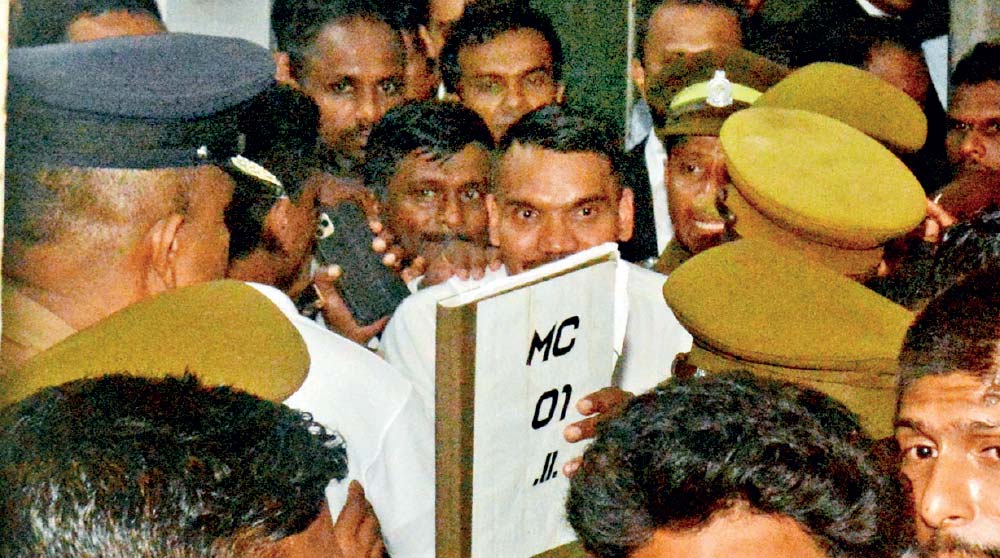
MP Namal Rajapaksa (centre) minutes before boarding the prison bus following the Colombo Chief Magistrate’s Court order that he be remanded until 18 September after he was arrested by the Commission to Investigate Allegations of Bribery or Corruption over allegations that he received Rs. 100 million in bribes linked to an aircraft procurement deal involving SriLankan Airlines
 An arrest has been made, but indictments have not yet been served. Now the priority must be the expediting of the case. Whatever the decision is, it will be appealed. Hopefully, a final decision can be reached before election season begins in 2028-2029
 Given what I had written about the remanding of other politicians, it is reasonable to ask for my response to the above question. Also, I have been pursuing this matter since 2020 when the evidence first emerged.
On 2 January 2024, in an article entitled “What can (and cannot) be done about corruption,” I wrote:
Even more importantly, all who want to live in a decent society under the rule of law must pressure the government to accelerate the complete implementation of the Anti-Corruption Act. With or without all the components being in place, it is important to expedite a case such as that against the former CEO of SriLankan Airlines and his wife, where the relevant evidence is an “agreed Statement of Facts in relation to a Deferred Prosecution Agreement (“DPA”) about the alleged commission by Airbus SE of offences of failure to prevent bribery.” By this means, it will be possible to demonstrate to the public that effective action can be taken against grand corruption without violating legal norms.
Timeline
The admitted payments made to facilitate aircraft and VIP kit purchases by the State-owned airline constituted grand corruption. And the investigation has taken too long. The money changed hands in 2013-2014. I do not say “allegedly” because the evidence includes a UK court document, the Deferred Prosecution Agreement referred to above that includes the following admissions in paragraph 43:
In 2013, Airbus engaged the wife of a person concerned with the purchase of aircraft from SLA through a straw company (the Company of Intermediary 1). Pursuant to the engagement, Airbus employees offered up to $16.84 million to the Company of Intermediary 1 to influence SLA’s purchase of 10 Airbus aircraft and the lease of an additional 4 aircraft. In fact, only $ 2 million of the $ 16.84 million was paid. The Company of Intermediary 1 was approved by Airbus employees as a BP [Business Partner].
The DPA was released in final form on 31 January 2020. Investigations were initiated, leading to the arrest of Kapila Chandrasena [intermediary 1] and his wife in February 2020. Both Chandrasena and his wife were released on bail in March 2020. Not much happened with the investigation during the terms of Presidents Gotabaya Rajapaksa and Wickremesinghe, other than the adoption of the Anti-Corruption Act and the appointment of the current members of CIABOC which were done by the latter.
My article “Other people’s money: Lessons from the Airbus corruption case,” was published on 11 February 2020, a few days after Chandrasena and wife surrendered to the CID, during the term of President Gotabaya Rajapaksa.
The new, much stronger, Anti-Corruption Act, No. 9 of 2023, was certified by the Speaker on 8 August 2023 at the midpoint of President Wickremesinghe’s term. It was reasonable to plead again for action on this case in January 2024 as the new Members of CIABOC appointed by President Wickremesinghe assumed office. But the Director General position was vacant at that time. That appointment was made by President Dissanayake on 10 January 2025, 20 months ago.
Was 20 months needed to find what happened to the $ 2 million mentioned in the DPA? We should all be pleased that the investigations appear to be complete.
Is the remand request justified?
One justification for remanding suspects is to avoid interference with witnesses and the investigation. Six years and seven months from the initial arrest of Chandrasena and his wife appears more than enough time for whatever interference that was feared to occur. If there is anything that could happen within these 14 days in August 2026 beyond what has happened since 2020, CIABOC could at least give us a hint. Intermediary 1 is dead; his wife, whose company received the bribe, is absconding. A key witness is in Australia, immune to interference.
In the absence of reasons being provided, it is not unreasonable to conclude that the request supported by a certificate from the Director General under section 149 of the Anti-Corruption Act for remanding is performative. Now that the political objective has been achieved, Rajapaksa should be released on bail as soon as possible. The new DG has been in office for 20 months which is plenty to assemble the evidence for this kind of case, especially because the DPA serves as the foundation.
An arrest has been made, but indictments have not yet been served. Now the priority must be the expediting of the case. Whatever the decision is, it will be appealed. Hopefully, a final decision can be reached before election season begins in 2028-2029.




