Thursday Oct 15, 2026
Thursday Oct 15, 2026
Tuesday, 25 August 2026 06:07 - - {{hitsCtrl.values.hits}}
 Sri Lanka’s post-2022 macroeconomic trajectory has often been described as a textbook recovery. Single-digit inflation, a stabilised rupee, replenished central bank gross official reserves, and primary budget surpluses reflect the fruits of disciplined fiscal management under the IMF’s Extended Fund Facility (EFF).
Yet, macroeconomic stabilisation is merely the bridge out of insolvency; it is not an engine of long-term prosperity. As the grace periods of external debt restructuring draw to a close over the medium term, Sri Lanka faces an unforgiving mathematical reality: servicing restructured sovereign debt while lifting household living standards requires real GDP growth of at least 6% to 7%. That trajectory is impossible without a structural surge in foreign exchange (Forex) revenue.
This raises an urgent policy question: Is our current approach to trade policy, investment promotion, and procedural modernisation adequate without fully implementing the Economic Transformation Act (ETA) No. 45 of 2024? The short answer is no. Relying on legacy administrative structures to deliver transformative Forex growth is attempting to run a modern, globally integrated economy on an analogue engine.
Anatomy of status quo: Fragmented and sub-scale
For decades, Sri Lanka’s trade and investment framework has operated in administrative silos:
n The Board of Investment (BOI) deployed blunt tax holidays that frequently attracted non-tradable real estate and domestic-market-oriented investments rather than export-linked manufacturing.
n The Export Development Board (EDB) and the Department of Commerce (DoC) promoted goods and negotiated access abroad, but wielded zero statutory authority over the border taxes and non-tariff barriers governed by Sri Lanka Customs and the Ministry of Finance.
n Foreign missions pursued traditional diplomatic agendas largely divorced from measurable, ground-level export promotion targets and investment pipelines. While recent efforts to resume Free Trade Agreement (FTA) talks, host overseas roadshows, and introduce partial digital filing at border agencies are steps in the right direction, they remain incremental patches on a structurally broken architecture.
Under this status quo, merchandise exports have hovered sluggishly around $ 12–13 billion annually—over-reliant on low-complexity apparel and unrefined tea/rubber—while net Foreign Direct Investment (FDI) rarely crosses 1.5% of GDP. This trajectory cannot generate the Forex cushion needed to insulate the economy against future global shocks.
Why administrative "good intentions" fail without ETA
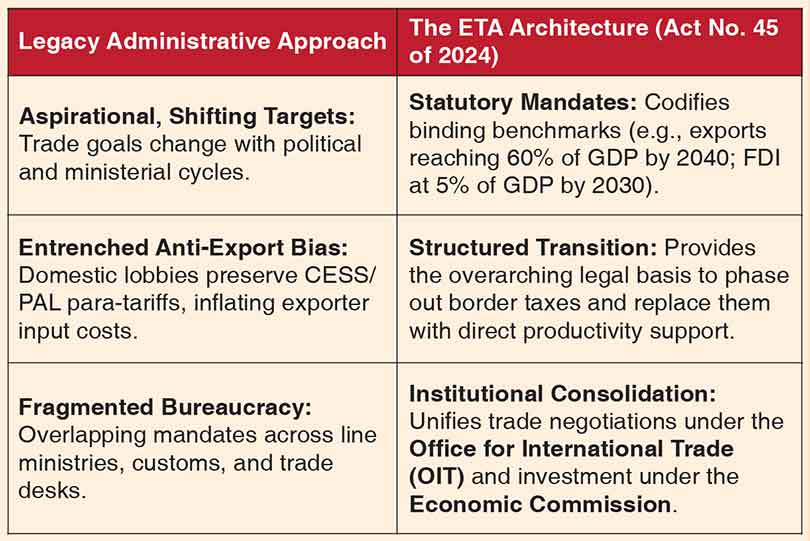
The Economic Transformation Act No. 45 of 2024 was enacted precisely because decades of administrative "good intentions" repeatedly foundered on institutional inertia and policy inconsistency. Operating without the full operationalisation of the ETA leaves three critical structural vulnerabilities unaddressed:
Budgetary blueprint: Actionable priorities for the national budget
If the Economic Transformation Act provides the legislative architecture, the National Budget must serve as its financial engine. To avoid repeating historical failures of unfunded statutory mandates, upcoming budget cycles must move beyond fiscal accounting to implement five concrete structural allocations:
If Sri Lanka takes the path of least resistance—relying on standard promotions, seasonal tourism spikes, and worker remittances without overhauling its trade architecture—the economic fallout is predictable
1. Capitalise the new apex bodies (OIT & Economic Commission)
The Office for International Trade (OIT) and the Economic Commission of Sri Lanka (ECSL) cannot function if they inherit underfunded civil-service operational structures. The budget must provide dedicated, ring-fenced funding to recruit specialised international trade lawyers, econometric modellers, and seasoned investment negotiators capable of closing complex trade pacts (such as ETCA and RCEP accessions) and pitching directly to Fortune 500 supply chains.
2. Establish a Trade Adjustment Assistance (TAA) fund
As protective para-tariffs (CESS and PAL) are systematically dismantled over a 3-to-5-year horizon, domestic producers face direct competition. The Treasury should establish an earmarked TAA Matching Grant Fund (LKR 10–15 billion) to co-finance factory-floor automation, renewable energy integration, and international quality certifications (e.g., ISO, CE, ESG standards) for local SMEs transitioning into export value chains.
3. Ring-fence capex for the Trade National Single Window (TNSW)
Compressing cargo clearance dwell times from days to hours directly reduces the "shadow tax" on Sri Lankan exporters. Under the Public Financial Management (PFM) Act, the Government should establish a multi-year, legally protected capital expenditure line to fully integrate the digital TNSW across Customs, the Sri Lanka Standards Institution (SLSI), and port authorities, insulating the project from mid-year spending cuts.
4. Replace blanket tax holidays with targeted productivity credits
The national tax framework must shift from discretionary corporate tax holidays toward performance-linked R&D and capital expenditure tax credits. Tax incentives should reward tangible exporter upgrades—such as patent acquisition, software adoption, and workforce re-skilling—directly supporting the ETA's high-tech export mandates.
5. Introduce a commercial diplomacy performance envelope
The Treasury should restructure overseas mission allocations by tying a dedicated operational budget envelope to verifiable economic deliverables. Commercial attachés in key regional hubs (New Delhi, Singapore, Brussels, Washington, Tokyo) should operate under clear, performance-linked KPIs evaluated by resolved non-tariff barriers, bilateral investment leads, and exporter market penetration.
Cost of Inaction: Next Balance-of-Payments trap
If Sri Lanka takes the path of least resistance—relying on standard promotions, seasonal tourism spikes, and worker remittances without overhauling its trade architecture—the economic fallout is predictable:
1.Low-growth trap: Real GDP growth will stagnate in the 2.5% to 3.5% corridor, failing to create high-value employment or meaningfully reduce poverty.
2.Debt service vulnerability: When foreign debt amortisation ramps up, an export base locked below $ 15 billion will leave the current account defenceless against commodity price shocks.
3.Regional marginalisation: As regional peers rapidly automate border clearances and realign regulatory frameworks to capture global supply-chain relocation, Sri Lanka will remain bypassed by tier-one export capital.
Conclusion
Moving beyond stabilisation
Incremental modernisation and ad-hoc trade roadshows offer the illusion of progress without the structural capacity to sustain it. To permanently break the cycle of balance-of-payments crises and sovereign defaults, Sri Lanka must leverage the legislative powers of the Economic Transformation Act and finance them through outcome-driven, transformative national budgets. Fiscal discipline ensures a country avoids insolvency; only a competitive, outward-oriented trade and investment architecture can deliver lasting economic prosperity.
(The author is the Principal Consultant and CEO of KiWi Strategy Consultants, based in Sri Lanka. A Chartered Engineer with a diverse professional portfolio spanning senior corporate leadership, investment management, and strategic consulting, he holds a B.Sc. in Mechanical Engineering from the University of Peradeniya and an MBA from the University of Colombo. Leveraging his expertise in industrial systems, macro-policy structures, and professional management frameworks, his current research focuses on structural economic dynamics, trade optimisation, and development economics in South Asia.




