Monday Oct 12, 2026
Monday Oct 12, 2026
Friday, 1 May 2026 08:27 - - {{hitsCtrl.values.hits}}
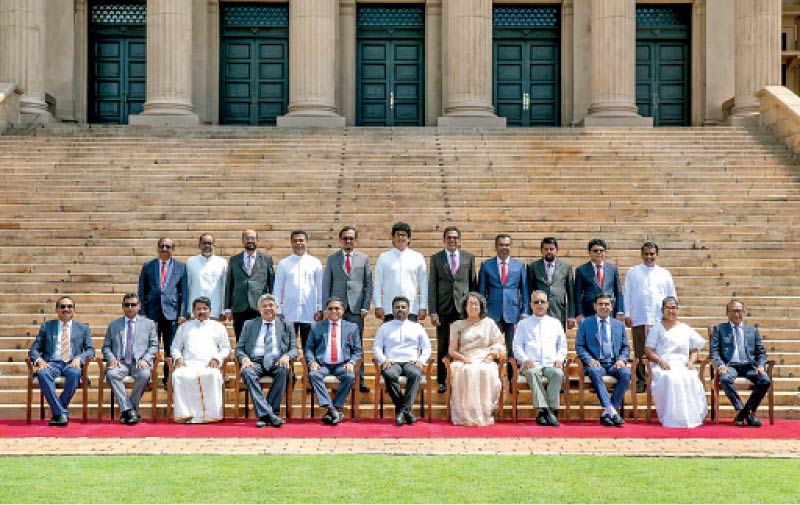
NPP Cabinet of Ministers in November 2024 with President Anura Kumara Dissanayake
 The NPP’s image is no longer pristine because multiple sectors show simultaneous irregularities, Government’s messaging has grown increasingly defensive, and the early promise of rapid accountability has been largely unmet
 The National People’s Power cantered into office quite convincingly on a ticket of anti-corruption, ethical exceptionalism and much-needed systemic reforms. To date, and on the so-called positive side of the ledger, no major case has been made to definitively deny the NPP its moral mandate.
Yet, a cluster of controversies – governmental lapses, procurement irregularities, conflicts of interest, and deficits in transparency (to put it politely) – have converged to make a case. Today, it may even be felt in opposition quarters to militate towards a ‘Mayday!’ for the grand project of overhauling the business of governance as usual in Sri Lanka.
For many moderate citizens willing to take matters more seriously than political opportunists, however, there is an ominous cloud on the scorching-hot horizon of happy days...
Thus for them – dare I say, for us? – the risk is not yet systemic corruption. The greater risk is credibility drift that could dig a ditch to entrench the usual suspect in our country’s downfall.
The big C!
Open and shut case
The first red flags in this regard may have been raised very early, in fact. That was when 309 high-risk containers were released without mandatory inspection. It may have been customary under previous administrations dining with the devil. But for the supposedly sea-green incorruptible regime (then only recently installed), this was a red-label scandal-in-the-making militating towards rule-bending under pressure.
It was a process that violated the law and established procedure, and lacked documented risk assessment. And it entailed the release of suspect containers without as much as a cursory scan. The implications were serious, running the gauntlet from national security through public health to state revenue.
As the first major scandal to set back the still rookie Government, it was a case of administrative expediency overriding compliance protocols – a classic precursor to systemic abuse.
The evidence does not show or prove entrenched corruption under the NPP Govt. But it does reveal something arguably more consequential at this stage of the regime’s praxis. And that is a pattern of Government stress that resembles the early rumblings of previous State and national failures. The Government’s anti-corruption credibility is strained now, and could deteriorate if delays persist amidst spokespersons’ ongoing defensiveness
Coals to Newcastle
More recently, a bigger shock was in store for fans and friends alike. The so-called ‘Coalgate’ of the incumbent administration – when substandard coal was found to have been procured despite regular procedure being followed – was a defining stress test for the NPP’s integrity.
In April of this year, a special audit found multiple irregularities in coal procurement for the Lakvijaya plant. It led to an acknowledgment from no less a personage than our President – a most sea-green stalwart of yon incorruptible regime – that inferior-quality coal imports had taken place, impacting the country’s power generation, and attendant costs to the state and consumers.
A subsequent controversy that erupted triggered the resignation of Energy Minister Kumara Jayakody. It signalled that at least something was not quite yet utterly rotten in the state of Denmark, as such a resignation was an unprecedented move by so senior a governmental official – ahead of any official probe, at that – in decades.
Yet, even here, the waters were muddied, as the mandarin in question had also already been indicted separately over previous procurement-related allegations of irregularity – opening another can of worms: that of the acid tests for passing muster to be appointed to an NPP administration.
Let us not hasten to darken counsel by also raising the still unresolved spectre of a Speaker of Parliament whose proof of doctoral qualifications remains lost in the post. But some early signs were already there...
Be that as it may, the scale and seriousness of the coal power scandal is severe. Allegations against the Government span the spectrum from tender irregularities and pricing concerns to substandard supply.
Critics of the administration claim that the losses to the State could be colossal – a charge that is politically contested by the incumbents but widely cited by a demonstrably delighted Opposition, which had previously been grasping at straws, but now clutched a solid plank (it would seem) to crucify the Government.
Coalgate is significant for Sri Lanka policy-wise because it affects a high-risk procurement SOE sector – power and energy – and is arguably more damning than merely embarrassing for the Government. This is simply because it dismally combines ‘process defence’ (“the proper procedures were followed”) with ‘outcome failure’ (“but the coal is bad after all of that”).
Certainly, it has triggered the desired executive accountability in the Minister’s resignation. However, it remains to be seen if systemic reform – a cleansing of a particularly shambolic Augean stables (the power and energy sector) – will follow suit.
For the JVP-led NPP, it warningly signals a policy shift: from anti-corruption activism (or even merely the rhetoric of it) to policy defensiveness.
Shock, not surprise
Yet another biggie in terms of shock value – though perhaps lacking the surprise element, since it has ranked among the usual suspects in a corrupt state sector for a long time, indeed – flies overhead.
That is the double-header of governance failures and appointment optics facing SriLankan Airlines of late. A whistleblower disclosure last month alleged millions of dollars in unjustified commissions and the manipulation of route profitability data.
The allegations came on the heels of a long-running debacle, in which the arrested former CEO of the airline had let the cat among the pigeons by a good deal of juicy finger-pointing at the paterfamilias of a previous dispensation, opening up a new can of worms as regards the former regime and SriLankan.
Fresh developments in the month gone by comprising leadership instability saw the resignation of the Chairman and the senior leadership of the beleaguered national carrier.
State responses were comprehensive – ranging from presidential imperatives to probe corruption, procurement irregularities, recruitment abuses and external interference – yet compromised. Namely, allegations of a picked successor being shoe-horned in for reasons not redounding to the national interest.
Even without definitive proof of nefarious motives, the volatile context – an SOE, historic corruption in the national carrier’s lucrative aisles and current leadership churn – makes any (even perceived) interference highly sensitive and damaging to SriLankan’s future prospects.
Need we underline the sad reality that the airline has a long history of politicised appointments and financial leakage? The sins of successive regimes are legion, and the dust has not settled on the case of SriLankan and alleged grand larceny as regards the Rajapaksa regime.
As far as the present governors of the State go, the policy risk is the shift from a clean-up of past corruption to suspicions about present control being inimical to the national interest.
To arrest the drift, the regime is advised to consider immediate, then medium-term, and eventually structural or systemic reforms
Smack in the face
The latest curve ball comes with no minor smack in the face for an administration that touted itself as both technocratically savvy and not lacking in the elusive integrity that had brought sundry previous administrations to grief.
In that sense, the established facts of the $ 2.5 million heist raises more questions than have been answered as regards cyber-fraud and financial governance.
That a two and a half million dollar payment was ‘misdirected’ due to a breach by phishers is not in doubt. The question is – and it has occurred to a chortling Opposition to pose it in Parliament, chuckling in malicious glee – who received the money and why transparency over the probe into how it was effected is lacking.
The Finance Ministry, for its part, claims that the funds were diverted via anonymous hackers at one end and fraudulent instructions at the other. In between the giving and the taking, the policy risks presented to the powers that be are not insignificant. Weak financial controls and poor cybersecurity oversight, on top of delayed or incomplete public disclosure.
Even if this eventuates to be criminal fraud and not corruption, it signals governmental vulnerability at best and incompetence at worst.
A twist in the sad, sorry, shocking tale of state financial leakage came this week, with further revelations that a sum of $ 625,000 was ‘lost in the post’ (ahem) in a state-to-state transaction between Sri Lanka Post and its American counterpart stateside.
What lies beneath
Other niggles lurk underneath the veneer of transparency. Conflict-of-interest concerns have cropped up occasionally. For instance, a senior presidential advisor reportedly held concurrent and simultaneous roles in a major private sector firm. This matters much, because the NPP campaigned long and hard against elite capture and insider advantage. And now, the policy risk is a blurring of lines between public duty and private interest.
Ministerial lifestyles and integrity optics have also come under the microscope of late. An emerging controversy arises from questions being raised over a grand residence linked to a sitting minister, who has certainly not been long enough in power to enjoy the perks of such luxury. While corruption has not been proven but simply insinuated, the optics clash with the NPP’s austere image and egalitarian messaging. Once again the policy risk is the perception gap between political branding and personal conduct.
Gone with the wind
Pertinently to the bigger picture of power politics, perhaps, is a particular energy policy and external deal controversy. The Government was once reviewing a $ 444 million wind power deal involving the Adani Group of India amid global bribery allegations. The issues raised were tariff concerns, which were higher than local alternatives; and geopolitical and governmental transparency implications. And the policy risk remains exposure to external corporate controversies undermining domestic anti-corruption initiatives, programmes and credibility.
The alarm call
Across all of the above cases, a systemic pattern emerges in which the convergence of governmental weaknesses sounds an alarm call to the public and other stakeholders in Sri Lanka’s national interest.
First and foremost, there is institutional bypassing as regards the Customs’ container release and decision-making opacity in a slew of SOEs.
Then there are procurement vulnerabilities from coal to energy deals to airline contracts.
And thirdly, an accountability lag whereby investigations into these cases have been initiated but the outcomes are pending.
Or even if none of the above are germane, good governance – as such that it aims to be – would do well to see to the correction of the NPP’s vision in terms of optics erosion: lifestyle questions, appointment suspicions, and communications defensiveness.
The coal scandal, Customs breach, airline dysfunction, financial irregularities, and emerging ethical issues do not serve individually to sink the ship of State. But taken together, they create a narrative risk whereby the ‘Tale of the NPP and No Corruption’ flips the page from exceptionalism to normalisation. And in Sri Lanka’s chequered political history, that transition – once it has begun – is rarely reversed without recourse to radical and decisive interventions
Categories, if you please?
If you’re wondering, as I am, if these are major cracks or minor friction, the truth be told it is not yet an irredeemable failure or irreversible fault. Nor is it systemic collapse as previously seen under sundry administrations in the past. This is by virtue of the fact that ministers have resigned, investigations have been duly initiated, and whistleblowing appears to be alive and well in the republic. Yet the NPP’s image is no longer pristine because multiple sectors show simultaneous irregularities, Government’s messaging has grown increasingly defensive, and the early promise of rapid accountability has been largely unmet.
A stitch in time
To arrest the drift, the regime is advised to consider immediate, then medium-term, and eventually structural or systemic reforms.
In the next month or so, or even up to three months, Government must publish full audit reports (coal and airline SOEs); fully disclose beneficial ownership and procurement details; and fast track visible prosecutions or exonerations.
And in a time of six months to a year, the NPP – to say nothing of the nation – might benefit from reforming procurement laws with real-time transparency portals; depoliticising strategic SOE appointments via independent boards; and strengthening cybersecurity protocols in public finance systems.
Structurally, a pressing need is to reconstruct anticorruption architecture beyond the mere agency of the Commission to Investigate Allegations of Bribery and Corruption (CIABOC), and institutionalise citizen oversight and open data governance.
A familiar pattern
The evidence does not show or prove entrenched corruption under the NPP Govt. But it does reveal something arguably more consequential at this stage of the regime’s praxis. And that is a pattern of Government stress that resembles the early rumblings of previous State and national failures.
The Government’s anti-corruption credibility is strained now, and could deteriorate if delays persist amidst spokespersons’ ongoing defensiveness. SOE governance is as weak as ever, and poses high risks to the nation’s image. Public trust, which is always sensitive to the next major scandal, is eroding at the margins. And slow institutional reform runs the risk of stagnation in the project of overhauling and rectifying all that was, is, rotten in the State.
The coal scandal, Customs breach, airline dysfunction, financial irregularities, and emerging ethical issues do not serve individually to sink the ship of State. But taken together, they create a narrative risk whereby the ‘Tale of the NPP and No Corruption’ flips the page from exceptionalism to normalisation. And in Sri Lanka’s chequered political history, that transition – once it has begun – is rarely reversed without recourse to radical and decisive interventions.
(The writer is the Editor-at-large of LMD and is a senior journalist with a Post-graduate Diploma in Politics and Governance)




