Friday Oct 16, 2026
Friday Oct 16, 2026
Wednesday, 27 May 2026 00:11 - - {{hitsCtrl.values.hits}}
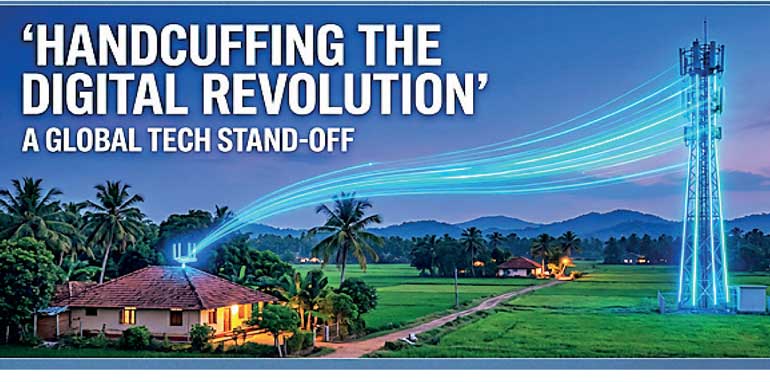
 Back in December 2025, when the Telecommunications Regulatory Commission of Sri Lanka (TRCSL) finally wrapped up the 5G spectrum auction, it felt like we had turned a corner. It was a massive win for the country, bringing in over LKR 15 billion for the state. More importantly, it felt like the formal start of a high-speed era that would finally connect the entire island. But as we move into the second quarter of 2026, that initial excitement is starting to feel like a memory. While urban areas are beginning to see 5G signals on their phones, the real game changer, 5G Fixed Wireless Access (FWA), or what most of us call 5G Home Broadband, is stuck in a regulatory waiting room.
The problem isn’t the technology or the lack of investment. Our local operators, specifically Dialog and SLT-Mobitel, have already paid the Government billions for these spectrum rights and are ready to go. The issue is a strange, self-inflicted policy stall. We are essentially sitting on a goldmine of digital potential while the authorities hesitate to sign off on the commercial approvals needed to bring high-speed 5G internet into our living rooms and offices.
The reality outside the Colombo bubble
It is easy to forget, if you live in a Colombo apartment with a fibre connection, that 80 percent of Sri Lankans live in rural or suburban areas where fibre optic cables simply don’t exist. For these nine million people, the digital economy is something they hear about in the news, not something they experience.
We talk a lot about the “National Digital Economy Strategy 2030” and reaching a USD 15 billion digital GDP. But how do we get there if nearly 40 percent of the population still lacks reliable internet access?. In the current economic climate, where remote work and online education have become survival tools rather than perks, a stable home connection is a basic necessity.
The traditional solution of laying fibre cables everywhere is just not realistic. It is too slow, too expensive, and the return on investment in a sparsely populated village is often negative. This is exactly where 5G Fixed Wireless Access comes in. It provides fibre like speeds through the air, bypassing the need to dig up roads or wait years for a cable to reach your house. Between 2013 and 2018, we saw 4G wireless broadband triple our home internet penetration. We know this works. So why are we holding back the next generation?
The 4G wall and the 5G fix
If you have tried using a 4G home router in a busy area lately, you know the frustration. Speeds that used to be decent now crawl along at barely 1 Mbps during peak hours. This isn’t because the operators are lazy; it is because 4G technology has hit a physical limit. The “pipes” are full.
5G is the only way over this wall. It uses massive MIMO antennas and advanced signal processing to handle thousands of devices at once without breaking a sweat. In fact, the 27 GHz “millimetre wave” spectrum that Dialog purchased is specifically designed for this. These high-frequency signals don’t travel very far and struggle to go through walls, which makes them nearly useless for a mobile phone in your pocket while you drive down the road.
But they are perfect for a fixed receiver on your roof. By restricting 5G FWA, the TRCSL is effectively forcing this expensive, high-capacity spectrum to sit idle. It is like buying a high-performance sports car and then being told you are only allowed to drive it in a parking lot.
The Starlink irony and market fairness
The most baffling part of this situation is how we have treated foreign companies compared to our own. In 2024, the Government moved with lightning speed to amend a 28 year old law just to make room for Elon Musk’s Starlink. We rolled out the red carpet, gave them a license, and approved high-priced tariffs with almost no delay.
But fast-forward to 2026, and the risks of that rushed approach have become clear. Starlink’s operations were recently suspended because the Government realised it couldn’t monitor data or ensure national security through a foreign satellite network.
Meanwhile, our domestic operators, who have spent decades building the country’s infrastructure and complying with every security and tax law on the books, are still waiting for the green light to offer 5G home broadband. It is a massive double standard. We gave a foreign satellite company a free pass to enter the home broadband market, but we are keeping our own terrestrial operators in a regulatory chokehold.
Protectionism vs. progress
There are whispers in the industry that the real reason for the delay is protectionism. The State still has a major stake in Sri Lanka Telecom (SLT), which has invested heavily in fibre. The fear seems to be that if we let mobile operators offer 5G home broadband, they will eat into the fibre business.
But this is a narrow way to look at the market. Fibre and 5G wireless aren’t enemies; they are partners. In every developed market, from the US to the UAE, operators use 5G FWA to fill the gaps where fibre can’t reach. By trying to “protect” fibre, we aren’t helping SLT; we are just hurting the rural consumer who has no hope of getting fibre anytime soon.
If the goal is truly a USD 15 billion digital economy by 2030, we need every tool in the shed. We need the SME in a remote village to be able to plug in a 5G router and start selling to the world today, not three years from now.
A technical solution is already here
The regulators might worry that 5G home users will hog all the bandwidth and slow down mobile phones. This was a valid concern ten years ago, but 5G has a built-in solution called “Network Slicing”.
Essentially, an operator can carve out a dedicated “slice” of the network just for home broadband. This ensures that your neighbour’s Netflix binge doesn’t interfere with your phone calls or emergency services. We have the technology to manage the traffic; we just need the permission to use it.
The TRCSL could also encourage infrastructure sharing in rural areas, letting companies share towers and radio gear to cut costs and reach unserved districts faster. This is common sense, and it is considered international best practice for closing the digital divide.
The road ahead
Deputy Minister of Digital Economy, Eng. Eranga Weeraratne has spoken frequently about transforming our economy through AI and digital IDs. He is right to be ambitious. But all these high-tech dreams—the “Super App,” the digital national IDs, the AI-driven farms—require a foundation of solid, fast connectivity.
We cannot build a 21st-century digital economy on a 4G network that is running out of steam. The spectrum has been auctioned, the money has been paid, and the towers are being built. The only thing missing is a simple administrative “go” from the TRCSL and the Ministry.
Authorities should adopt a “Service Neutrality” policy, which is a fancy way of saying: let the operators use their spectrum for whatever the customer needs, whether that is a mobile phone or a home router.
If we want to compete in the global digital market, we have to stop handicapping ourselves. Let’s unlock 5G Fixed Wireless Access and finally give every household in Sri Lanka a chance to join the digital future.
(The author is a telecommunications engineer turned environmental and wildlife conservationist, citizen scientist, and wildlife documentary filmmaker whose work focuses on advancing policy-level reforms to strengthen environmental and wildlife conservation in Sri Lanka. He is also a veteran telecommunications engineer and policy analyst who began his career with Motorola Distributors from 1988 to 1993, followed by a decade at Etisalat as an Engineer in Mobile Systems. He later served briefly as a Senior Project Engineer for the GSM network rollout at SLT Mobitel and has since spent many years as an official sales partner for global network planning and test equipment providers in Sri Lanka and the Maldives)




