Monday Oct 12, 2026
Monday Oct 12, 2026
Monday, 6 July 2026 03:41 - - {{hitsCtrl.values.hits}}
 Preamble
As a distant observer, it appears and sense the deterioration of the state in both politically and financially, affecting the day to day life of public. Public anger is growing daily, increased cost of living and the frauds reported in the media and social networks. However, the Government appears to be not overly concerned of what is being faced, but believing they are in control of State machinery,the fulfilling the election promises and on track to achieving IMF objectives and targets – awaiting to qualify for the final tranche in November and wrapping it up.
IMF Extended Fund Facility (EFF)
To date Sri Lanka has consumed $ 2.4 billion out of the $ 3 billion (approx.) agreed upon. The program will officially end in November 2026 or instead will go soft landing with a revision and extension. Despite consuming 80% of the total. Has Sri Lanka now totally in good shape economically or worse? The Economic pundits say Sri Lanka is still crawling. The Ditwah cyclone and the ongoing middle east crisis, continuing over 100 days had been squarely attributed as the core reasons to quash and manage the public anger and the rising cost of living. Furthermore, to divert public attention of Government’s inability in addressing ongoing social issues, tactfully in the process of bringing past political figures to CID for questioning, remanding and apply Detention Orders etc.
Treasury and Sri Lank Central Bank
The objectives of the two institutions are not strictly complementing. The former provides fiscal stability and the latter manage primarily the inflations. These two functions hardly overlap in the strict sense; however, one could hardly see independence despite CBSL being an autonomous institution. The recent deterioration of Sri Lanka Rupee against USD, the CBSL arranged currency swaps with local banks. This shows a temporary relief and to overcome harsh criticism of opposites and some political leverage for the Government to dodge, however the move was effortless and downward trends being continued.
Historically, central banks do flush the financial system with money during times of severe economic crisis. When an economy slows down, central banks pump cash into the banking system to keep the economy moving. However, excess borrowing may lead to inflation hence need to be regulated. In the local context cost of living had increased for other reasons e.g. increased power consumption and fuel thus trending the collapse of MSME sector as a result of total financial system imbalance. Financial regulators need to banks balance borrowings and lending of people and businesses.
 Geopolitical impacts on Economy
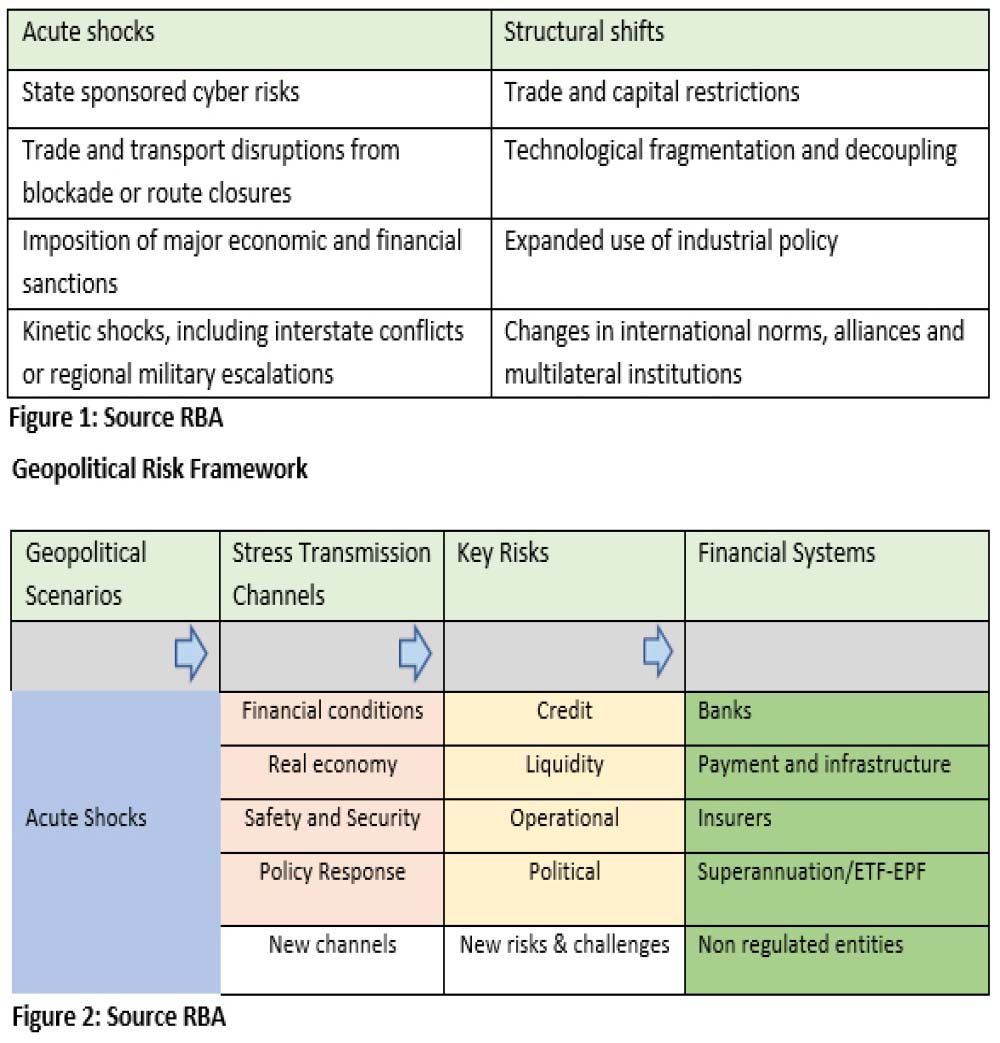
Geopolitical impacts had become a widely spoken subject of multi-dimensional nature and in the midst of continuing Middle East crisis and the Russian aggression on Ukraine. As illustrated by RBA Australia, it differs from more traditional macro-financial stress in many ways leading to operational challenges for financial systems thus emphasis for robust contingency planning to tackle the consequences based on country specific. As countries impacted in varying degrees upon their respective economic stability, these shocks need to be addressed through range of channels, from market disruptions to operational and security risks—cyber-attacks.
A structured framework proposed by Council of Financial Regulators of Australia illustrates the impacts on the financial system, trade restriction, sanctions, grey zone activities and conflicts. Recently, Sri Lanka too have subjected to the Grey Zone activities and seems to be unaware and taking a lukewarm action with blame games despite opposition excoriation. Have our Economists or the Advisors educated the President and the Cabinet in timely manner to minimise the shocks and disruptions with list of prudent actions? I never believed so.
Risk Scenarios –
The risk framework distinguished the acute shocks and the long-term trends on financial systems. The figure 1 shows acute shocks and the likely structural shifts, Figure 2 illustrates how the stress is transmitted to Financial systems with specific risks. Lately Sri Lanka economy had been a victim of geopolitical stress and its consequences.
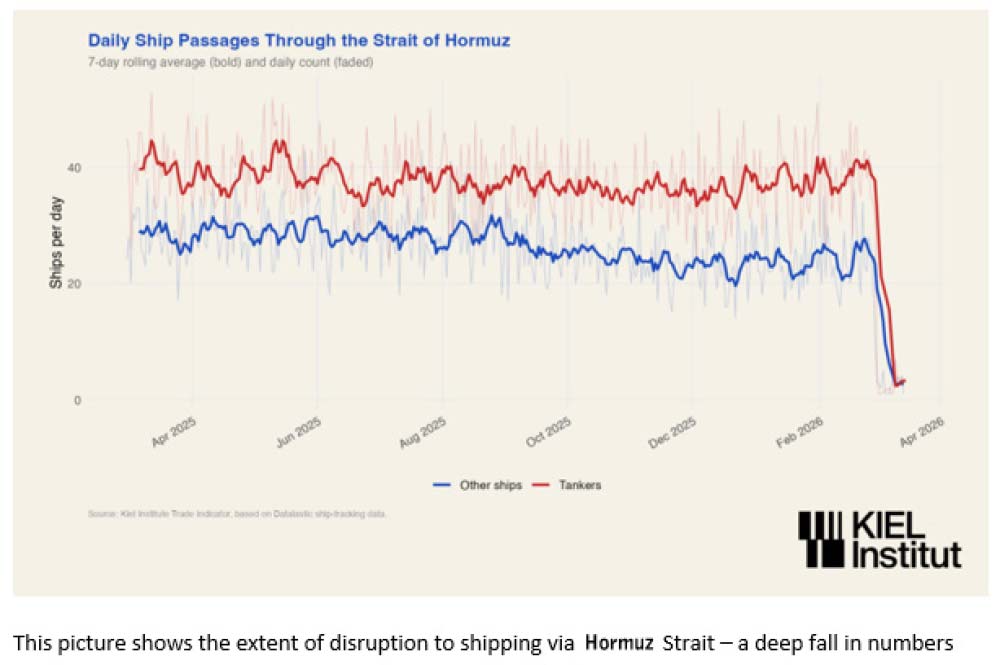
Some examples, [a] initially increased trade traffic imposed by the US, [b] disruption to supply chain as a result of Hormuz Strait closure – shortage and increased fuel and food prices, scarcity of fertilizer for cultivation, disruption of export market e.g. Tea for Oil. These shocks effected macroeconomy resulting $ 1.9 billion to national imports.
This picture shows the extent of disruption to shipping via Hormuz Strait – a deep fall in numbers
Illegal transaction resulting Loss of revenue
At the very outset and as a young inexperienced Government, the 323 containers with RED labels slipped through the port with no proper process. Items not accounted for, but they were released with the blessings of the Government. Subsequent claims reported by a MP stated that there were weapons and arms – belongs LTTE. The Government actions were reshuffling the Ministers and officials.
Purchase of coal for electricity generation. The Government
reiterates the tender procedure was intact hence the loss of revenue will be charged to the supplier based on standard of quality. The delayed purchasing of coal and manipulating between term and spot tendering open even the defaulted parties to bid and win based on cost and less concern of calorific value which is a critical specification of the tender. It is still not revealed as to how the loss is compensated for low calorific coal (i.e. contains more ash). Multiple factors need to be taken into account not the way Government assess, but the assessment and recommendation by professional Engineers.
Wrongly processed and paid $ 2.5 million, 10 payments to an unknown party from December 2025. This loss was not revealed until a Free-Lawyers Association made public few months ago. Secretary to Treasury was unwilling to appear at CoPF and divulge the truth of omissions of the ministry. It is laughable how these ten transactions were made via e-mail requests over an “outdated e-mail server”. Who was responsible Treasury of CBSL? Public believes that this was intentional as to how 10 transaction go on the same path unnoticed. Unfortunately, losing the life of a public servant believed to be suicide.
Rebuilding Sri Lanka: Despite billions of rupees in local and foreign donations have been deposited into Government-held treasury accounts for the “Rebuilding Sri Lanka Fund,” the fund has not yet been formally established thus it was revealed at CoPF there is no provisions to assess the accountability as it was not legally established as a statutory fund. It was also understood that, none of the money has been spent on recovery or rebuilding projects, anxiously waiting to receive relief by affected citizens and relief camps—this is an another opening for fraudulent transactions.
A temporary increase of import surcharge 50% on vehicle in May 2026 resulted a sudden spike in opening LCs by certain groups thus avoiding the surcharge prior to the effective date (LCs for 1,782 vehicles valued at $ 23.71 million)—how could these groups knew before hand? The unofficial figures of opening of LC hurriedly amounts to 4,000 a financial crime. The increase was justified as to stabilise the parity rate and draining of foreign reserves as a result of heavy criticism. Had the Government achieved its objective or a temporary patch work as usual?
Multi-billion fraud at National Development Bank. This fraudulent transaction carried out by the Central Bank in collaboration with NDB siphoning Rs. 13 billion It was understood that a forensic audit process has been initiated to determine the root cause. It appears that CBSL had not done the required supervisory and regulatory functions, also IMF warned to strengthen the mechanism and be vigilant.
Several voices have been raised a $ 808 million was unaccounted from the Central Bank credit and debit balance accounts, However, the Governorgave a long explanation attributing as a compilation error at CoPF.
Furthermore, there were multiple instances recorded of fraudulent activities where funds have been lost and accounted—haven’t heard such instances over the past 75 years, where the present Government unfairly blamed during the election campaign
Secretly signing MoUs with India and the US made public in quandary, such actions have not seen during past regimes. The results of these deals now slowly being trickle-down and visible.
IMF EFF $ 3 billion program
Officially IMF EFF ends this year, the target was $ 8 billion, which
was revised down from $ 11 billion lately. The progress of growth of reserves between April to May was 1.6% an increase from $ 6.7 billion to $ 6.8 billion. The growth was hardly sufficient to reach the IMF target. These reserves include; currency swaps and Chinese Yuan components, which CBSL doesn’t own. As the forecast of $ 8 billion unachievable, will the Government negotiate a relief package and continue with the IMF? The actions so far from the Government side was not in favour for extended program with the IMF. Let to see in the next few months.
Conclusion
The present state of economy cannot be evenly attributed due to sudden unexpected geopolitical events. The financial mismanagement is a crucial fact to fall into state of quagmire not financially, but politically as well. Getting out of quagmire requires [a] determine to freeze actions for political advantage, [b] initiate genuine stabilisation phase and [c] a robust action plan not political manoeuvring but a genuine one with the participation of able knowledgeable people—with Opposition members, also seek foreign assistance under the IMF free-of-cost, but not funding or loans. Outside the IMF program it was learnt that the Government had borrowed billions of dollars. This non-IMF external debt consists primarily of $ 10.7 billion from bilateral lenders, $ 10.3 billionin International Sovereign Bonds (ISBs), and various other commercial loans. This is a heavy burden on economy and the thoughtless way out is to increase VAT and levies, which will drive current poverty level above 24%. The only option of Government to build revenue by taxing public as the MSME sector is severely affected by high production cost etc., which is the main driver of economy.
Finally, as highlighted in previous sections, geopolitical risk should not be neglected as it is increasingly prominent for financial stability. Furthermore, security risks carry operational risks despite not directly classified to financial and economic stability, nevertheless, poses a potential threat leading to trading non-public sensitive information and foreign interferences. Lately, Sri Lanka has seen a growing trend in ‘syphoning public funds’ to third parties, a purposely carried transactions and deliberately palming off to cyber threat or a sabotage by the Treasury public servants. The IT systems need to be upgraded or replaced as they have limited lifetime; this is should be the policy of the Government Before upgrading, a rigorous testing regime need to be formulated and performed to cover all security aspects, original functions to be retained and new functions introduced for enhancements shouldn’t interfere the reliability.
It is also to be sensitive that changes of geopolitical developments may give rise to organisational capacity risks, affecting offshore teams or third-party providers in conflict situations, disruptions or communication outages. These activities lead to surge capacity in specialist functions, viz: cybersecurity, sanctions compliance and legal risk management, placing additional strain on organisational resources.
The growing crisis and unable to see an end in the near future, will Sri Lanka be resilient to these shocks and swings? In the area of IT more tangible works to be undertaken with proper assessment and implementation timeframe. Use available IT skills to assess and quantify and develop and implement timely solutions rather than playing a political game blaming A, B and C etc.
References:
[1] https://www.themorning.lk/articles/gJmhxGlA1TvjLoHujjWt
[2] https://www.ft.lk/front-page/Vehicle-import-surcharge-yet-to-dent-demand-Customs/44-793045
[3] https://www.rba.gov.au/publications/bulletin/2026/jun/geopolitical-risk-and-financial-stability.html
[4] https://www.macrocolombo.com/p/open-market-operations-fx-purchases




