Saturday Nov 07, 2026
Saturday Nov 07, 2026
Saturday, 7 November 2026 00:10 - - {{hitsCtrl.values.hits}}
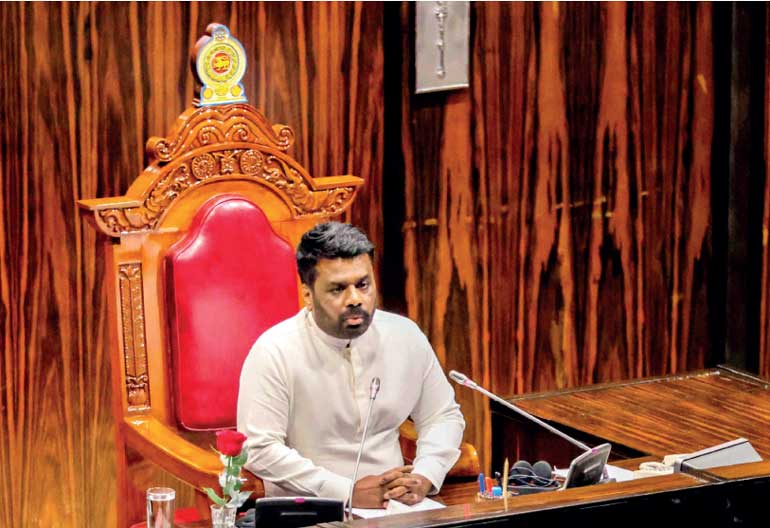
President Anura Kumara Dissanayake
President Dissanayake still has an opportunity to demonstrate that the NPP’s original commitments were more than an electoral promise. The NPP came to power promising to dismantle a system characterised by concentrated political power, weakened accountability and institutional privilege. It must now decide whether it intends to transform that system or merely occupy it. The greatest danger for the NPP is not necessarily losing power at the next election. It is losing the democratic purpose and moral credibility that brought it to power in the first place
 The late Dr. Colvin R. de Silva, the distinguished constitutional lawyer, Marxist politician and political thinker, once made a memorable observation about his contemporary and former classmate, J.R. Jayewardene, architect of Sri Lanka’s Executive Presidency and the Prevention of Terrorism Act (PTA): “The problem with Dickie is that often he runs faster than the winds that buffet him.” Veteran journalist Sarath De Alwis recently recalled this observation in the Daily FT.
Watching President Anura Kumara Dissanayake (AKD) navigate the complexities of governance, one is tempted to ask the same question: Is AKD running faster than the winds that buffet him?
There is an uncomfortable irony in Sri Lankan politics. The National People’s Power (NPP), elected in 2024 on an extraordinary mandate for democratic renewal, institutional accountability and the abolition of oppressive legislation, is now proposing two controversial Bills: the Protection of the State from Terrorism Bill (PSTA) and the Prevention of Organised Crimes Bill (POCA). Both have generated serious concerns among constitutional lawyers, human rights organisations and civil society.
Their stated objectives—protecting national security and combating organised crime—are legitimate. No responsible Government can ignore terrorism, drug trafficking or threats to public safety. The fundamental question, however, is whether the proposed means risk undermining the democratic freedoms the Government promised to restore.
From abolishing oppressive laws to creating new instruments of coercion
The NPP’s electoral appeal rested substantially on breaking with the political practices of the past. Its manifesto promised to abolish oppressive legislation, protect fundamental rights and establish accountable democratic governance.
The PTA, introduced in 1979 as a temporary measure, became one of the most controversial instruments of State power in Sri Lanka’s modern history. Successive administrations used it in circumstances involving arbitrary arrests, prolonged detention and the suppression of dissent. The JVP itself experienced the consequences of State repression and emergency legislation.
Yet the proposed replacement legislation raises an uncomfortable question: has the Government genuinely reconsidered the architecture of coercive State power, or is it simply seeking to administer that architecture under different statutory names?
The Centre for Policy Alternatives and the Bar Association of Sri Lanka have raised serious concerns about the Bills, particularly their broad provisions, detention powers and potential restrictions on fundamental freedoms. On 30 October 2026, the UN Human Rights Office called for substantive redrafting of the PSTA, warning of provisions that could reproduce or expand weaknesses associated with the previous legislation.
The constitutional challenges to POCA have also brought these concerns into sharp focus. During the Supreme Court proceedings, President’s Counsel Saliya Pieris and other senior lawyers questioned provisions concerning identification of alleged criminal-group membership, detention, bail and judicial supervision. The inclusion of characteristics such as clothing, tattoos, associations and personal appearance raises an important question: how much discretion should Police officers possess when deciding whom to arrest?
A democratic Government cannot rely merely on assurances that extraordinary powers will not be abused. It must establish safeguards that prevent their misuse by this administration or any Government that follows.
The Executive Presidency:
An inheritance that refuses to disappear
The contradiction extends beyond security legislation. The JVP and NPP spent years condemning the concentration of executive authority under the presidential system and promising its abolition. Yet, the present administration continues to exercise the considerable powers of that very institution, reinforced by its parliamentary supermajority.
Constitutional reform requires careful preparation and public consultation. Delay alone does not establish abandonment of a commitment. Nevertheless, there is a fundamental difference between taking time to design a better constitutional order and allowing inherited executive authority to become politically convenient.
The real test of democratic renewal is not how effectively a Government exercises power when it commands a parliamentary majority, but whether it is prepared to establish institutions capable of restraining its own authority.
Political movements can gradually become protective of the very institutional privileges they once challenged. The danger is that the practical demands of governing may turn temporary concentrations of power into permanent political conveniences.
Economic recovery is not economic prosperity
There is, however, an equally important question that deserves greater attention: what is happening to the economic transformation that brought the NPP to power?
Sri Lanka’s economic catastrophe in 2022, declining living standards and widespread frustration with corruption created the conditions for an unprecedented political transformation. Citizens wanted not merely different political leadership, but a fundamentally different economic future.
To be fair, the Government has maintained important elements of macroeconomic stabilisation. According to the World Bank’s October 2026 Sri Lanka Development Update, the economy expanded by 4.7% in the first half of 2026, with projected growth of 4.4% in 2026 and 4.2% in 2027. Real GDP has returned to pre-crisis levels.
These achievements deserve recognition. Nevertheless, the same assessment estimates poverty at 16.9% in 2025, substantially above pre-crisis levels. Household welfare, real incomes and employment opportunities continue to lag behind the broader recovery.
This is the distinction the Government must confront: macroeconomic stabilisation is not synonymous with economic prosperity.
A fiscal surplus does not automatically translate into better hospitals, functioning schools or completed infrastructure. Higher tax revenue does not necessarily create employment. Debt restructuring does not, by itself, restore household purchasing power.
The 2027 Budget, scheduled for presentation on 12 November, is therefore a critical test. Sri Lanka needs more than revenue mobilisation and fiscal consolidation. It needs productive public investment, stronger exports, private-sector confidence, technological advancement, employment generation and meaningful relief for households struggling with living costs.
Economic discipline must be a foundation for development, not an end in itself.
When economic necessity becomes political convenience
This brings us to a wider political-economic concern. Can a Government sustain an economic programme that imposes considerable adjustments on the population without ensuring that citizens experience tangible improvements?
Emeritus Professor of Economics at the University of Peradeniya, Sumanasiri Liyanage, recently explored this question in the Daily FT,
drawing upon Italian political economist Clara E. Mattei’s influential book, The Capital Order: How Economists Invented Austerity and Paved the Way to Fascism.
Mattei’s historical analysis examines how austerity policies and coercive political institutions can reinforce one another when economic restructuring generates resistance. Her argument is not that every program of fiscal consolidation is authoritarian, but that economic policies imposing unequal social costs can, under certain political circumstances, be supported by increasingly restrictive instruments of State power.
Sri Lanka’s circumstances are not identical to those of Fascist Italy, and simplistic historical comparisons would be intellectually careless. Nevertheless, the underlying institutional question deserves attention.
Workers must retain their right to organise, trade unions must be free to negotiate, journalists must be able to investigate, and citizens must be able to protest peacefully. The State must distinguish genuine terrorism and organised criminality from democratic opposition, industrial action and legitimate public criticism.
If security legislation creates an environment in which resistance to economic policies becomes increasingly difficult, the consequences would extend far beyond individual civil liberties. They would undermine the democratic foundations upon which economic and social reform must rest.
Business confidence requires institutional confidence
The implications are equally important for the business community. Investment depends not merely on attractive tax rates or financial incentives, but on predictable regulations, independent Courts,
transparent administration and confidence in the protection of commercial and individual rights.
Sri Lanka cannot realistically expect to attract foreign investment, expand exports and encourage entrepreneurship,
while creating uncertainty about the boundaries of executive and police authority.
The Government’s economic programme requires private-sector participation. Democratic accountability and economic confidence are therefore complementary objectives, not competing priorities.
The choice before AKD
President Dissanayake still has an opportunity to demonstrate that the NPP’s original commitments were more than an electoral promise.
Both proposed Bills should undergo genuine public scrutiny, and substantive revision in response to concerns raised by constitutional lawyers, the BASL, human rights organisations and the Supreme Court process. The Government should also establish a credible timetable for constitutional reform, including its commitment to abolish the executive presidency.
Equally important, Budget 2027 must demonstrate how economic recovery will translate into higher real incomes, productive investment, employment and improved public services. Public expenditure must be judged by delivery, not merely allocations, while accountability must apply equally to present officeholders and their predecessors.
Dr. Colvin R. de Silva’s observation about J.R. Jayewardene remains relevant because political leadership is ultimately tested by its ability to recognise the forces surrounding it.
The NPP came to power promising to dismantle a system characterised by concentrated political power, weakened accountability and institutional privilege. It must now decide whether it intends to transform that system or merely occupy it.
The greatest danger for the NPP is not necessarily losing power at the next election. It is losing the democratic purpose and moral credibility that brought it to power in the first place.
Sri Lanka does not need another Government that believes national security requires excessive State authority or that economic recovery justifies indefinite public sacrifice. It needs leadership confident enough to tolerate criticism, capable enough to transform the economy and principled enough to limit its own powers.
The ultimate measure of AKD’s leadership will not be how effectively he preserves the authority of the State, but how successfully he builds a country in which the State itself is answerable to its citizens.
That is the real promise of political renewal—and the test the NPP must not fail.



