Thursday Oct 15, 2026
Thursday Oct 15, 2026
Friday, 17 July 2026 00:26 - - {{hitsCtrl.values.hits}}
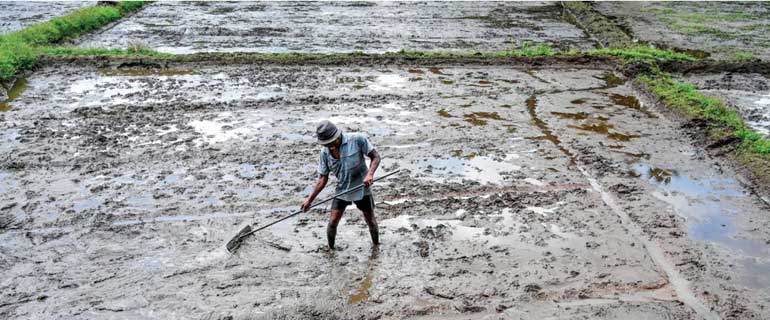
 It has now been nearly two weeks since my note on the farmers’ protests was published. (Peasants in Revolt: A step towards a new mode of agriculture, Daily FT, June 26, 2026). During these two weeks, we have witnessed farmers’ protests in almost every small town across the North Central Province, the Eastern Province, Kurunegala District and Giruwa Pattu. Farmers burned effigies of the Minister and Deputy Minister of Agriculture. They smashed coconuts in ritual protest in nearby devala, invoking curses against the President and the National People’s Power (NPP) Government. There is hardly an agricultural region in the country where farmers have not engaged in demonstrations and struggles. The 19,600 farmers’ organisations scattered across the country have warned the Government that unless satisfactory solutions are provided to their burning grievances, they will organise and bring their protest to Colombo. If they send 10 farmers to Colombo as they claimed, the crowd would be closer to 200,000.
So far, the Government has taken no meaningful steps to resolve the farmers’ crisis. Instead, ministers either insult the farming community or mock them with arrogant rhetoric. This attitude has significantly deepened farmers’ hostility towards the Government. Although the present protests and struggles are largely confined to the paddy-growing regions, there is every possibility that the agitation will soon spread among potato farmers as well. Small tea growers are facing similar difficulties. Why? Because the same rise in production costs that has affected paddy cultivation is also affecting potato cultivation. Nevertheless, this article confines itself to paddy cultivation and the regions where it predominates.
The central issue at present is the inability of either the market or the state to guarantee producers a price that reflects the cost of production including a reasonable level of margin. Estimates of Rs. production costs vary according to different varieties of paddy, and cost structures also differ across agricultural regions. According to figures provided by the Hector Kobbekaduwa Agrarian Training and Research Institute, farmgate/producer prices vary from Rs. 96 in Ampara and Embilipitiya to Rs. 162.80 in Kalawewa. Besides, the farmers know the cost of production from their own experience. Moreover, the farmer leaders at the forefront of these protests are well acquainted with the surveys that have been conducted on production costs. Athula Dissanayake, a farmer leader from Eppawala, who is at the forefront of the campaign told me that according to calculations made by HARTI the average production cost of one kilogram of paddy is Rs. 137. Yet the Government has announced procurement prices of only Rs. 120 per kilogram for Nadu, Rs. 130 for Samba, and Rs. 140 for Keeri Samba that do not reflect the actual cost of production. A young farmer leader from Kekirawa posed the following question with irony:” Why is it that the International Monetary Fund, which insists that the prices of fuel, electricity, and water in Sri Lanka should reflect their production costs, does not apply the same principle to the price of paddy?
Rising farmgate price
There are two closely interconnected reasons for the rising cost of paddy production. The first is the continuous increase in the price of agricultural inputs. With the spread of the Green Revolution during the 1970s, the nature of agricultural inputs in Sri Lanka like in many countries in the global south underwent a fundamental transformation. In many respects, agriculture today resembles the export-oriented garment industry that became the dominant foreign exchange contributor in Sri Lanka after 1977. In garment production, apart from the land on which factories are built and the labor employed within them, virtually every other input is imported. Likewise, under the Green Revolution model, the cost structure of paddy production has come to resemble that of garment production as shown in Table 1.
In recent years the prices of all these imported inputs have shown a persistent upward trend. Moreover, sudden external shocks such as wars can trigger sharp increases in the prices of imported inputs. There are, however, two important differences between these two sectors. First, garment production is primarily export-oriented, whereas paddy production serves domestic consumption. Second, garment production is labor-absorbing, while changes in the cost structure of paddy cultivation have made it increasingly labor-displacing.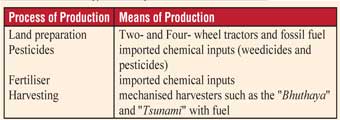
The second major reason for the continuous increase in production costs is the “urbanisation” of rural lifestyles. This new pattern of living is especially evident in education, healthcare, transport, recreation, and consumer aspirations. As a result, the gap between the income farmers require for the maintenance of their families and their expenditure has widened considerably. Nonetheless, the producer margin has not increased accordingly.
People and class
Many of those participating in and leading these protests openly state that they voted for the National People’s Power in both the 2024 presidential and the 2025 parliamentary elections to bring it to power. The election results in agricultural districts confirm this claim. Before the two elections, large crowds identified as “the people” flocked to NPP meetings. They expected the new Government to bring about positive changes for the satisfaction of ‘people’. Why? Because they viewed the National People’s Power as a popular and populist force that represented the people and would fulfil their aspirations. The people cannot be blamed for holding such expectations. However, once in power, the Government refused to step outside the policy framework laid down by the International Monetary Fund and the peasants interpreted it as a betrayal of their interests. At first glance, one might think that the farmers’ protests over paddy prices, which recur during the harvest season each year, are merely another routine episode of the normal cycle. However, there is a difference this time. The agitation is wide-spread, and peasants tend to think that they were neglected.
The very struggle of the peasants leaves two interrelated theoretical questions unanswered. Although a comprehensive answer to these questions cannot be offered here, they should at least be flagged.
The first question is: how should we understand the current peasant agitation? In 2022, we witnessed an urban uprising, particularly led by urban youth, anticipating a “system change.” This was followed by an electoral victory of the NPP. What lies ahead? As Daniel Bensaïd argues, we can make no oracular predictions, but only conditional anticipations. This means that we have been passing through not a uniform and homogeneous time, but through the discordance of times. From this perspective, the current peasant agitation should be understood not as an isolated event but as a manifestation of the contradictions of Sri Lankan history including its agrarian structure. Crises occur with less frequency and growing intensity.
The second question relates to the choice of the language. Some tend to suggest that the class as an important category and explanatory device in a situation like this has now waned and it should be replaced by simple and popular word people. Who are the peasants in revolt? Can they be understood as a class, or is identifying peasants as a class merely a discursive articulation? Let me briefly address this issue. “People” and “class” operate in two different political fields. The people act and identify themselves primarily in parliamentary politics, where expectations of gradual change shape political action. By contrast, class operates in the non-linear temporality of history, marked by social breaks and ruptures. Careful observation reveals that the protesters identify themselves as goviyo (peasants or farmers), rather than janathāva (the people), thereby emphasising a structurally determined identity rooted in their social relations within the class structure.
The present farmers› protests, and the potential they contain, demonstrate that this is not merely an interlude in parliamentary competition. Rather, it is an untimely eruption of the ongoing struggle for livelihood within the capitalist structure.
(The writer is a retired teacher in political economy at the University of Peradeniya)




