Thursday Sep 24, 2026
Thursday Sep 24, 2026
Thursday, 24 September 2026 00:23 - - {{hitsCtrl.values.hits}}
 Targeting inflation
In Sri Lanka, nine is not generally considered an auspicious number. Coincidentally, the word inflation has nine letters. But inflation, whatever the number attached to it, is hardly welcome by anyone—perhaps with the occasional exception of Donald Trump. And it certainly has nothing to do with the number nine.
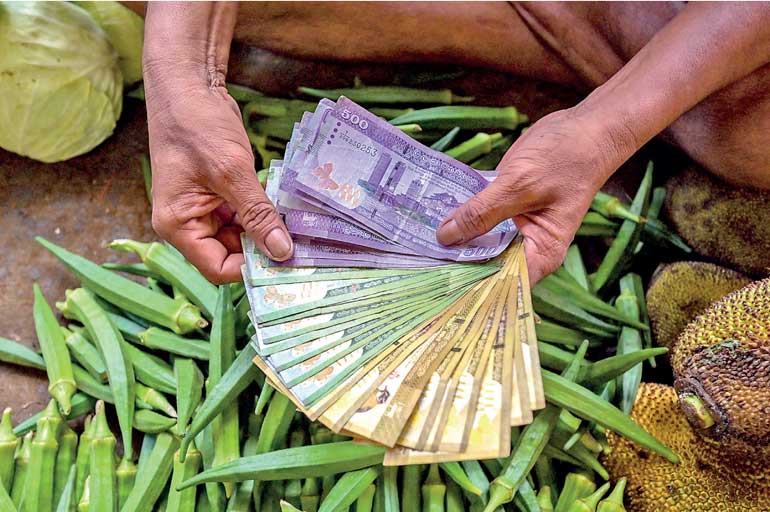
Inflation, in simple terms, is the rate at which the general level of prices of goods and services rises, reducing what money can buy over time. In Sri Lanka, the Colombo Consumer Price Index (CCPI), which primarily reflects prices in the Colombo urban area, is the principal measure of headline inflation. There has long been debate about the appropriateness of the CCPI in relation to its calculation and as a single index to capture the inflation experienced by a diverse household.
What matters to the ordinary citizen is: what can I buy with the money in my pocket?
Sri Lanka experienced an extraordinary inflationary shock in 2022, when inflation reached an unprecedented 67.4%. The prices of food, fuel, medicine and other essentials rose dramatically, placing enormous pressure on household budgets. Today, the Central Bank of Sri Lanka (CBSL) operates with a 5% inflation target, with an allowable margin of ±2 percentage points.
Purpose of inflation target
Deciding the inflation rate by CBSL does not mean that the bank decides the price of a packet of rice, a loaf of bread or a litre of fuel in the market. It sets an inflation target to maintain domestic price stability and support sustainable long-term economic growth. It gives businesses, investors, and citizens a predictable baseline and protects the value of savings, encourages investments, and stabilises the exchange rate and prevents price hikes.
Under the Central Bank of Sri Lanka Act No. 16 of 2023, the inflation target and related parameters are reviewed at least once every three years, or sooner under exceptional circumstances. The current Monetary Policy Framework Agreement between the Government and the CBSL was published in October 2023. Next review is due in October this year.
The CBSL has already undertaken a public consultation survey as part of the review, seeking views on the inflation target and related parameters. This helps to assess whether the existing framework remains appropriate or whether adjustments or improvements are needed in changing economic circumstances.
Milton Friedman meets the man in the street
Economists have long debated Causes of Inflation. While the conventional monetary view gives considerable importance to money creation and demand pressures, structuralist economists emphasise supply constraints, institutional weaknesses and structural bottlenecks—particularly in developing economies.
The famous economist and Nobel laureate Milton Friedman once described inflation as “always and everywhere a monetary phenomenon.” His argument was that sustained inflation is ultimately associated with money growing faster than the economy's capacity to produce goods and services. The experience of the man in the street, however infamous he is, illustrates why the debate cannot be reduced to a single cause, however famous Fried-man is.
Causes of inflation
According to CBSL, year-on-year headline and core inflation moved steadily upwards from January and reached 8% in August 2026, above the 5% target. Food and non-food prices have recorded significant increases. CBSL has acknowledged that Sri Lanka's inflation outlook is subject to considerable uncertainty. Global energy and commodity prices, geopolitical tensions, prevailing tensions in the Middle East, exchange-rate movements, supply-chain disruptions and domestic production conditions all influence domestic prices.
For an open economy such as Sri Lanka, a weaker rupee can increase the domestic price of imported fuel, food and raw materials. International shipping disruptions can increase the cost of imports. Global oil prices can affect transportation and production costs. Weather conditions can disrupt agricultural production and push up food prices. Expectations of future price increases can themselves influence the behaviour of consumers and businesses.
No doubt, money matters. Supply, imports, exchange rates, taxes, logistics, production costs, weather, regulation and expectations matter more.
Inflation and its different faces
Does the inflation rate decided by CBSL tell the story of what you and I experience when we go to the market? For the citizen who goes shopping for rice, vegetables, milk powder, medicine or school requirements, an inflation percentage is meaningless. What matters is the price tags displayed in the supermarket.
A wealthy household and a poor household face exactly the same percentage increase in the price of a commodity, yet inflation does not affect both equally. In Sri Lanka, the bottom 20% of households receive only 4.6% of income, while the top 20% receive 51.4%. For a wealthy consumer, a price increase is immaterial. He is not/less sensitive to a price increase. For him what matters is the availability, convenience and the preference. The appearance of expensive brand-new latest models of vehicles on already congested Sri Lankan roads following the relaxation of import restrictions provide an excellent example for this.
For a poor household the story is different. Price increase means reducing the quantity of food bought, postponing a medical purchase, borrowing money or sacrificing another essential expenditure. They spend their meagre earnings to buy essentials. They find other ways to pay for them. A parent may borrow or steal a coconut fallen on his neighbour’s garden to buy milk for his hungry child. A household may pawn his wife’s jewellery to settle an electricity bill before the CEB disconnects the supply. A family may reduce the quantity or quality of food consumed. Inflation experienced by the poorest is much harsher than the average inflation number suggests.
Prices controlled by Government
The price of a commodity in the market is not determined by monetary conditions alone. Several important prices in the economy are directly decided by the Government or by State-owned enterprises. Electricity, water, fuel and cooking gas are a few such items. They have a significant impact on household expenditure and business costs. When such prices rise, the effects do not stop with the particular product or service. Electricity affects factories, shops and households. Fuel affects transportation. Transportation affects almost everything else. Government taxes, tariffs, import duties, clearing charges, transport costs, energy costs and other regulatory interventions can all influence the final price paid by the consumer.
Similarly, government interventions such as maximum retail prices for selected commodities i.e. rice, minimum purchasing prices for agricultural products (paddy) and subsidies (fertiliser) influence market behaviour.
Whether such interventions correct market failures or create new distortions is a separate and important policy question.
Is 5% the most suited inflation rate?
Deputy Finance Minister Anil Jayantha has told Parliament that a 5% inflation target is most suited for an open developing economy such as Sri Lanka because of its exposure to external shocks, supply-side disruptions and exchange-rate volatility.
If the CBSL succeeds in bringing headline inflation back towards 5%, will the ordinary household necessarily feel that life has become affordable? An inflation rate of 5% means prices are rising more slowly than before. It does not mean that prices have returned to where they were several years ago. This distinction is lost in public discussion.
If the price of an essential item/s has risen sharply over several years or suddenly as happened in 2022, reducing the annual inflation rate does not reverse the earlier increase. It merely means that the rate of further increase is controlled. For the household whose income has not kept pace with the accumulated rise in prices, “lower inflation” is still expensive living.
This is where the technical language of economists used in scholarly work differ from the language we use at the dinner table. The economist may say, “Inflation is coming down.” The housewife may reply, “But my grocery bill has not.” Both statements are true.
Inflation and investment
There is also an argument that maintaining price stability is essential to attracting investment. The argument is correct. Investors prefer predictable and stable economic conditions. But inflation stability alone does not bring investors through the BOI doors.
Investors consider a much wider range of factors beyond the price stability: political and economic stability, regulatory conditions, transparency, legal frameworks, taxation, infrastructure, market size, access to finance, governance and the ease with which business can actually be conducted. Complaints about bureaucratic delays, excessive documentation, regulatory complexity and institutional fragmentation therefore matter too.
An investor may look at an interest rate or an inflation number—but will also ask:
A stable inflation rate alone cannot answer that question.
The CBSL has substantial influence over monetary conditions. Through its monetary policy instruments—including the Overnight Policy Rate, open-market operations, standing facilities and reserve requirements—it can influence the cost and availability of money and credit. The Monetary Policy Committee also considers developments across the monetary, financial, foreign-exchange, fiscal, external and real sectors when making its decisions. These are not mere mechanical but serious, technical and demanding work.
The CBSL deserves credit for attempting to maintain price stability in an economy that remains exposed to substantial domestic and external shocks. Its inflation-targeting framework provides a useful anchor for expectations and economic decision-making.
But there is a limit to what monetary policy can achieve.
The CBSL cannot manufacture more rice when the harvest fails. It cannot produce oil when global petroleum prices rise. It cannot repair every supply-chain disruption. It cannot eliminate every bureaucratic obstacle faced by an investor. Nor can it determine the efficiency with which a State-owned enterprise operates.
The CBSL has considerable control over currency issuance and influences commercial-bank credit conditions. But many transactions take place through an enormous variety of channels, including digital payments, credit cards, leasing, informal arrangements and other authorised and unauthorised financial activities in today's increasingly complex economy.
The monetary system is no longer simply a matter of notes and coins printed by a central bank and loans issued by commercial banks. It has become considerably more complicated. This does not diminish the importance of monetary policy. It only makes the task more difficult.
The kite in the storm
The CBSL is trying to steer inflation towards a desired path while the economy is being pushed and pulled by many uncertainties such as exchange rates, commodity prices, geopolitical tensions, climate shocks, domestic supply conditions, fiscal policy and global financial developments.
I recently saw a CBSL cartoon in Lankadeepa newspaper on the “Story of Inflation”, built around two kite runners. It made me think: Is the CBSL, holding a tiny thread called monetary policy, trying to steer the kite of inflation towards the 5% target in stormy weather?
(The author is the former Secretary, Ministry of Plan Implementation. He can be reached on [email protected])




